Interagency Emergency Health Kit
Essential medical supplies for children and communities during emergencies

The Interagency Emergency Health Kit (IEHK) provides life-saving medicines and medical supplies to meet the needs of children and communities in humanitarian emergencies. The kit is a vital component when UNICEF responds to emergencies around the world, including armed conflicts and natural disasters.
These kits can be pre-positioned in countries where emergencies such as seasonal floods and cyclones can be anticipated. Or they can be deployed on-demand from UNICEF’s network of strategically located global supply hubs.


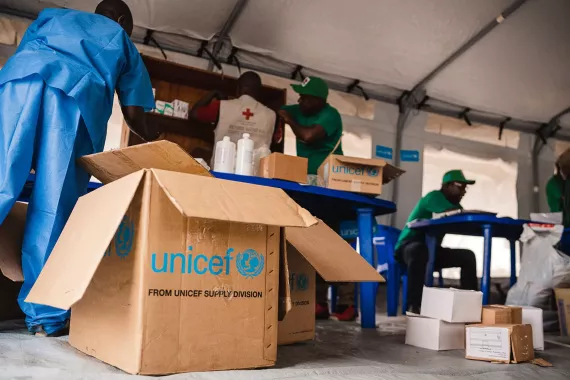


A look at some items inside the basic kit
The IEHK equips primary healthcare systems and health workers to deliver emergency health services for a population of 10,000 people for a period of three months. The basic IEHK module, which is usually the first component to be deployed, contains:
- Medicines such as paracetamol and ibuprofen to relieve pain, fever and inflammation; antibiotics to treat infections; and oral rehydration salts to treat dehydration caused by diarrhoea.
- Medical consumables for dressing injuries such as gauze, bandages, cotton wool, medical tape and iodine, as well as soap and sterile gloves to prevent infection.
- Medical equipment including scissors, pins, dressing forceps, artery forceps and other instruments needed for surgery, as well as devices such as thermometers, and also mid-upper arm circumference tapes which are used to diagnose severe acute malnutrition.
In addition, the basic module has the option for a malaria unit with oral antimalarial medication and rapid diagnostic tests.
Packing for rapid distribution and use
The basic IEHK for a population of 10,000 people – excluding the malaria unit – fits into 30 medium-sized cardboard boxes, each of which can be carried by one person. How each box is packed and labelled is critical to how fast it can be put into use when it arrives. To facilitate distribution to small and often remote health facilities, it is packed into 10 identical sets of three boxes, each set meeting the needs of 1,000 people.
Supplementary units
The IEHK has 10 supplementary units, which are dispatched based on the needs of children and communities in each emergency. There is a bespoke supplementary unit each for (1) additional medicines and medical consumables and (2) medical equipment. There is also a dedicated supplementary unit each for (3) oral medicines, (4) injectable medicines, (5) controlled medicines, (6) mental health medicines and (7) malaria medicines, as well as (8) a unit for medicines require a cold chain for transportation and storage and a (9) glucometer unit.
There is also (10) a post-exposure prophylaxis unit – also called a PEP kit – with antiretroviral medications to help prevent HIV infection after a sexual assault.
An inter-agency effort
The development of the IEHK is a collaboration between UNICEF, the World Health Organization (WHO), the United Nations Population Fund, the United Nations High Commissioner for Refugees, Médecins Sans Frontières, the International Committee of the Red Cross, and the International Federation of Red Cross and Red Crescent Societies. UNICEF has a lead role in the area of logistics, including determining how the kit is packaged, labelled, stored and distributed.
The IEHK is reviewed and updated periodically, also taking into account a wide variety of factors, including user feedback. The current version in use is the IEHK 2024.