Japan supports urgent assistance for children in Yemen as conflict surges
Tokyo, 08 March 2017
“Indeed, your contribution will help the next generation of Yemeni children secure the peace that we all pray comes soon to that beautiful country.” -Anthony Lake, Executive Director, UNICEF

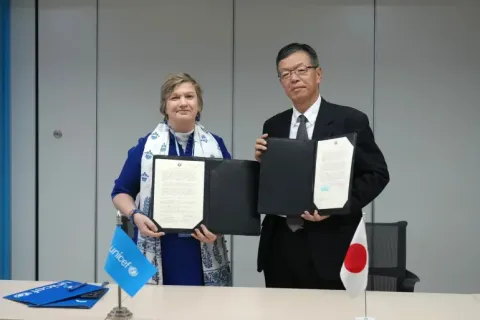
Tokyo, 08 March 2017 – The Government of Japan has made a generous financial contribution to UNICEF to respond to the urgent needs of children affected by the intensifying conflict in Yemen.
“More than ever, children in Yemen need immediate assistance. Contributions like this from the people and Government of Japan are crucial to keep children alive and help meet their urgent needs”, said Meritxell Relano, UNICEF Representative in Yemen.
The grants, which cover both development assistance and supplementary budget for emergencies will be used to address the health, nutrition, education and protection needs of children.
The funding from the Government of Japan will allow UNICEF to improve access to health care and nutrition services for vulnerable communities, and to enhance the quality of education for disadvantaged children, including those in hard-to-reach parts of Yemen. The contribution comes at a critical time as Yemen’s conflict has left the health and nutrition system on the verge of collapse, with children hit the hardest.

Specifically, in health and nutrition;
- More than 360,000 children will be provided with preventive services for stunting, including growth monitoring and promotion, infant and young child feeding counselling, micronutrient supplementation and hygiene awareness activities,
- Over 50,500 children will be treated for severe acute malnutrition,
- More than 252,000 children will be treated for childhood illness such as pneumonia and diarrhoea
- Nearly 69,000 pregnant and breastfeeding women will be provided with reproductive health services.
In Education:
- More than 43,000 children will be provided with school materials and supported to stay in school.
- School management support for teachers, parents committees and students.
- Water, sanitation and hygiene facilities in schools will be improved to enhance learning environments.
Insecurity, violence and attacks on education infrastructure have interrupted the education of at least 350,000 children, adding to the more than 1.6 million children who were already out of school before the conflict escalated.
The Japanese contribution will also support activities in ten governorates prioritized for their large IDP populations, where humanitarian needs remain enormous:
- 500,000 children will be vaccinated against tuberculosis.
- 20,000 children will be treated against childhood illnesses
- 28,000 children will be treated for severe acute malnutrition.
- 27,000 children and pregnant and breastfeeding women will receive micronutrient supplementation.
- 63,000 displaced persons will receive awareness on landmines and unexploded ordnances.
- Over 28,000 children will receive psychosocial support to cope with the horrors of Yemen’s brutal conflict.
- 35,000 people from internally displaced families and host communities will gain access to safe water through rehabilitation of rural water sources.
Despite the violence, UNICEF and its partners are working in all 22 governorates in Yemen to respond to the needs of children with a continuum of services in health, education, child protection, water, sanitation and hygiene.
本プレスリリースの日本語版はこちらをご覧ください。