Japan contributes more than $4 million to help drought-affected people in southern Madagascar
Antananarivo, 8 March 2017
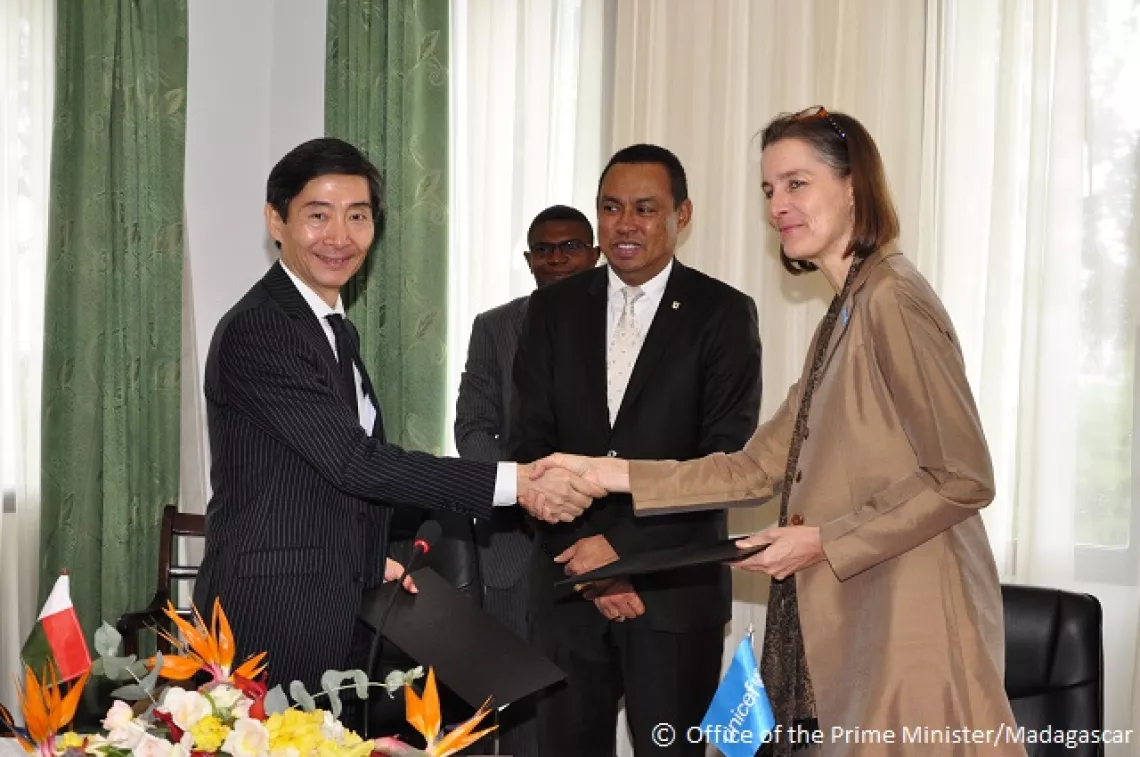
Antananarivo, 8 March 2017 –The Government of Japan today announced a total financial contribution of US $4,285,000 through UNICEF to support people affected by drought in southern Madagascar, notably in the domains of health and water.
The southern part of Madagascar has suffered several years of insufficient rainfall. An estimated 1.1 million people have been impacted by drought in the eight most-affected regions of Madagascar’s “Grand Sud”.
Prolonged dryness has resulted in inadequate access to nutritious foods, particularly for pregnant women, infants and children. Malnutrition is worsening, with limited access to safe drinking water and sanitation infrastructure, worsened by poor hygiene practices. The situation is further exacerbated by difficult access to quality health services in a region characterized by a high prevalence of infectious diseases such as pneumonia, diarrhea and malaria in children under five.
Overall, 748,000 people in the eight most-affected districts live more than two hours' walk from the nearest health center; 130,990 of them are children under 5 years of age (including 30,000 newborns); 34,000 pregnant women; and 178,000 women of reproductive age – representing the most at-risk groups of the population.
"Inadequate water and poor hygiene have increased dramatically in children under five years of age, and the number of cases of pneumonia, diarrhea and malaria has increased the infant mortality rate," said Mr. Ichiro Ogasawara, the Ambassador of Japan to Madagascar. "In response to this humanitarian emergency and in response to the appeal made by the Government of Madagascar, the Government of Japan has decided to finance various United Nations projects for the benefit of the affected people of the South. Today’s contribution brings Japan’s total contributions to approximately $9 million, half of which is earmarked for the UNICEF project being signed today."
UNICEF works in the south in close coordination with local authorities, ministries and other UN agencies.
"Our emergency interventions continue to focus on multi-sectoral approaches that target both the underlying causes and the resulting crisis, in order to ensure a sustainable response," said Ms. Elke Wisch, UNICEF’s Representative in Madagascar. "This tremendous support from Japan, in addition to that provided jointly to the entire United Nations system, will help us strengthen the national system in order to ensure equitable access to sanitation and water for all, and to help improve hygiene practices for all, including people living in the most disadvantaged areas."
More specifically, Japan's contribution will be used by UNICEF to:
- provide quality integrated basic health services through the rehabilitation of 50 health centers;
- build capacity of health workers;
- increase outreach activities to provide health services to people living in remote areas;
- strengthen health information systems and improve health input supply chains to avoid stock-outs;
- ensure adequate water, sanitation and hygiene infrastructure and emergency services for health centers and communities through the construction and rehabilitation of water points;
- eliminate open defecation and promote the use of improved latrines and hygiene practices.
本プレスリリースの日本語版はこちらをご覧ください。