Teaching Climate Change in South Asia

Teachers’ views on climate education in schools

UNICEF South Asia
UN0328249
UNICEF/UN0328249/Chakma
06 July 2021

South Asia countries are among the most vulnerable globally to the impacts of climate change. Extreme climate-related events - heatwaves, storms, floods, fires and droughts - affect more than half of the region's population every year and continue to burden South Asian countries’ economies. 

“Climate change is real and its impacts are intensifying day by day.”

Vikas Drall, Science Teacher from India

Rising global temperatures and changing weather patterns have put the futures of millions of children living in climate-vulnerable areas in South Asia at constant risk. Worse, before they can recover from one disaster, another one strikes, reversing any progress made. To end this cycle, South Asian communities need to build greater resilience.

A boy
UNICEF/UNI102929/Noorani A boy, holding a piece of sugarcane, runs on a cracked sugarcane field in Dera Ismail Khan District of Khyber-Pakhtunkhwa Province in Pakistan.

Climate education is an essential element linked to the global response to climate change-induced disasters. It helps communities understand and address the impact of global warming, encourages behavior changes, and helps them adapt to climate change.

According to UNICEF’s regional U-Report poll, 65% of respondents said they learned about climate change in school, but 64% reported they do not understand it and can’t explain it. 

“Climate education is the basis for 21st-century skills that will allow us to reduce consumption of energy and raw materials, limit greenhouse gas emissions, minimize waste and pollution, and protect and restore ecosystems,” says Reis Lopez Rello, Regional Climate Change Adviser at UNICEF South Asia.

Hazrat Bilal Internally Displace People
UNICEF/UNI321519/Fazel Hazrat Bilal Internally Displace People. Mazar-e-Sharif, North of Afghanistan. 15-April-2020

“Education systems must not just ensure that climate change is taught scientifically and systematically across subjects, but also in such a way that children feel the consequences of their own actions, however large or small.”

Jim Ackers, Regional Education Adviser at UNICEF South Asia

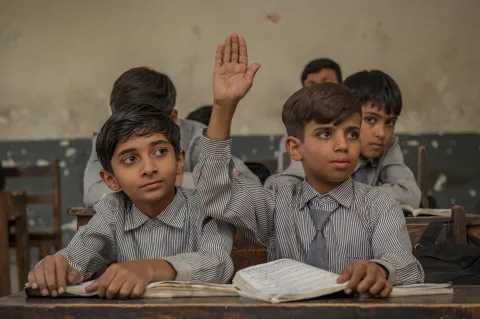
Aysha, Bashara, Asim, and Vikas represent teachers from the region actively advocating for climate education to be taught in schools. According to them, including climate education in national curricula will empower children and young people with the required knowledge and skills, to build a green, sustainable and climate-resilient future.


Aysha Siddiqa, Physics Teacher, Pakistan

Climate education is not taught in schools in Pakistan. It’s up to the teachers like Aysha to take action and talk to their students about climate change mitigation.

“I tell my students that plantation is a very good solution to reduce global warming and air pollution. I advise them to do a practice of plantation in their homes and their surroundings.”

UNICEF South Asia


Bashara Ismail, Social Studies Teacher, Maldives

The school curriculum in Maldives emphasizes teaching environmental issues and climate change. These topics are not covered in one single school subject, but across the curriculum.

“Schools and teachers are the primary resource to educate about climate change. We make students aware of the environmental issues, and we let them come up with different things that they can do individually to help the environment. Schools have organized various events, such as beach cleaning days, planting trees, and various recycling programs.”

UNICEF South Asia


Asim Acharjee, Assistant Headteacher, Bangladesh

Even though climate change is part of the school curriculum in Bangladesh, teachers like Asim are finding additional ways to motivate their students to protect the climate in their communities.

“I have formed a team-like student cabinet with fifty members in my school. I arrange motivational classes with the team and some students are thinking of doing climate-friendly businesses, such as arts and crafts made from earthen materials, straw, used papers. They try to avoid plastic. And they are now more aware of the greenhouse effect, changing temperature, and emission of carbon monoxide.”

UNICEF South Asia


Vikas Drall, Science Teacher, India

Vikas believes that awareness and knowledge about climate change is an important skill for the 21st century. To mitigate the indoor air pollution in his school, he initiated a project called “Green Classrooms”. With his students, Vikas planted more than 60 air-purifying indoor plants and put them inside the classroom in hanging pots. The students noticed that there was an improvement in their concentration level and in the quality of air. 

“It is very important to teach your students about climate change because the youth of today are the leaders of tomorrow. And the leaders play a vital role in policy making and action planning.”

UNICEF South Asia