How to support your daughter with her first period

Expert tips for parents on talking about periods

UNICEF South Asia
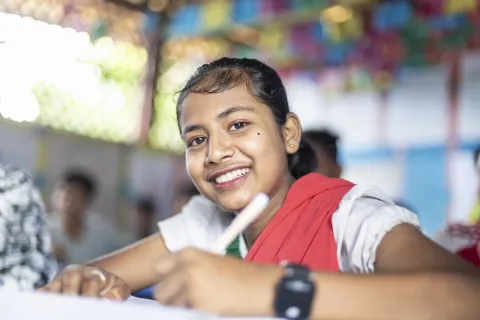
Aanchal explains about the use of sanitary napkin
UNICEF/UN0591794/ Bhardwaj
28 May 2023

Getting your period can be an overwhelming and confusing experience. But it can be especially distressing for girls if a period comes as a surprise or is surrounded by secrecy and shame.  

1.8 billion people across the world have periods — they’re a natural, healthy and normal part of life.  

But sadly, the topic of periods is still taboo. Many girls are taunted and shamed about something that is natural. Others are excluded from social and family events.   

A bad experience with a first period can shape a girls’ perspective of her body for years to come. It can make her feel isolated, stop her from asking for help and from understanding how to manage her periods hygienically. This can lead to infections, worry and upset.  

We know that for many parents, raising the topic of periods can feel stressful. You're not alone. 

Here are our expert tips to help you, help your daughter prepare for her periods, with kindness, openness, and sensitivity.  

Having the conversations

Read up on the science 

Periods are shrouded by myths and taboos, so it’s important to talk about the topic with your daughter in a simple and factual way.  

Read up on the science of periods yourself, so that you are equipped to explain what periods are and why girls get them — and can confidently and correctly answer any questions she might have. 

This video, developed by Menstrupedia, is a good starting point: 

Embedded video follows
Menstrupedia Hello periods! A video created by Menstrupedia to teach girls about periods and managing them
Start talking about puberty early  

Every girl's body is different, but it’s typical for girls to get their first period any time between the ages of 9 and 15. The average age that girls start their period is around 12 years old.  

Typically, girls start their periods about 2 years after their breasts start growing. Other signs that her period could start soon include: 

  • She has grown underarm and pubic hair.  

  • Her moods change more.  

  • She has started to get pimples or acne.  

To make sure that your daughter is confident and prepared to get her first period, it’s a good idea to start small conversations about growing up and puberty from an early age. 

For instance, from age 9 and older you can consider incorporating periods into any conversation you plan to have about the female reproductive system or about how a girl’s body changes over time.  

You can also talk to your daughter’s school to see when and how they are covering these topics and plan your conversations at home to coincide.  

Remember, this guidance is not set in stone. Your intuition is your best guide to decide when you think your daughter is ready for these conversations, based on her development. However, make sure you have the conversation before her first period arrives.  

Aanchal explains abbout the use of sanitary napkin
UNICEF/UN0591791/ Bhardwaj
Pick a good time and place 

We understand it can be an awkward or difficult topic to raise. So, it’s important to choose a time when you and your daughter are relaxed and have time to talk, without stress or distraction. 

Try and find a comfortable spot, where you won’t be disturbed. Be open, relaxed and reassuring to help your daughter feel comfortable.  

If you are feeling nervous, awkward, or behaving evasively she will notice, and it will make her feel uncomfortable about the subject too.  

Channel your inner calm, remain positive and take your time. You can even practice what you’re going to say beforehand. If you don't feel prepared, but think there might be an aunt, cousin, or other adult female confidant who is, ask for support. 


Use an icebreaker to open a conversation 

If you’re unsure about how to start the conversation, an icebreaker can help. For example: 

"Have you learned anything about periods in school or from your friends?" 

"I wanted to talk to you about something that's a normal part of growing up for girls." 

  "As you're getting older, your body will start to go through some changes, and one of those changes is related to periods." 


Explain in a way that is suitable for her age 

Make sure you’re using clear and age-appropriate language. You can use books, diagrams, videos and apps to help explain. 

Be honest and avoid using slang phrases or labelling periods as something dirty or impure. Instead, use scientific words like 'vagina' and 'blood'.  

But it’s best to keep explanations simple, so you don’t overwhelm your daughter with too much information at once. Be patient. Let her process the information at her own pace. 

If you can see that she feels uncomfortable, tell her that nerves are normal and there's nothing to worry about. 

Some child friendly explanations of periods can be found in this document

You can also download the Oky Period Tracking App, that includes a period encyclopaedia. 

Radhika explains about Menstrual Hygiene Management
UNICEF/UN0591698/ Bhardwaj
Ask questions — and listen to her answers 

Ask her what she’s already heard about what happens to girls’ bodies as they grow up and about periods. 

Let her respond without interrupting. And listen to what she is saying to show you care about what she has to say. 

She might have heard rumours about periods before, or she might know nothing about them. Be prepared for both situations. Think about how you will handle them in advance.  

Remember there is no right way for her to feel. Don't criticise or judge what she says. Empathise with her and try to understand how she’s feeling.  

If she tells you incorrect information, make sure you correct it in a kind and gentle way.


Encourage her to ask questions — and answer them honestly 

Ask her if she has any questions — and tell her that there are no silly questions.  

You can also ask her if she has any worries or concerns about anything you’ve told her. 

Try to answer all her questions as honestly as you can. If you aren’t sure of the answer, tell her you’ll look it up and get back to her — and make sure you do. 

Taking about period pain and stains

It’s important to let her know what happens during periods and what to expect. But be careful not to focus too much on the challenges or scare her. Instead, focus on how the challenges can be managed.  

Period pain 

Sometimes periods can be painful! She could experience cramps, mood changes, headaches or back pain in the days leading up to and during her period.  

Most pain can be eased by going on a short walk, having a nap, using a hot water bottle, drinking lots of water and some gentle pain medicine. 

Period stains 

Her period may arrive unexpectedly, especially in the first few years. This can cause stains on clothes or bedding, which may be distressing for her. Reassure her that accidental stains are nothing to be ashamed of and something every woman is likely to have experienced.  

Tell her that if her period starts when she’s away from home, she can cover stains by tying a jumper around her waist. If she doesn’t have one, she can ask a trusted adult woman or older girl for help.

Members of the adolescent girls club hold sanitary pads
UNICEF/UN0439981/Boro

Supporting her with sanitary products and hygiene

There are several products out there that can be used to catch blood during periods, including menstrual cups, tampons, cloth and disposable pads. It’s important to work with your daughter to find out what works best for her. 

Sanitary pads and cloths are often the simplest solutions to start off with. In South Asia, girls use both disposable pads and reusable cloth.  

Disposable pads can be expensive and are worse for the environment, so many girls use reusable cloth. Whatever pads she’s using, make sure she knows how to use them and isn’t ashamed to ask. 

Lead by example. Show her how to put the pad and cloth in a pair of underwear and remove it. 

Be positive and open when demonstrating the pads, so she knows they aren’t something to be ashamed of, or that need to be hidden. 

Embedded video follows
Menstrupedia
Talk to her about changing sanitary pads and cloths hygienically  

It’s good to also advise her on how often she should be changing pads and cloth and how to dispose of or clean them. 


Disposable pads: 

  • These need to be changed at least every six hours. However, depending on the flow, 3-4 hours may be ideal to prevent infections.  

  • Wrap the used pad in newspaper, tissue or the wrapping paper of the new sanitary pad and put it in a dustbin.  

  • Don’t put used pads down the toilet, as they can get stuck.  


Reusable cloths: 

  • These need to be changed at least every six hours, or earlier if they feel full. 

  • To reuse a cloth hygienically, it needs to be thoroughly washed with soap and water and hung outside in the sun until completely dry.  

  • If she changes her cloth at school, she can take the soiled one home in a bag to wash. 


Give her a period pouch  

It’s a good idea to give her a period pouch filled with essentials, like a spare pair of underwear, pads and tissue, to carry in her schoolbag before she starts her period. So, she has what she needs when she does.  

If she starts her period and has forgotten her period pouch, teachers and the school nurse should also be able to help. 


Talk to her about menstrual hygiene  

Poor hygiene during periods can cause infections, so it’s important to talk to your daughter about hygiene during periods and make sure she understands how to best clean and look after herself.  

Here are some tips: 

  • Keep up your normal personal hygiene. (There is no reason not to shower or bathe during your period. Showers and baths help you stay clean and hygienic and can relieve period pain.) 

  • Wash your hands with soap before and after going to the toilet, touching your vagina or changing your pad/cloth. 

  • Wash your genital area at least once a day.   

  • If you do not have access to a shower or bath, use a small amount of plain water, soap and a soft cloth. 

  • Wash from the front of the vagina to the back.  

  • Don’t use soap or wash inside the vagina. 

  • Wear clean underwear (change it every day). 

Talking about period shaming and taboos

Talk to her about the culture of silence around periods and some of the myths. You can explain that often in society girls can face pressures that try to make them feel ashamed or embarrassed about their bodies. 

Some girls may even be stopped from going to school, made to avoid certain foods and in extreme cases, forced to live in isolation. 

Explain to your daughter that: 

  • Periods are normal and there is nothing to be ashamed of. 

  • Period shaming is a type of discrimination that unfairly targets women and girls for a healthy and natural bodily function. 

  • Period shaming can affect girls' self-esteem and confidence. 

You can also ask her if she’s seen any examples of period shaming herself or reflect on your own experiences, how it affected you and how you overcame it.  

All this can help your daughter feel less alone and more empowered to speak up against period shaming. 


Suggest role models  

Encourage your daughter to talk to other women in the family, such as an older sister, aunt or grandmother, for advice and support. 

Hearing from other girls and women who have gone through the same experience can be very helpful. 


Involve the men in the family  

It’s important to talk to the men in the family about periods and the taboos around them. Make sure they understand how important it is that they have a positive and open outlook towards periods as well.  

This is critical, especially when the primary caretaker is a male. Over time, the men in the family can help debunk myths and taboos about periods that have been passed on for generations and provide a supportive environment for girls.   

Your daughter will feel more confident if she is supported by the whole family. 


Keep the conversation going 

Periods are a big topic and covering all aspects might take some time. Keep the conversation going, so it continues as she grows, learns and experiences new things.  

You can use everyday moments to raise the conversation in a natural way. For example, when you see an advert about period products on TV, or when you know the topic of periods has been covered at school.  

This approach will help her feel more comfortable discussing periods. It will also help her feel safe and supported to approach you in future with any concerns and questions about her body and development. 

Supporting her when her period arrives

Be prepared for the day her period starts 

Be prepared for the day she comes to you to tell you her period has started. Stay calm.  She’ll need your support, positivity, kindness and reassurance. 

You can prepare a cupboard in advance with essentials like chocolates, a hot bag and sanitary supplies. 

Hug her and ask her what she wants to do. She might want to stay at home or go out and do something special.  

Empathy is key here. Let her talk about how she’s feeling and try to understand why. 


Encourage self-care 

Talk to your daughter about the importance of self-care during her period. Including: 

  • Eating a balanced diet that is rich in iron, like beans, dark green leafy vegetables and nuts.  

  • Getting enough sleep. (Girls aged between 6 and 12 need 9–12 hours sleep per night. Girls aged between 13 and 18 need 8–10 hours of sleep per night.) 

  • Exercising. (Exercise is a great way to ease period pain and boost mental health.) 

  • Taking warm baths or using a hot bag. 

  • Practicing relaxation techniques, like meditation and deep breathing. 


Don't stop her from doing things 

When she’s on her period don't stop her from leaving the house, taking part in sports, going to school or interacting with other people. She can still do everything she did before if she wants to.  

Aarti stands with her bicycle outside a toilet
UNICEF/UN0591661/ Bhardwaj
Encourage her to do the activities she loves and enjoys 

After starting her period, a girl has many years left of development. 

She’s still a child. Make sure she gets out and plays, and don’t push teenage stereotypes on her. This is especially important if your daughter starts her period young. 


Share resources to help her understand periods  

There are loads of resources out there to help your daughter understand and understand, manage and track her periods, with you or independently. Here are some of our favourites: