UNICEF and JICA sign a protocol for the construction of 26 secondary schools in Burkina Faso
Ouagadougou, 27 July 2022

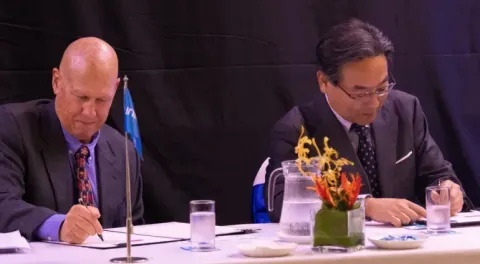
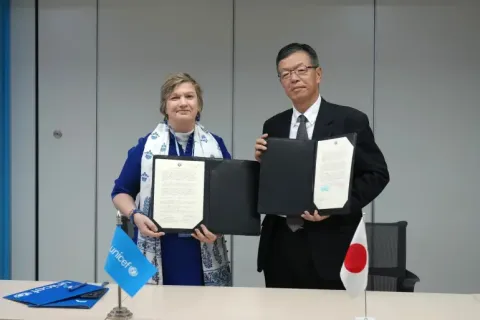
OUAGADOUGOU, 27 July 2022 - UNICEF has signed a partnership agreement with the Government of Japan, through Japan International Cooperation Agency (JICA), for the construction of educational infrastructure for general education, technical and vocational training in the Central and Central-West regions of Burkina Faso. The amount of the agreement is USD 9,298,410 (about 5,987,618,000 FCFA). The construction of these post-primary schools is the second phase of a larger project supported by the Government of Japan and implemented by UNICEF to support the Ministry of National Education, Literacy and Promotion of National Languages (MENA-PLN) of Burkina Faso.
With this funding, eight educational institutions will be built to accommodate up to 6,450 students over the next 15 years, or approximately 1,720 children each year (50 per cent girls). The main objective of this project is to improve access and quality of education by providing safe and child-friendly learning spaces and improved skills in school governance, use of training facilities and school safety protocols and psychosocial care by 2024.
Within the overall framework of this partnership, a first phase devoted to the realization of 18 general education colleges for an expected enrolment of 5,200 students and amounting to USD 12,972,656 has already been financed by JICA.
According to Okitsu Keiichi, JICA Resident Representative, "This support from Japan for the construction of general education, technical education and vocational training infrastructures contributes to the implementation of the educational continuum and the operationalization of multipurpose colleges. Like the first phase, the second phase of this project is part of JICA's programme of interventions in the education sector entitled "Support Program for Students and Teachers in Basic Education".
The deteriorating security crisis in conjunction with the impact of the COVID-19 pandemic has exacerbated existing structural problems in the education sector. An estimated 2.6 million children and adolescents between the ages of 6 and 17 are not in school, and more than half of the school-age population (51.4 per cent) of these out-of-school children, one in two lives in areas particularly affected by the conflict.
"On this important day, on behalf of UNICEF, I thank the Government of Japan and the people of Japan for this generous contribution for children and adolescents in Burkina Faso. When children are in school, not only do they prepare for their future and development, but they are also protected from dangers such as economic exploitation, abuse and all types of violence," said Sandra Lattouf, UNICEF’s Representative in Burkina Faso, during the signing ceremony of the agreement." Thanks to this programme, access to education will be improved even if we have to do more in the face of growing challenges.
The schools built will serve as models of child-friendly post-primary schools in Burkina Faso thanks to the infrastructure, equipment and teaching materials, which are essential levers for resilient, inclusive and quality schools. Some of the classrooms, dedicated vocational center will also serve as a platform for the new multiple skills reform of technical education, vocational training and general education. Through this reform, the government intends to accelerate access to technical education by pooling infrastructure and equipment for both education and training systems.
Within the framework of the Resilient Child-Friendly Schools programme, UNICEF has supported MENAPLN in developing specific modules for education for peace and social cohesion. This is an integral part of Burkina Faso's national curriculum, in the Human and Social Sciences subject area of the new national curriculum reform. Participatory management of education by communities will also be promoted in all the Resilient Child-Friendly Schools built where school management committees, parents' associations and associations of mothers’ educators will have their capacities strengthened in order to contribute effectively to the management, protection and maintenance of school buildings and infrastructure.
These quality child-friendly schools will integrate hygiene and sanitation standards through awareness raising on good practices and the distribution of WASH kits to provide a healthy learning environment, while preventing the spread of COVID-19 and other preventable waterborne diseases in schools. These interventions aim to improve the health and learning performance of school-aged children, and by extension their families, by reducing the incidence of water and sanitation related diseases.
本プレスリリースの日本語版はこちらをご覧ください。