“I am proud to work for this great Yanomami family”
Meet Venezuelan Maria Audaly, who works every day to save the lives of Yanomami children suffering from malnutrition in Roraima

- Português
- English
When the Venezuelan Maria Audaly, 43, left her homeland, she never thought she would end up working again in emergency situations in her new country. In Brazil, she is one of the health assistants responsible for ensuring the recovery of Yanomami, Ike’uana and Sanumã boys and girls suffering from malnutrition at the Nutritional Recovery Center of the Yanomami Indigenous Health House (CASAI, the Portuguese acronym for Centro de Recuperação Nutricional da Casa de Saúde Indígena Yanomami) in the city of Boa Vista in the state of Roraima.
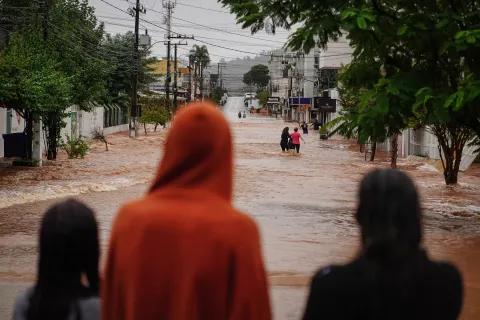
Illegal gold mining in the Yanomami Land had a large impact in the livelihoods of the indigenous communities in Roraima and triggered a humanitarian crisis causing serious health problems such as malnutrition, malaria and mercury poisoning threatening the lives of adults and especially Yanomami children.
“We have received children so weak that they didn’t have the strength to cry. It was an extreme situation that I had never seen since I started to work in healthcare after I arrived in Brazil in 2018”, says Maria.
For Maria Audaly, who had previously worked in humanitarian actions related to the Venezuelan migration flow, this new role demands, more than any other, a lot of affection and trust building.
“The extreme vulnerability, a language I don’t speak and a completely different culture were, at first, a big barrier. But affection changes everything. When I see a child crying, I hug him with lots of love and with this gesture of affection, I gain the trust I need to feed him with the nutritional formula. Hugs are a global language,” she says.
The loving methods of professionals like Maria, combined with intensive nursing, and Brazilian protocols adapted to the specificities of indigenous people, allowed 127 children with acute and chronic malnutrition to receive appropriate care in the Yanomami Indigenous Land and at CASAI, the indigenous health center in Boa Vista where the most serious cases from the Yanomami territory are sent for treatment.

Since Brazil declared a Public Health Emergency of National Importance by the Ministry of Health, on January 20, UNICEF has been working with the Brazilian Government and other partners, on a crisis management response at the Public Health Emergency Operations Center.
The health team is thrilled with every gram gained by the little ones who are on their way towards stabilization and recovery. This was possible with assisted therapeutic feeding five times a day; weight monitoring and clinical evaluations being conducted daily. In addition to the numbers of lives saved, for Maria, the biggest accomplishment was the difference in the relationship of trust with the Yanomami families.
“It is incredible to see the staff evolving and observe the positive change in the behavior of the Yanomami community. Now we feel trust from their families and many children who have already been discharged want to return to the nutrition room because they feel welcomed. It wasn't like that when we started”, recalls the health assistant, who works for the Adventist Development and Assistance Resources Agency (ADRA), a UNICEF partner in the response to the Yanomami emergency.
In addition to the work in CASAI, the Ministry of Health opened the Reference Center for Indigenous Health in the Yanomami Indigenous Land to strengthen permanent care and assistance, reducing the need for the indigenous people to travel to Boa Vista. UNICEF is a partner of the Nutritional Recovery Center. The unit is equipped for emergency care, exams, appointments and treatment for malnutrition and malaria.
UNICEF also works to provide clean water, sanitation and hygiene. At CASAI, the proposal includes the emergency restoration of existing bathrooms and the construction of new ones, as well as the installation of more drinking water and hand washing points. Also, two water, sanitation and hygiene specialists were hired to monitor free chlorine residual in drinking water and the site's infrastructure, and also to promote hygiene and health education to prevent diseases in the community. The plan aims to provide, in partnership with public authorities, access to drinking water for eight priority basic health units and 14 Yanomami communities.
All actions are possible thanks to the strategic support of the European Union through the European Civil Protection and Humanitarian Aid Operations (ECHO) the Labour Prosecution Service, through the Àwúre Project, and philanthropists.

A Change in Trajectory
In 2018, Maria left her position as a forensic criminalist to seek better living conditions in Brazil, where one of her daughters was already living. She initially worked as a volunteer in different institutions. Once she was able to stabilize her situation in the country, she brought in her other two children. Maria’s first home in Roraima was one of the Welcome Operation’s shelters, the humanitarian response of the Federal Government and partners to the migration flow from Venezuela. “I lived there for two years and helped form the shelter’s health committee, and help community emergencies as best we could,” she recalls. The health committee is an important instrument for community participation at the shelter and relies on the voluntary cooperation of refugees who have experience or training in the health field.
Afterwards, as an assistant, Maria worked, in shelters for refugees and migrants, and in the Basic Health Units (UBS, in the acronym in Portuguese for Unidades Básicas de Saúde) of Boa Vista, in order to support the referral and access of refugees and migrants in the city to the services of the Unified Health System (SUS, in the acronym in Portuguese for Sistema Único de Saúde) through a partnership between UNICEF and Boa Vista City Hall.
Threatened Territory
More than 30 years after being officially declared an indigenous territory in 1992, the Yanomami Indigenous Land – the largest in the country, with 9.6 million hectares between the states of Amazonas and Roraima – faces a humanitarian crisis due to the substantial increase in mining and illegal logging activity, which led to violence by invaders against the indigenous population, as well as disease outbreaks and increased infant mortality.
It is estimated that 20,000 miners invaded the territory where 31,000 indigenous people from 376 groups live, some still in voluntary isolation. Since the declaration of emergency and in view of the action coordinated by the Federal Government, miners began to leave the indigenous land. But challenges, including invasion of territory, continue.
“No Yanomami child should be deprived of access to health, nutrition, water, sanitation and hygiene. Therefore, UNICEF's response – which is being implemented with support from the European Union, the Labour Prosecution Service (Àwuré Project) and donations from philanthropists – focuses primarily on life-saving interventions, but also on strengthening the long-term needs of the system, under the leadership of the Federal Government”, says the UNICEF Emergency Coordinator in Brazil, Gregory Bulit.
In 2019, UNICEF released data from the survey on the social determinants of malnutrition in indigenous children up to 5 years of age in eight villages within the Yanomami Special Indigenous Health District. According to the study, eight out of every ten children under the age of 5 are chronically malnourished, in two of the base centers surveyed.