

Antini in Tanzania
Stitching a future
In Tanzania, skills training and social protection programmes are opening new paths for young people.
Squeezed into a narrow market stall in Kigoma Region, the United Republic of Tanzania, 17-year-old Antini leans over a sewing machine. A thread held between her lips, she guides the needle with steady hands. Behind her, colourful fabrics and half-finished garments hang like vibrant curtains.
“I love fashion, it’s my calling now. My dream is to have my own shop with 30 sewing machines, where I can also teach youth,” says Antini.
This future is very different from the one she’d envisioned for herself before her father died. Like every child her age, Antini had imagined completing her education.

“My late husband and I shared one dream: that all five of our daughters finish school,” explains Koretha Mahepa, Antini’s mother. “He always said: ‘Education is the one thing no one can ever take away.’”
Their dream was shattered when, after suffering a mental breakdown, Antini’s father turned to alcohol.
“He wasn’t himself anymore,” Mahepa says. “One day, I found him lying cold on the floor.”
His death changed everything for the family. Mahepa began subsistence farming to provide food, and Antini dropped out of school at just 12 years old. Her two oldest sisters were already married, so Antini became the caretaker of her two younger sisters.
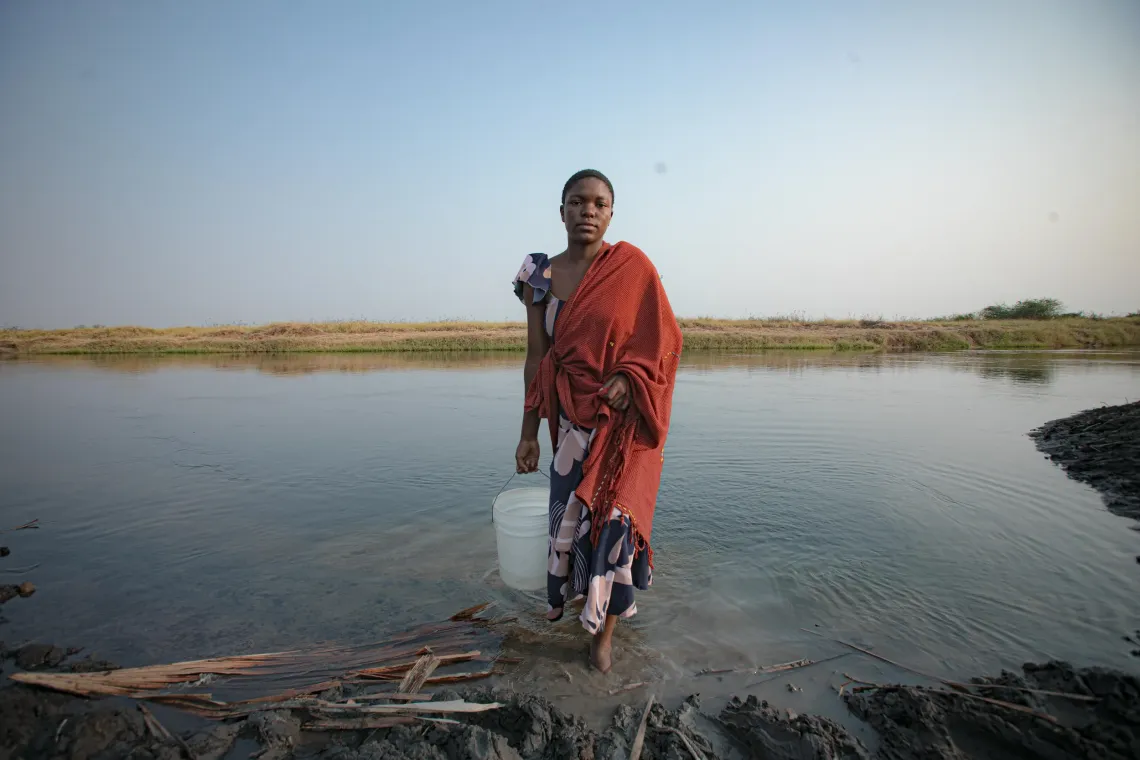
Antini uses her bicycle to travel to a nearby lake to collect water for her family, part of her daily chores.


Gradually, the weight of household responsibilities shifted to her. By age 13, she had organized her routine around her family’s needs: waking up before sunrise, managing household chores and caring for her sisters – duties she still shoulders today.
When she watches her sisters leave for school each day, Antini hopes they won’t be forced to drop out early:
“I want my sisters to have a better future.”
“When Dad passed, I knew I had to step up to help my mother and siblings. Even though I wanted to learn, it felt impossible,” she says.
“Sometimes I feel guilty because she should be in school, not taking care of us,” admits Mahepa.
Social protection and skills training
Things began to change when Antini’s uncle introduced her to Ujana Salama (“Safe Youth” in Swahili). Implemented by the Tanzania Social Action Fund, with support from UNICEF and the Tanzania Commission for AIDS, Ujana Salama is a cash-plus intervention – part of the Government of Tanzania’s Productive Social Safety Net programme (PSSN). PSSN provides cash transfers to poor households, along with running public works projects and livelihood enhancement activities. Ujana Salama complements this support by giving vulnerable adolescents a productive grant alongside skills training, mentoring and health awareness, all with the goal of reducing poverty and opening new opportunities for vulnerable youth.
Through Ujana Salama, Antini received an initial grant of US$50. After developing a business plan, she received an additional US$30. She used the money to buy a sewing machine, a floral printed dress and a pair of sandals.
So far, the programme has reached 10,757 adolescents (boys and girls) like Antini, aged 14 to 19 years, in four regions of Tanzania.


Antini sews while working as an apprentice.

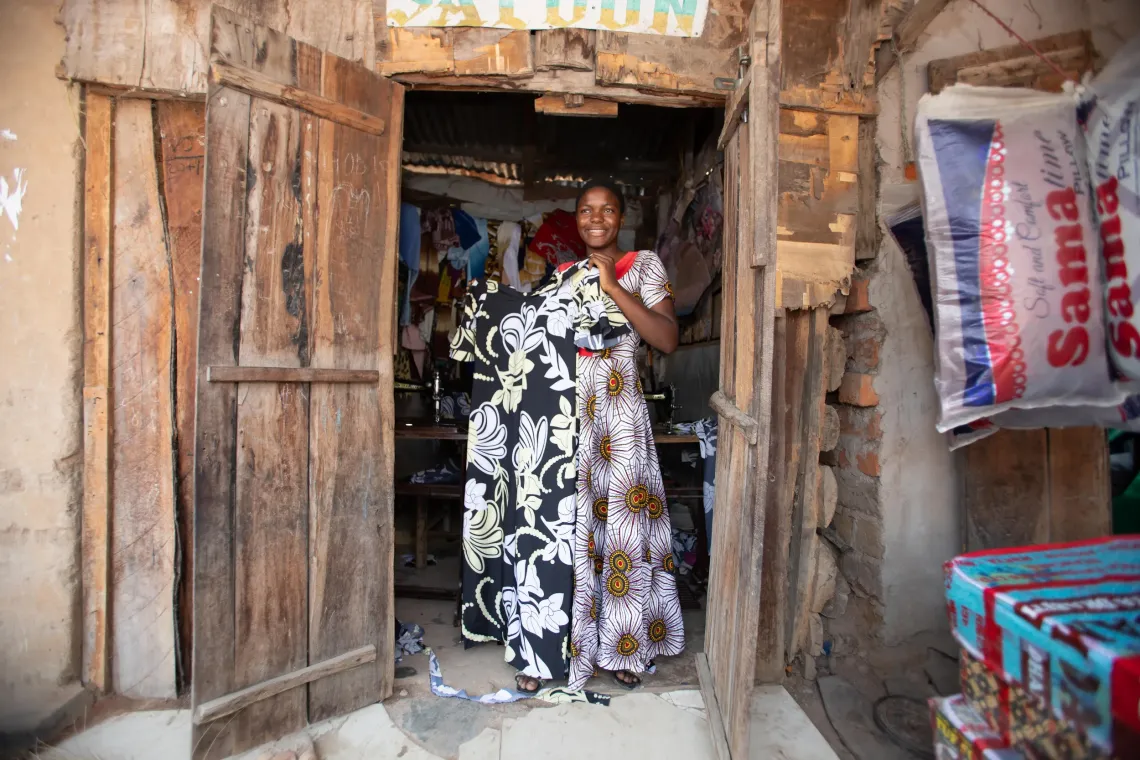
“My sewing machine changed my life. I can make clothes and provide for my family,” Antini explains.
Now employed as an apprentice at the local seamstress’s market stall, Antini receives a stipend that enables her to bring home flour, beans and sometimes a small portion of fish. Through the Every Adolescent Girl Learns programme, funded by Global Affairs Canada, she will soon receive formal tailoring training.
“Right now, I can make simple dresses and school uniforms,” Antini says, running her fingers over a neatly stitched seam. “But one day, I hope to dress celebrities and have my own fashion show.”

In a world of plenty, too many children are suffering as poverty strips them of their rights and endangers their futures. But child poverty is not inevitable. Stories like Antini's show what is possible when children are prioritized and inclusive social protections are expanded.
Learn more about ending child poverty in Tanzania and beyond in The State of the World's Children 2025.


