The power of flexibility
At a time of unprecedented cuts to international aid, multiyear, flexible, and unearmarked resources can help UNICEF to support the world’s most vulnerable children.

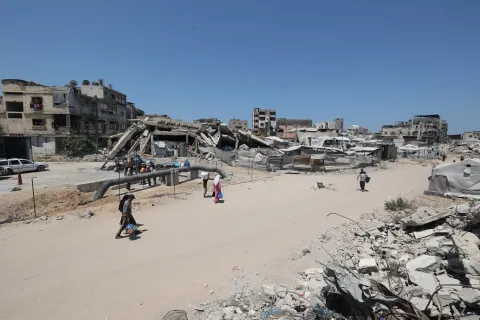
Nearly one in five of the world’s children live in conflict zones. Almost 50 million are displaced. More than 210 million children will likely require humanitarian assistance this year, buffeted by a deadly combination of violence, war, and rising poverty. Countless others could miss out on essential programmes that protect them from harm and abuse.
In the face of such adversity, Global Humanitarian Thematic Funding (GHTF) provides a crucial lifeline for children, both now and for the future. Unlike funding tied to specific projects or regions, GHTF empowers UNICEF to respond swiftly and fairly to children’s needs, wherever they may be. This means that when a crisis erupts – whether it’s a sudden disaster or an existing yet overlooked emergency – UNICEF can act immediately to provide life-changing assistance to the most vulnerable families, support that is:
- Fast, because we can release funds in a timely manner and respond quickly to the needs of children;
- Fair, because we can meet the needs of children in hard-to-reach areas and in underfunded emergencies, whether or not a crisis is in the spotlight;
- Prepared, because investing in preparedness enables us to be ready to act effectively in the initial life-saving response phase of an emergency.
But even as UNICEF works around the clock for children in emergencies, international funding cuts are impacting the humanitarian system in which UNICEF operates. These cuts pose an immediate and severe threat to children’s protection and survival.
Investing in GHTF is more than a donation – it’s an investment in a rapid, fair, and effective response system. But we have never done it alone. In 2024, thanks to donors big and small, GHTF supported UNICEF’s response for children in dozens of countries, including:
Haiti

Haiti is trapped in a humanitarian crisis. Armed violence in Port-au-Prince and Artibonite continued to devastate communities throughout 2024, displacing more than one million people across the country. Families are enduring unimaginable hardships, with children particularly at risk of being caught in the crossfire. Pervasive violence has shattered the education system, forcing children to flee schools that have been looted, occupied or destroyed. In addition to displacement, many of these children face a heightened risk of social exclusion, recruitment by armed groups and gender-based violence, including sexual and physical abuse.

Thanks to GHTF, UNICEF and its partners have been able to provide critical support to address the worsening situation. The funding in 2024 helped strengthen health systems with a focus on primary healthcare services, including direct support for cholera vaccination campaigns. UNICEF and partners also continue to focus on delivering life-saving interventions, including the procurement of Measles-Rubella vaccines for populations in hard-to-reach areas.
“The situation in Haiti continues to deteriorate in ways we are rarely able to fully predict, so our response must be flexible and rapid to meet the evolving needs of children and families. Flexible funding like that provided by GHTF enables us to adapt quickly and provide critical services where they are needed most, especially in the hardest-hit areas.” Gloria Thermidor, Health Specialist at UNICEF Haiti
Sudan

Two years of violence have shattered the lives of millions of children across Sudan. The conflict that erupted in April 2023 has displaced millions of people within Sudan and across borders. These children are at heightened risk of violence, abuse, and exploitation even as government systems responsible for their protection are on the brink of collapse. The number of grave violations against children has surged over the past two years.

In response to this crisis, UNICEF has worked closely with governments, civil society organizations, and community-based child protection networks to scale up its child protection response, including establishing safe learning spaces to provide structured learning opportunities and psychosocial support, while also strengthening the social workforce system in Sudan.
“The unpredictability of the conflict, and the resulting displacement of children and their families, means flexible funding has been critical in allowing UNICEF to respond quickly as new hotspots of need emerge. For example, flexible funding meant UNICEF and partners could retain and deploy well-trained social workers to provide specialized services when and where needed – a vital lifeline amid the chaos of conflict.” Fosca Giulidori, Chief of Child Protection, UNICEF Sudan
Ethiopia

Ethiopia is contending with a complex humanitarian crisis driven by climate-related threats, conflict, displacement, and economic challenges that together have had a severe impact on the well-being of millions of children and their families.

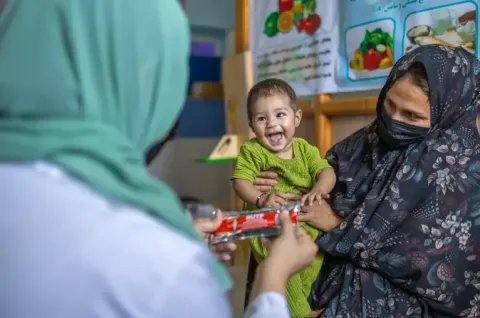
Timely treatment can be a matter of life or death for a child suffering from malnutrition, particularly severe acute malnutrition – its most immediate, visible and life-threatening form. GHTF has played a critical role in UNICEF’s response to malnutrition in Ethiopia, ensuring that the most vulnerable children receive nutrition services, including screenings, treatment and micronutrient supplementation. In 2024, UNICEF and partners provided life-saving treatment to more than 600,000 children suffering from severe acute malnutrition and provided almost 12 million children with vitamin A supplementation – boosting immunity and providing life-saving protection for vulnerable children.
“Flexible funds have allowed us to initiate life-saving responses at the very onset of emergencies. The funds play a crucial role in enabling us to preposition essential supplies in strategic locations to provide life-saving nutrition services, especially to internally displaced people and refugees in conflict-affected areas.” Sanjay Kumar Das, Nutrition Specialist, UNICEF Ethiopia
Armenia

An escalation in hostilities in the region in late 2023 led to more than 115,000 ethnic Armenians fleeing their communities into Armenia. UNICEF-supported social workers who were providing mental health and psychosocial assistance for arriving refugee children reported that many of those they encountered were experiencing intense feelings of sadness, anxiety, fear, and anger. Others had shut down and become detached, unable to express emotions or connect with the situation unfolding around them.

Thanks to the timely allocation and flexibility of GHTF, UNICEF Armenia was able to invest in emergency preparedness ahead of the refugee crisis, including establishing a strategically positioned field office, pre-positioning emergency supplies, and developing partnerships with our implementing partners who play a crucial role in our responses. As a result, psychosocial support and temporary learning spaces could be activated almost immediately. To ensure we could continue the response and keep meeting the needs of children, GHTF was used in 2024 to support a range of services for refugee children, including counselling, health and nutrition services.
“GHTF was critical, enabling UNICEF to be the first UN agency on the ground, conducting real-time monitoring of the evolving humanitarian situation. The first emergency supplies reached refugee children in less than 10 hours after the initial arrivals, and the first child-friendly space became operational on the second day of the emergency.” Heghine Ghukasyan, UNICEF Armenia Emergency Officer
Bangladesh

Bangladesh regularly faces overlapping crises, especially from climate-related hazards such as cyclones, heatwaves, waterborne diseases, and landslides. The country’s flat topography and dense population make it particularly vulnerable to the powerful and unpredictable forces that climate change is compounding. Public health emergencies further exacerbated the challenges for many families in 2024, including an acute watery diarrhea outbreak and a surge in dengue cases, which strained already overwhelmed health systems.

Flexible funding allowed UNICEF to respond quickly to unfolding emergencies. Flexible funds allowed us to support urgent child protection interventions, including the deployment of social workers and the establishment of safe spaces for children. GHTF also funded the rapid distribution of learning kits, temporary learning spaces, and damage assessments for affected schools. In addition, flexible resources supported cash transfers to vulnerable families, helping them prioritize their most urgent needs and supporting their recovery, and enabled emergency screening and treatment of malnourished children.
“Because of the flexibility of these funds, we were able to act swiftly to respond to the acute needs of the women and children severely impacted by floods and cyclones in the east and south of Bangladesh.” Antonio Garcia, Chief of Field Services, UNICEF Bangladesh
Ecuador

Escalating violence and the growing presence of organized crime have put children and adolescents at alarming risk in Ecuador. Forced recruitment by criminal groups is a daily reality in many of the communities most affected by poverty, displacement, and social exclusion. Meanwhile, soaring homicide rates against children in the past few years have underscored the importance of ensuring young people aren’t pulled into cycles of violence.

GHTF has played a critical role in helping UNICEF Ecuador respond to the crisis, allowing us to expand the Protective Communities Programme to high-risk areas and to focus on strengthening community-led responses to prevent child recruitment. This has included empowering youth with conflict resolution and violence prevention skills, supporting educators, and establishing support centres that offer psychosocial and legal services. GHTF resources have helped us deploy specialized personnel, provide training, and deliver materials to schools and community centres in areas where the risk of recruitment by criminal groups is particularly high.
“Thanks to flexible funding, we’ve been able to act fast and reach children where the risks are greatest. In places where criminal groups are recruiting the most vulnerable children, UNICEF is building a protective shield – community by community, child by child.” Arturo Romboli, UNICEF Representative in Ecuador
Myanmar

Throughout 2024, Myanmar remained one of the most dangerous and difficult places to be a child. Children bore the heaviest burden of rapidly escalating conflict, near economic collapse, and natural disasters – including Typhoon Yagi and severe flooding. An unprecedented 3.5 million people remained displaced in 2024, around a third of them children. Myanmar also became the world’s epicentre for landmine and explosive remnants of war casualties, with over 1,080 civilian victims. Many children were injured or killed on their way to school or while playing – a devastating reminder of the shrinking safe spaces for children in Myanmar.

GHTF allowed UNICEF to respond rapidly and strategically to shifting conflict and sudden-onset disasters, including helping us work with partners to reach children with safe, inclusive education, home-based learning kits, mental health and psychosocial support, and life-saving landmine and explosive remnants of war awareness. GHTF support also enabled the delivery of critical water, sanitation and hygiene services during outbreaks of cholera and acute watery diarrhoea. These interventions were essential in reducing the risk of disease and supporting safe hygiene practices in overcrowded displacement sites.
“GHTF gave us the flexibility to move quickly, adapt to fast-changing needs, and reach some of the most vulnerable children in the hardest-hit and most inaccessible areas. From education and WASH to protection, this support enabled life-saving interventions that would not have been delivered through traditional funding alone.” Faika Farzana, Emergency Manager – UNICEF Myanmar
Pakistan

Pakistan is one of the most vulnerable countries in the world in terms of climate-related risks, particularly flooding. In August 2024, heavy rains and floods impacted tens of thousands of children in Dera Ghazi Khan and Rajanpur districts, areas that were still reeling from catastrophic monsoon flooding in 2022. The floods badly damaged many schools, disrupting access to education.

GHTF has helped UNICEF support hundreds of schools with essential learning supplies, including in areas impacted by floods. Flexible funding has also been used to procure and deliver thousands of hygiene kits for children, removing a significant barrier to school participation in flood affected areas. This has been particularly important in helping adolescent girls stay in school. Millions of girls and women around the world are unable to manage their menstrual cycle in a dignified and healthy manner, which restricts their mobility and affects school attendance – particularly during humanitarian emergencies. GHTF also helped UNICEF provide life-saving health and nutrition services to thousands of people in flood-affected areas.
“Thanks to flexible funding and strong coordination, UNICEF ensured the swift delivery of essential education, water, sanitation and hygiene supplies and services. This helped lay the foundation for long-term resilience for children and communities in Dera Ghazi Khan and Rajanpur during flood recovery.” Yasir Arafat, Education Officer UNICEF Pakistan