The planet is changing. It can be hard to find the words to talk about this changing world, and because humans have never faced anything on this scale before we often do not know how to even imagine how it will continue to change.
The impact of climate change is cumulative (record heat waves, wildfires, sea level rising, ice melting, glaciers disappearing, flooding, increased storms, etc.) which lead to both physical and mental health distress.
The impact on children and young people can be profound, but with the right support and resources, they have the potential to develop remarkable resilience and strength to cope with challenges.
Climate change and mental health
We are far more used to facing crises or threats that end – and then we can go back to how things were before (or close to anyway). But the climate crisis will always be evolving from now on, because of the amount of carbon in the atmosphere. We need to imagine different futures with rising sea levels and heat. Because this can feel too big to think about all-in-one go, we can feel overwhelmed and over-anxious or shut down emotionally (feeling too much or too little).
Climate change is a psychological stressor. It could be argued that it is an Adverse Childhood Experience (like experiencing war or child abuse), which can have lifelong mental health impacts on children.
When we look at the mental health impacts of climate change, we must look at:
- The direct impacts, such as people caught in wildfires and floods, leading to direct trauma, loss and distress.
- The indirect impacts, such as observing people fleeing wildfires and floods or hearing stories of people caught up in disasters or trauma.
We also face distress from short term (shock and fear) and long-term stressors (constantly worrying about safety and wondering if fires or floods will return).
We are now seeing the mental health impact of climate change result in vicarious or direct trauma, post-traumatic stress disorder, depression and complicated grief – we feel grief about the loss of places and animals we care about, while we are also aware that we (humans) have caused this loss.
What is eco-anxiety?
Climate- or eco-anxiety is an emergent mental health problem, which means that as a condition it is changing and developing in line with the changing climate crisis.
To understand climate anxiety, we must look at two things:
- First, it is anxiety and other emotions such as sadness, anger and grief in response to what we see happening in the world today with the pressure of climate change on our planet.
- Second, and just as important, it is how we feel in relation to other people’s responses, especially those with the power to act to prevent the worst from happening, but who all too often deny, minimize and disregard the distress experienced by vulnerable communities.
This second distress is often harder to cope with than the anxiety about climate change itself. This is frequently misunderstood. The injustice, unfairness and lack of care can be heartbreaking to many communities, including young advocates around the world.
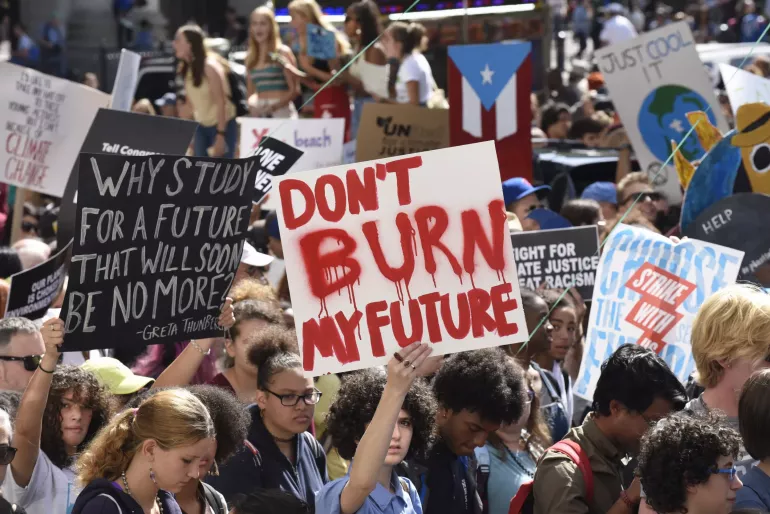
It is a sign of mental health – that children and young people care about the planet.
We are not just facing uncertainty about the scale and speed of the changes taking place around the planet. We are also facing uncertainty about whether people will take effective and sufficiently rapid action to make the world a safer place for ourselves and our children in the future. The fear about the changes taking place on the planet is made much worse by fears that people with the power to do something about this - such as governments - are often doing the opposite.
Not just feelings
It is also not just about feelings, but thoughts about the future. The largest global survey on eco-anxiety in children and young people collected data from 10,000 young people aged between 16 and 25 years old in 10 countries (Hickman et al, 2021). The results showed that:
- nearly 60% of young people are 'very' or 'extremely worried' about environmental problems
- 50-67% said climate change makes them feel sad, scared, anxious, angry, powerless, helpless and guilty
- 45% reported a negative impact of these emotions on daily functioning such as eating, concentrating, sleeping, going to school, and playing
- 83% think adults have failed to take care of the planet
- 75% believe that the future is frightening.
The survey also offers insight into young people's perceptions of governmental responses to climate change. Participants tended to rate government responses negatively: 64% think governments are not taking their concerns seriously, are not doing enough to avoid a climate catastrophe and are failing young people around the world.
How can children cope?
These difficulties are not going away, so we need to learn how to face them. Here are some things we can tell children to help them cope with climate anxiety:
Learn to regulate emotions so you validate the feelings but do not get overwhelmed (feeling too much) or shut down (feeling too little). Mindfulness and meditation can be helpful with this, but so is anything that helps to build emotional resilience and emotional intelligence.
Be part of a community of like-minded people so you are not alone and can find people to share feelings and thoughts with.
Understand that it is important to have hope, but radical hope is better than naive hope. Radical hope allows us to feel sad about what we have done that has already caused widespread planetary problems whilst at the same time finding courage and determination to do what we can to stop things from getting worse.
Tips for parents
About the author
Caroline Hickman has a background in mental health social work. She is a psychotherapist and lecturer at the University of Bath researching children and young people’s emotional responses to climate change globally examining eco-anxiety and distress, eco-empathy, trauma, moral injury, and the impact of climate anxiety on relationships.