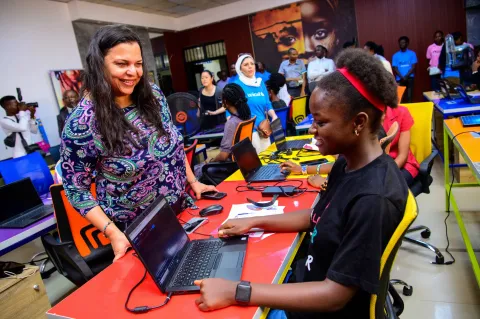
This moment in history can feel like a hard place to be for many girls around the world.
Whether living through conflict or climate disaster, girls tend to be hit hardest when crisis strikes. Child marriage rates in fragile contexts soar to nearly twice the global average. Risks of sexual violence rise, often with little or no support for survivors, alongside incidents of teenage pregnancy and maternal mortality.
Through it all, evidence shows that a growing proportion of young men hold inequitable attitudes about power, gender roles and violence.
Yet even in this context, funding is being slashed at staggering levels. Public financing for investments and services that protect girls and advance their rights has historically been low – despite decades of research that confirm when girls thrive, everyone benefits. Today, unprecedented cuts to global aid make a challenging situation for girls even worse.
But this is not the whole story. Around the world, we also see a generation of girls, boys and young people advocating for equal rights, determined to see their communities stand on equal footing. They recognize that gender equality is tied to peace, prosperity and freedom for all.
This is cause for hope. But we need to get behind them.
Girls and young women remain critically unrecognized – and underfunded – for their leadership in crisis response. In fact, they are often first responders in disaster-affected communities, providing life-saving care and building resilience. Because of their proximity and experience, they are uniquely positioned to provide peer support and tailor responses to the most excluded girls.
What this looks like: Stories from the Democratic Republic of the Congo
The Democratic Republic of the Congo represents one of the world’s most protracted crises. Decades of violence, poverty and pervasive gender-based violence have caused unprecedented needs.
Yet girls and young women here are leading responses, reclaiming power through arts, sports and technology. They distribute food and water, menstrual products and reproductive health services. They provide referrals for evacuation and psychological support, and document cases of violence. They use art and sports to more actively, creatively engage with survivors, peers and communities to make change. Many groups are led by survivors themselves, whose trust and proximity enable them to support others.
For example, Kongo Mwinda, a group led by young women under 25, focuses on health, education and vocational training so displaced women and girls can rebuild independence and protection systems. They’ve trained activists on rights and digital security, reached 15,000 more through campaigns, and provided dignity kits to 100 displaced girls.
Initiative Congo Debout is another girl-led group that supports survivors of violence with services and training for income-generating activities, bolstering resilience. Over 1,500 households have participated; more than 1,000 people have been reached through digital campaigns; and hundreds of girls have been supported to restart their lives.
POWER4Girls: A different path forward
Belief in the power of girls and young people to change the world is at the heart of UNICEF and Purposeful’s new global initiative, launched at the UN earlier this year with girls, government leaders, philanthropists and UNICEF Goodwill Ambassador Millie Bobby Brown.
POWER4Girls disrupts the notion that systems are too big to reform or that movements are too small to matter.
It is powered by a partnership between UNICEF – the only UN agency dedicated exclusively to child rights – and Purposeful, an Africa-rooted hub for girls’ organizing that ensures resources reach young women making change in their communities.
Scaling up direct grants and mentorship for girl- and youth-led organizations is core to POWER4Girls programming. UNICEF’s Global Girl Leaders Advisory Group and Purposeful’s youth advisors are central to decision-making, from resource allocation to programme design. This year, girl- and youth-led groups in the Democratic Republic of the Congo were funded through Purposeful's Global Resilience Fund.
In September, we spent time with girls in Tanganyika Province, advising on POWER4Girls programming. Girls and boys spoke at the launch in Kabalo, underlining how peace, justice and the rights of girls are inseparable.
POWER4Girls will scale the best evidence-based solutions to expand essential services and programmes for girls, aligned with priorities identified by girls themselves. This includes economic empowerment, skills training, safe spaces, and platforms for health, protection and education. It also means engaging boys, men, parents, teachers and health workers in a coalition to advance girls’ rights.
Evidence of scale and impact
Progress so far has been significant. Under its pilot phase, UNICEF reached over 47 million people with new programming: This means millions of girls benefiting from services like gender-based violence prevention, skills training, and adolescent-friendly health and nutrition. Communities are also reached through parenting and care programmes, and diverse partnerships with girl- and youth-led networks. Public finance has been mobilized too, including from the Dominican Republic and Egypt, with policy dialogues live in many other countries.
Purposeful has provided over $5.2 million to girl-led groups in over 100 countries, supporting leadership, advocacy and movement building with flexible funding.
What’s more, over $10 million in new resources has now been committed to POWER4Girls since its launch, including for fragile contexts like the Democratic Republic of the Congo and Ukraine. Investing in adolescent girls is one of the smartest investments leaders can make. Decades of research confirm that when girls thrive, everyone benefits.
Acting to ensure girls’ safety, services and rights is not optional – it is essential. When times are tough, it is time to double down in support of girls.
Ruth Graham-Goulder is a Senior Advisor, Gender Equality, at UNICEF.
Ruby Johnson is Director of the Global Resilience Fund at Purposeful.
Rosaline Tskepuia is Regional Advisor for Grant-Making in West and Central Africa at Purposeful.
Aabha Khatri is a consultant working on adolescent girls' rights at UNICEF.