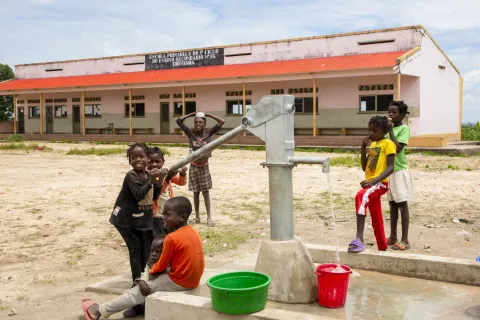
Global Handwashing Day.
Benefits of handwashing: A small gesture with a giant impact.

- Portuguese
- English
On October 15, World Handwashing Day is celebrated, a date that highlights the importance of a simple but essential gesture: washing your hands with soap and water. This often-overlooked practice is one of the most effective ways to prevent infectious diseases.
When made accessible and routine in the life of every person, family, and institution, such as schools, hospitals, and health centers, handwashing can save lives.
Studies show that washing hands with soap and water can reduce the incidence of diarrhea by about 40 percent, and respiratory infections by up to about 25 percent. Hand washing can contribute significantly to reducing mortality and malnutrition in children and adolescents.
The promotion of good hygiene practices as a line of defense against cholera, combined with access to clean water and adequate sanitation, is fundamental in preventing and controlling the spread of infections. In Angola, the cholera outbreak has already affected 29,850 people and caused 824 deaths, with active transmission in 18 of the 21 provinces.
When adopted on a large scale, handwashing contributes to reducing epidemic outbreaks and improving public health indicators, being an essential tool in prevention and response campaigns to health emergencies. For this reason, this practice is among the five most important to contain a cholera outbreak.
Rosalina Graciano is a community agent and belongs to the ADECOS (Community and Health Development Agents) group. During the peak of the outbreak in Luanda, she and her companions walked the streets of Cacuaco, daily, from door to door, teaching and encouraging good hygiene practices, such as hand washing, ensuring access to information in a clear and accessible way.
"When the cholera outbreak began, many families did not know what to do. Today, we mainly teach women and children how to treat water, wash their hands properly and identify the first symptoms." Spoke.

One of the reasons behind the creation of the handwashing day celebration is the promotion of handwashing in schools to encourage children to promote this practice. With the cholera outbreak, this need was once again realized to the extent that, as part of the response to the outbreak, one of the measures supported by UNICEF was the promotion of this measure in several schools in the most affected provinces.
The Ministry of Education, with the support of UNICEF, launched the "Safe Back to School" campaign. To protect children and ensure the continuity of school activities.
"We reaffirm that investing in early childhood education is sewing opportunity: true social transformation is born in the preschool classroom. It is our duty to strengthen the training of educators and ensure that each child begins their journey with confidence, curiosity and equity." Francisco Pacheco, Secretary of State for pre-school and primary education.
The initiative covers 113 schools in the most affected provinces, including Cabinda, Zaire, Uíge, Lunda Norte, Cuanza Sul, Huíla, and Namibe, directly benefiting 173,333 children, of which 84,102 are girls.
Among the actions of the campaign are the installation of mobile handwashing stations, the distribution of soap, bleach, and disinfectants, and awareness of students and teachers on cholera prevention.
"Cholera can affect people of all ages, but young children are particularly vulnerable to the disease as they have weaker immune systems and are more likely to become dehydrated quickly. With the provision of water, soap, biosafety material, we contribute to the protection of children and help create a safer environment for them," added UNICEF representative Cristina Brugiolo.

Children who practice regular handwashing have fewer school absences for health reasons. Regular handwashing contributes to healthy and safe development, especially in school and community settings.
The success of these actions has been possible thanks to the support of partners such as ECHO, CERF, the Government of Korea, Gavi, and the Church of Jesus Christ of Latter-day Saints. And support from Organizations such as World Vision International, Angolan Red Cross, CUAMM, and technical coordination with the World Health Organization (WHO).
Washing hands is more than an act of hygiene; it is a commitment to life, health, and the future of our communities.
On this World Handwashing Day, the call is clear: to make hand hygiene a daily routine at home, in schools, in health centres, and throughout the community. It is a simple, accessible, and life-saving gesture.