How mealtime looks around the world
Families want to feed their children the nutritious food they need to grow up healthy. But there are big barriers to doing so.

A child’s first bite of food is celebrated among families around the world. It marks a new phase of discovery – new tastes, textures and smells. A nutritious diet in early childhood has the power to shape a healthier future for a child, helping to build a strong immune system, fuel a growing body and nourish a developing brain.
Sadly, millions of young children across the globe are missing out on the benefits of a nutritious diet due to a combination of factors, including a broken food system, the COVID-19 pandemic, families struggling to find and afford nutritious foods, increasing poverty, and mounting time pressures on mothers.
Yet change is possible. Even in the poorest contexts, families are finding ways to provide diverse meals that provide the energy, protein, vitamins, minerals and other nutrients needed to fuel growing bodies and brains and keep children healthy, active and strong.
Here are some examples of nutritious foods that children are eating around the world:

Eight-month-old Sakha holds an orange at his home in Central Java Province, Indonesia. Sakha loves fruit and vegetable porridge. “Most people don’t eat enough fruits,” Sakha’s mother says. “And there are also people who prefer to buy instant meals. But I don’t think those are healthy because of the preservatives and colour additives.”

Gelsi, 3, holds up a plate of tofu at her home in Central Java Province. Also pictured are boiled chicken, boiled egg, vegetable soup, rice, orange, grapes and longan fruit.

Diomande, 14, holds up a bowl of rice with potato leaf sauce in a suburb of Abidjan, Côte d'Ivoire. His favourite dish is rice with peanut sauce, which he has loved eating since he was 8 years old.

Amandini, 6, also lives in Abidjan. She’s eating Garba, a dish made with cassava semolina, fried tuna and vegetables. “She loves Garba, like many children in the neighborhood,” her mother says. “People are aware that it’s essential to eat healthily, but they do what they can because they have little money.”

Hender Jonathan, 23 months old, holds an apple outside his family home in Colotenango, Guatemala. In the dishes surrounding him are beans, tortillas, rice, tomatoes, eggs, pasta and fruit – all things his mother uses when she prepares his meals. “Sometimes it’s difficult for me to feed my son healthy food due to a lack of resources and the distance to the market,” his mother says.

Jessica Domingo, 5, holds an apple outside her home, also in Colotenango. In the dishes surrounding her are beans, corn, rice, tomatoes, eggs and Incaparina (a mixture of corn flour and soy flour fortified with vitamins and minerals that is used as a food supplement).

Nakalema, 3, sits on her favourite chair in her home in Uganda. On her plate is rice, matooke (mashed banana), groundnut paste, leafy vegetables, avocado and peas.

Daniel, 5, is also from Uganda. He’s holding up a plate of a meal that includes pumpkin, rice, groundnut sauce, red vegetables, avocado, peas and beef.

Girisha, 3, holds up a spoonful of her afternoon meal at her grandparents’ home in Ratnanagar, southern Nepal. The meal consists of banana, apple and a plate of jaulo (a mix of rice and lentils) prepared by her mother.

Ten-month-old-Marium holds a tomato in Dhaka, Bangladesh. Marium’s favourite food is porridge rice. “I also breastfeed her and give her other foods,” her mother says. “I think if my child eats healthy food, she won’t get sick and she’ll grow up healthy. I also think she’ll have a good brain if she eats good food!”

Khadija is 11 months old and enjoys eating eggs, grapes and pomegranates. “We can’t give our daughter the foods we ate when we were children,” her mother says. “We used to eat fresh vegetables from the fields. That’s not possible here in Dhaka.”

Jayden, 3, lives in Dili Municipality, Timor-Leste. He likes to eat fruits, including papaya, bananas and apples.

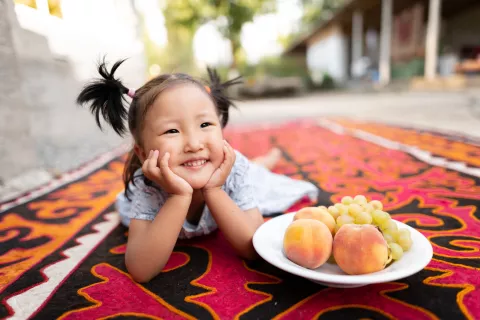
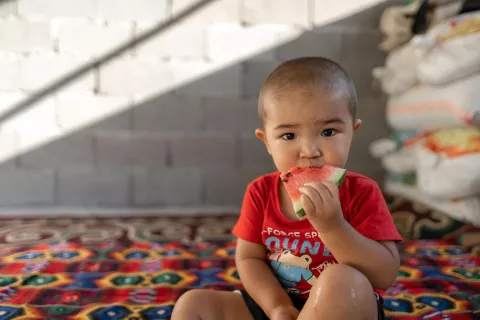
Ariet, 2, sits on the floor next to some of his favourite foods at his home in Kurshab Village, Kyrgyzstan. Ariet likes eating watermelon, peaches and cucumbers, and loves manty (dumplings) and shorpo soup (boiled meat with vegetables).

Nurayim, 3, eats a bowl of porridge at her home in Kurshab Village. Her mother says the family does its best to avoid unhealthy food, and they are fortunate to have a garden where they grow some vegetables.
Read more about UNICEF’s work to improve childhood nutrition and how food systems are impacting children’s health.