UNICEF Executive Director Catherine Russell’s remarks at the Nutrition for Growth Summit
As prepared for delivery
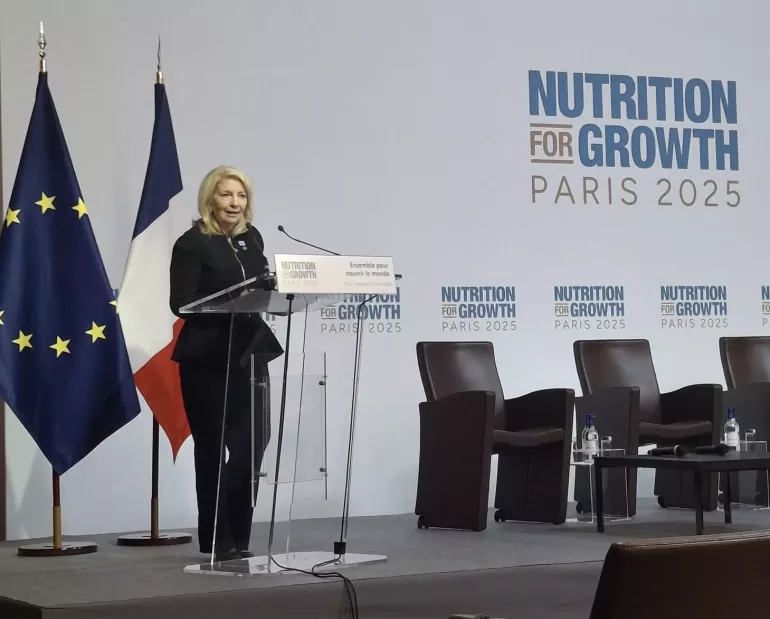
PARIS, 28 March 2025 - "Thank you, Minister Mohamed-Soilihi, for your remarks. I would also like to thank the Government of France and the Ministry of Foreign Affairs for hosting this Summit.
"The subject of this session is very close to my heart and to so much of UNICEF’s work: The nutrition of girls and women.
"Or perhaps I should say, the malnutrition of girls and women.
"Over the last few decades, the world has made significant progress in reducing child malnutrition all over the world.
"But today, we are facing a funding crisis that threatens to roll back our progress – and women and adolescent girls are bearing the brunt.
"Around the world, women and girls eat last and eat least.
"When food is scarce and money is tight, women serve the men and children first. They save the best and largest portions for them. They eat less and skip meals altogether.
"This is what life looks like for millions of women and girls around the world. And for far too many – especially those caught up in conflicts and other crises – the situation is getting worse.
"Between 2019 and 2022, the food insecurity gender gap more than doubled.
"How ironic – and how unjust – is it that women are responsible for up to 80 per cent of all food production in developing countries and yet are almost 27 per cent more likely to be food insecure than men.
"One billion adolescent girls and women suffer from undernutrition -- and more than 60 per cent of all chronically undernourished people in the world today are female.
"The food and nutrition crisis takes an especially brutal toll on pregnant and breastfeeding women and their children.
"In the 12 hardest hit countries, the number of pregnant and breastfeeding adolescent girls and women with acute malnutrition soared from 5.5 million to 6.9 million since 2020 – an increase of 25 per cent.
"Maternal malnutrition has dire consequences for women and adolescent girls themselves. Malnutrition disproportionately impacts their learning, their life choices, and their future earnings.
"It also threatens their health, their wellbeing, and their lives.
"Malnourished mothers are more likely to experience complications in pregnancy and childbirth – and their risk of dying is twice as high as that of well-nourished mothers.
"The consequences of maternal malnutrition can be catastrophic for their children.
"Undernourished and underweight mothers are at higher risk of pre-term births – which put babies at higher risk of death and disability.
"Babies born to malnourished mothers are also at much higher risk of low birth weight, in turn making them more vulnerable to infection, disease, and death.
"We estimate that maternal malnutrition contributes to the deaths of 800,000 newborns every year.
"Babies who do survive are at much higher risk of stunting, which causes irreversible physical and cognitive harm.
"We have made significant progress against stunting in recent years. But around half of all stunting still originates during pregnancy and in the first six months of life, when children are entirely dependent on their mothers for nutrition.
"The human costs of malnutrition in women and adolescent girls are tragic -- and the economic costs are also unacceptably high.
"A recent analysis shows that malnutrition in women and adolescent girls costs the global economy more than $1.6 trillion annually in lost productivity and wasted potential.
"Just anemia alone – which is on the rise and already affects nearly 1 in 3 women of reproductive age globally – costs approximately $113 billion annually.
"Especially in a time of skyrocketing needs and shrinking resources, we cannot afford to ignore the costs of inaction.
"These costs will surely rise. For example, without action and investment, malnutrition will only get worse in a warming climate. And here again, it will disproportionately affect women and adolescent girls.
"Extreme weather like droughts and erratic rainfall disrupt food systems that are often already strained.
"Among other things, this puts women and girls at greater risk of micronutrient deficiencies – and puts already-malnourished women and girls at greater risk of developing more acute malnutrition.
"Crises caused by warming climates force more girls than boys to drop out of school. This not only interrupts their education. In many cases, it also blocks their access to school-based nutrition programs.
"Women represent 80 per cent of the population displaced by climate change. This heightens their vulnerability to many harms – including disrupting their access to health and nutrition services, education, and protection.
"We are only five years out from the 2030 deadline of the Sustainable Development Goals, which prominently include the global goal to end hunger, achieve food security, and improve nutrition for all.
"We will never achieve this goal – and so many related goals – if we do not put the nutrition of women and girls at the center of the global development agenda.
"If we fail to act now, we will see hard-won gains in nutrition slip away, leaving millions of children more vulnerable than ever.
"Excellencies, from Afghanistan to Sudan, I have seen the impact of gender inequalities on the health and wellbeing of girls and women. I have seen women and adolescent girls go hungry to feed their families.
"But I have also seen families and communities flourish when women and girls have equal access to nutritious food and healthy diets.
"UNICEF is calling on governments and their partners to take the lead in accelerating progress for adolescent girls’ and women’s nutrition.
"That means committing resources and prioritizing access to nutritious food for adolescent girls and women – especially in crises when food and nutrition security are threatened.
"It means free access to essential nutrition services before and during pregnancy, and while breastfeeding.
"It means legislating to protect adolescent girls and women from nutrient-poor, ultra-processed foods. These foods are one of the root causes of the rapid rise of obesity and overweight. Not surprisingly, this global health risk affects more women than men.
"It means investing in more and better data about gender and nutrition so we can better understand the problem and develop more effective interventions.
"It means doing more to keep girls in school -- and investing more in healthy school food programs, as well as nutrition education.
"And it means breaking down the barriers and social norms that lead to nutrition gender disparities in the first place.
"That includes doing more for women’s economic empowerment.
"The women who are growing the food and cooking the food should have their fair share of the food – and the right to decide where resources are best spent.
"Improving nutrition for women and girls is not only a moral imperative. It is a sound investment in the future – unlocking a double dividend of mutually reinforcing benefits.
"The World Bank estimates that investing in women’s nutrition could increase economic productivity in low- and middle-income countries by $110 billion.
"Every dollar invested in reducing anemia in women could produce $12 in economic returns.
"Investing in girls’ nutrition yields another double dividend: Better nourished girls do better in school and stay in school longer, which can increase their future earnings. That’s good for them, good for their children, and good for their societies.
"This is the 30th anniversary year of the Beijing Declaration – the most important blueprint in history for advancing the rights of women and girls. And we have certainly made progress.
"Yet here we are, still confronting the denial of one of the most basic rights of all: The right to nutrition.
"We need to take stock of the inequalities that continue to undermine that right for millions of girls and women all over the world.
"And more than take stock: We need to take bold and collective action to break the intergenerational cycle of malnutrition and gender inequality.
"Women and girls have a right to their seat – and a full plate – at the table.
"Excellencies, we know what it takes to get life-saving nutrition support and services to the women and children who need it most. We just need to mobilize the political will and resources to act. There is no time to waste.
"Thank you."
#####
Media contacts
About UNICEF
UNICEF, the United Nations agency for children, works to protect the rights of every child, everywhere, especially the most disadvantaged children and in the toughest places to reach. Across more than 190 countries and territories, we do whatever it takes to help children survive, thrive, and fulfil their potential.
Follow UNICEF on X, Facebook, Instagram and YouTube