The Invisible Children of Mozambique: Bringing Birth Registration to Isolated Communities
“Without documents, it is like my son does not exist.” - Manuel Caetano.

- Português
- English
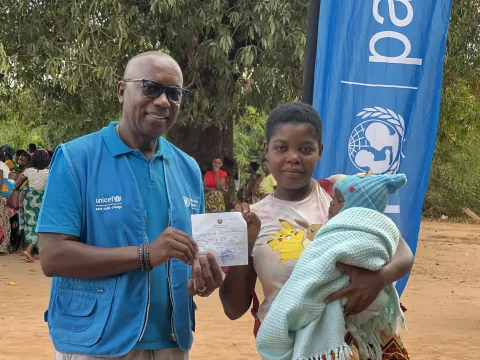
Sofala, Mozambique - Manuel Caetano, 26, retrieves a folded piece of white paper from a tin box on the floor of his house. He unfolds it to reveal a precious document - his two-year-old son’s birth certificate.
Born in the Bandua resettlement camp in 2021, Manuel Caetano Jr. was unregistered, undocumented, and effectively invisible to the government for his first two years. Without legal proof of identity, children are left uncounted and unable to access basic services. They officially do not exist.
“Without documents, Manuel Jr. cannot register for school or access the healthcare centre. Without documents it is like my son does not exist,” says Manuel.
In Mozambique, only 49 per cent of children under 5 have a birth certificate. Few registration locations, long travel distances, high transportation costs, and late registration fees are just some of the barriers that people face to register births.
Without an official document, children cannot be treated at hospitals, attend school, or enroll in social programmes. Furthermore, the lack of a birth certificate can make a child more susceptible to early marriage, statelessness, or child labour.
When documents are lost or damaged, getting new ones can be difficult. In 2019, Cyclone Idai destroyed the documents of many families. The cyclone's chaotic aftermath created additional challenges to registering the births of newborns.
Cyclone Idai, a category 4 tropical storm, hit Mozambique on March 14th, 2019. It brought winds that reached up to 167 kilometres per hour and floods that left entire regions of Sofala province under water. Manuel and his wife farmed land which lay directly in the cyclone’s path.
“During the cyclone, we lost everything”, says Manuel. “The cyclone surprised us, and we were not ready for it. Our house was destroyed completely. Everything in the house was destroyed or lost - food, clothes, cups, plates, documents - all gone. Even the mangoes in our field were gone. We were left with just the clothes we were wearing.”
Manuel and his family have been living in the resettlement camp ever since. When Manuel Jr. was born in 2021, birth registration was not an option. Traveling to a faraway town to register a newborn child was prohibitively expensive. Manuel Jr. was deprived of a birth certificate and remained ‘officially’ invisible for some time.
“Then one day last December, we were told that a mobile brigade would be here in the camp to register children and issue documents”, says Manuel. “The boy was registered for the first time. We received new numbers and new documents. Next year we plan to register Manuel Jr. for school, and we will do this with his document.”
Mobile brigades are bands of civil servants who travel to remote or vulnerable communities around Mozambique. They bring essential services like birth registration to these underserved communities, enabling children to be registered and birth certificates to be issued.

Possession of an official document immediately impacted Manuel Jr. when he was struck down with a serious illness earlier this year. His father explains:
“We urgently needed to bring Manuel Junior to the health centre in Bangua. He had malaria and was very sick. The document allowed us to get him treated at the health centre and he recovered.”
With Manuel Jr. finally visible to the government, he could receive the vital treatment that he needed. Mobile brigades are registering thousands of children in isolated communities around the country and helping them to secure their most fundamental rights.
UNICEF trained and equipped mobile brigades from the Ministry of Justice’s Civil Registry Office. Mobile brigades represent just one strand of UNICEF and its partners’ efforts to strengthen Mozambique’s civil registration and vital statistics system.
As Manuel says, “the mobile brigade has been very helpful because the documents are really important to the community in the resettlement camp. Everyone here has their documents now.”
With the generous support of the Government of Canada and the Government of Norway, UNICEF has supported the Government of Mozambique to expand access through the opening of 152 civil registration posts within health facilities, training of registration technicians, digitization of the civil registration system, and awareness raising activities at the community level.