Catarina’s dream takes flight as community leaders pledge to end child marriage
“Our community is free from premature unions. Finished! Child marriage has no future here.”

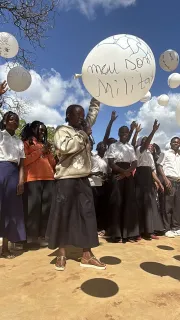
Nampula Province, Mozambique - In Boila-Nametória, an administrative post in Angoche district, Catarina da Floriana, 16, took the microphone in one hand and raised a white balloon high with the other.
“I am a girl,” she said. “I have the right to achieve all my goals. I have the right to study. I have the right to follow my own path. I have the right to be free, and I have the right to live in peace.”
Written across her balloon were the words meu sonho militar: my dream is to be a soldier.
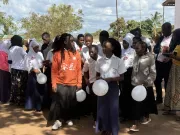
Around Catarina, dozens of girls in white school blouses held balloons bearing their dreams. Some wanted to become teachers, others nurses. Catarina wanted to serve in the military.
“We are happy that Nametória is now a place free of premature unions,” she said. “On behalf of all the girls, we wrote our dreams on these balloons.”
Moments earlier, Catarina and the other girls had watched 21 régulos, Mozambique’s traditional community authorities, publicly commit to ending child marriage in their communities.
The declaration marked a milestone for Boila-Nametória. Children, parents, traditional leaders, government officials and civil society representatives marched together, carrying banners that read “Let me be a child” and “Let’s put an end to premature unions.”
At the local administrative offices in Boila-Nametória, the régulos, dressed in khaki uniforms trimmed with gold braid, raised their right hands as one leader read the declaration aloud.
“Our community is free from premature unions. Finished! Child marriage has no future here.”
One by one, they stepped forward to sign it.
Salimo Latifo, régulo of Canhaua , said the commitment brought a new responsibility for traditional leaders to protect girls and keep them in school.
“From today, no child in our community should be forced into marriage. Our responsibility is to protect them and make sure they stay in school,” he said.
The declaration addresses one of Mozambique’s most persistent challenges. According to the 2022/23 Demographic and Health Survey, 48.4 per cent of women aged 20 to 24 were married before turning 18. In Nampula Province, the figure rises to 55.9 per cent, among the highest in the country.
It followed months of dialogue among traditional leaders, parents, adolescents, schools, health workers and local authorities to identify girls at risk, build consensus and encourage collective action before making the commitment public.
“What we’re doing here might feel like a drop of fresh water in the ocean,” said Ruben Cossa, Social and Behaviour Change Specialist at UNICEF Mozambique. “But we want this community to be known not as a place where girls marry young, but as a place that stands against child marriage and gender-based violence and inspires other communities here in Angoche and all over the country.”
After the declaration, leaders, mothers and children planted trees, pledging to care for them as they would the commitment itself. A stone marker beside the administrative offices reads: “United for a Boila-Nametória free of premature unions.”
Nearby, children, community leaders and officials pressed paint-covered hands against a school mural. Red, blue and yellow handprints spread across the wall among drawings of children with raised arms, forming a pledge that child marriage would have no place in the community.
Raul dos Santos Alde, Director of the District Services for Women and Social Action, urged residents to report cases of child marriage and support local efforts to protect girls.
“Without reporting, we will have no way to fight this,” he said. “As the district government, we are still spreading messages in the community.”
Community Child Protection Committees, traditional leaders, teachers, health workers, police and social welfare services will continue identifying girls at risk and supporting families. Boila-Nametória now joins 159 communities across Mozambique that have made similar public declarations under a model aligned with Mozambique’s Law No. 19/2019 and the National Action Plan for the Prevention and Elimination of Child Marriage (PNAC III).
As the ceremony drew to a close, Catarina and her classmates released their balloons into the afternoon sky. Each carried a dream written in a girl’s hand, rising above a community that had promised to give those dreams a better chance of becoming reality.
This activity was supported by the UNICEF-UNFPA Global Programme to End Child Marriage, funded by the Governments of Canada, Italy, the Netherlands, Norway and the United Kingdom, and Zonta International.