

Keeping families together
The impact of family separation and child institutionalization can be devastating and life-long. When children are separated from their parents, they may be left feeling worthless and unwanted, with lasting damage to their mental and physical health.
- English
- русский
Child institutionalization in Europe and Central Asia
Our goal: By 2030, zero children in institutional care in Europe and Central Asia.
UNICEF has worked to keep families together and prevent the institutionalization of children across the Europe and Central Asia region since the early 1990s.
Our work has led to the closure of large-scale residential institutions for children, and has helped to reunite children with their families, or place them in nurturing, family-based care.
Data from the region
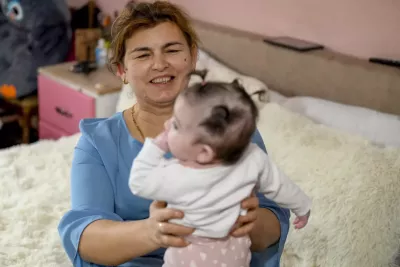
Despite some reductions in child institutionalization in the Europe and Central Asia region in recent years, nearly half a million children in the region still live in residential care, including in large-scale institutions.

The share of children living in residential care in the region is around 200 for every 100,000 children, compared to a global average of around 100 per 100,000.

Many are children with disabilities, who are up to 30 times more likely to be in residential care than children without disabilities.
Every child has the right to grow up in a family. Yet children across the Europe and Central Asia region are being institutionalized at twice the global average rate. Nearly half a million children are living in residential care facilities, despite the well-known and devastating impact. The younger the child when they are removed from their family – and the longer they spend in institutional care – the greater the damage.
Children who grow up in institutions are denied the social, emotional and intellectual stimulation that is vital for their healthy development. Often isolated from mainstream society, they are highly vulnerable to violence, neglect and abuse. And the impact can last a lifetime: those who spend their childhoods in institutions are more likely to be excluded from society as adults, to struggle with substance abuse, and to experience violence and imprisonment.
The most marginalized children across the region are also the most likely to be institutionalized. They include children with disabilities, who are up to 30 times more likely to live in residential care facilities than children without disabilities. Children from the poorest families, children affected by migration and children from ethnic minorities, including Roma children, are also more likely to be institutionalized, as well as older adolescents with complex needs.
What drives family separation and child institutionalization in the region?
- Social norms that still see the institutionalization of children as a valid option for families that are struggling – and particularly for children with disabilities.
- Discrimination against minority groups such as Roma children, children with disabilities, children affected by migration, and those living in poverty.
- A lack of support to help families stay together, such as local social workers, child benefits, decent housing, and access to education and health care.
- A lack of support for parents during a child’s earliest months of life.
An increase in other forms of care – such as foster care and guardianship – is welcome, but it shows that too many children are still being taken from their families. A lack of effective child protection services – including trained social workers – means that family separation remains the ‘default’ option in parts of the region, rather than the last resort.
Key policies
1989 Convention on the Rights of the Child
- Article 7: All children have the right to know and be cared for by their parents.
- Article 8: Children have the right to preserve their identities, including family relations.
- Article 9: Children cannot be separated from their parents against their will, unless this is in their best interests
2010 UN Guidelines for the Alternative Care of Children (64/142)
- General principles: The family is the fundamental group of society and the natural environment for the growth, well-being and protection of children. The goal should be to enable children to stay with their parents or, where appropriate, other relatives.
2015 Sustainable Development Goals
- Target 16.2: End abuse, exploitation, trafficking and all forms of violence against and torture of children.
What is UNICEF doing?
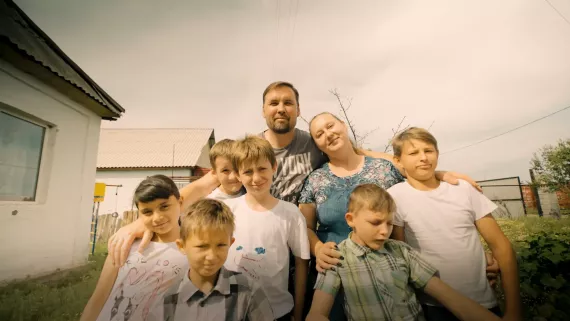
UNICEF is working with governments to end child institutionalization across the region by 2030. We are the region’s leading international organization on this issue, with decades of experience and a track record of support for effective reforms. Our position has always been clear: no child should grow up in a large-scale institution because there is no other family or community-based alternative for them. We have worked to prevent the institutionalization of children in the region since the early 1990s, recognizing that shutting a child away from society is never in their best interests. And over the last two decades, UNICEF has worked with governments to reduce the share of children in institutional care from 666 for every 100,000 children to 200 per 100,000.
We promote strong, child-focused services that help families stay together where possible. And we push for childcare reforms that shift much-needed resources from large-scale institutional care to family and community-based alternatives, based on a sharp focus on the most vulnerable and hard-to-reach children. We know that the replacement of institutional care by more humane approaches paves the way for a transformation of government social services that benefits all children and families.
In everything we do, we aim to give children and young people – particularly those who have experienced institutional care – a voice in the decisions that affect them and a chance to share their perspectives.
In Moldova, we have supported the successful closure of every residential school for children with disabilities. Their closure proves that – when political will is backed by action – such schools can be replaced by mainstream education, family support services and family-based alternative care.
We are working with governments, local organizations and families on five priority areas.
- The development of family support services to prevent unnecessary family separations and keep children out of the care system.
- The development of alternative care that is family-based or as family-like as possible, including support for fostering.
- Improving protection for children who are already in care.
- The design and implementation of effective childcare reforms to close institutions and scale-up social welfare and family-based care services to reach vulnerable children and families. This includes increasing the number of qualified social workers and training foster parents.
- Advocacy for deinstitutionalization and child care reform, raising the awareness of policy-makers and the public on the urgent need to prioritize family-based care.