

Early childhood education and care
Building bright futures through early childhood education and care for every child

Early childhood education and care in Europe and Central Asia
Our goal: To unlock the potential of every child in Europe and Central Asia – from their first years of life to their first day of school – by ensuring inclusive, high-quality early learning and care (ECEC) across the region.
Data from the region
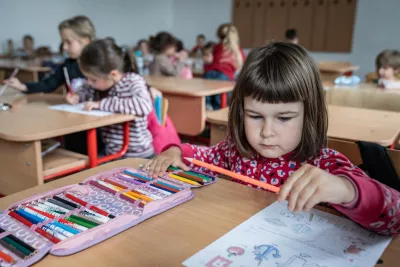
10 million children under the age of 6 in the Europe and Central Asia region do not have access to early childhood education and care (ECEC).

Children from poorer families and from ethnic minorities are 50 per cent less likely to attend ECEC programmes, and children with disabilities are 25 per cent less likely to attend.
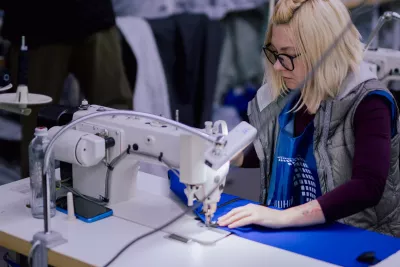
In the absence of universal ECEC services, women are still under-represented in the labour market across the region.
The governance of ECEC is spread across different ministries, resulting in a lack of service coherence and quality.
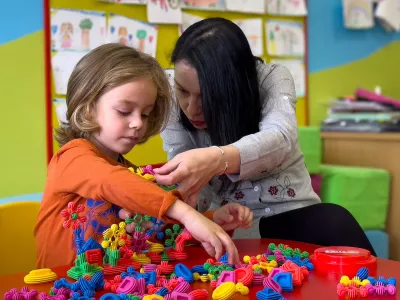
Public and private investments in ECEC are underprioritized, and funding is fragmented, limited and often inefficient.
High-quality early childhood education and care (ECEC) is a powerful catalyst for positive change that benefits children, families, economies, and societies alike. Good quality ECEC sparks curiosity, builds confidence, and lays the foundation for lifelong learning. It nurtures young minds, supports emotional growth, and helps every child thrive. It also boosts women’s participation in the labour market, promotes social cohesion, and closes equity gaps.
Yet across the Europe and Central Asia region, 10 million children under the age of six still lack access to this vital opportunity – a gap that not only hinders their development but also reinforces inequalities. Women continue to carry the burden of unpaid childcare, which limits their participation in the workforce, stifles their economic potential and perpetuates gender disparities.
Despite growing recognition of its importance, ECEC remains underfunded and fragmented across the region. Key challenges include shortages of ECEC service providers and a lack of professionalization in the system and inadequate infrastructure to deliver quality services. There is also a lack of capacity for the effective expansion of ECEC based on high-quality, inclusive systems that cater for all children, including those with disabilities. Governments often lack the tools and support needed to develop evidence-based plans, enforce quality standards, and identify the most impactful interventions.
To meet the Barcelona Targets – benchmarks for ECEC access and quality – there must be more investment in innovative partnerships to close the ECEC financing gaps. Without urgent and coordinated investment, millions of children will continue to miss out on the early support they need to thrive. And societies will miss the long-term returns delivered by high-quality ECEC.
Key policies

1989 Convention on the Rights of the Child
- Article 18: Support for parents in child-rearing, including child-care services
- Article 23: Effective access for children with disabilities to education and care services that promote their full development and dignity
- Article 28: The right of every child to education, including early childhood education, as well as equal access
- Article 31: The child’s right to rest, leisure, play, and participation in cultural life.
2015 Sustainable Development Goals: SDG 4 on quality education
- Target 4.2: By 2030, all children have access to quality early childhood development, care, and pre-primary education, so they are ready for primary education.
2002 Barcelona Targets
- These European Union benchmarks aim to improve access to ECEC, supporting child development and promoting gender equality by enabling greater female participation in the labour market.
- The targets are:
- At least 45 per cent of children under the age of 3 participate in ECEC
- At least 96 per cent of children between the age of 3 and the starting age for compulsory primary education participate in ECEC.
UNICEF aims to strengthen ECEC and build a solid foundation for a young child’s lifelong learning. We work with governments, for example to create an environment that fosters quality, inclusive ECEC, aiming to expand access and ensure that every child acquires the foundational skills they need. We support greater coordination across sectors, aiming to harmonize fragmented mandates, ensure coherent planning and monitoring, and support the development of clear policies to make ECEC services more accessible, inclusive, affordable, and responsive to the needs of families.
In Serbia, for example, working with Serbia’s Ministry of Education and the Institute for Improvement of Education to roll-out the ‘Years of Ascent’ preschool curriculum, which prioritizes relationships and learning through play. As well as providing support for legislative reforms, UNICEF has supported training, mentoring and peer learning on the curriculum for the country’s 23,000 preschool professionals, as well as community engagement.
We strengthen planning and financing to reach every child aged 0 to 6, working with governments to integrate ECEC into national education plans and budgets, and advocating for ECEC resources.
We promote child-centred learning that is based on play and that nurtures creativity, emotional development, and 21st-century skills, including green skills. We provide technical support to embed digital tools and inclusive approaches in teaching practices, to ensure that all children enjoy stimulating early learning.
We aim to build a skilled and motivated ECEC workforce, supporting government efforts to strengthen professional development, improve working conditions, and tackle staff shortages. We help to design programmes that equip educators with the skills they need to support the inclusion of children with developmental delays and disabilities.
We work to strengthen inclusion so that every child benefits from high-quality ECEC. We work with governments to develop inclusive ECEC services that integrate support from health, education, and social sectors so that all children can learn, play and interact, fostering a culture of inclusion for all.
We enhance data for accountability, working with national and local authorities to ensure robust quality assurance, shared visions and decision-making that is informed by compelling evidence.
Finally, we foster strong links between families, communities and services, helping governments to design flexible services that meet the diverse needs of families, including home- and community-based options. This helps to create a smooth pathway for every child from home to school and lifelong learning.