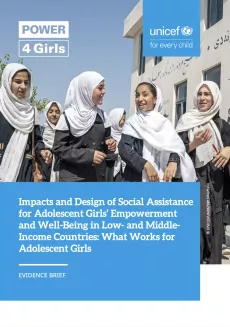
Impacts and Design of Social Assistance for Adolescent Girls’ Empowerment and Well-Being in Low- and Middle-Income Countries
What works for adolescent girls

About
This evidence brief explores how non-contributory social assistance programmes, such as cash transfers, can be intentionally designed to improve outcomes for adolescent girls in low- and middle-income countries. Drawing on global evidence, it examines how such programmes impact girls’ health, education, protection and empowerment and outlines the features that make these programmes more effective and gender-responsive.
Adolescence is a critical window of opportunity to disrupt cycles of poverty and gender inequality. Yet girls often face intersecting risks, including child marriage, school dropout, unpaid care work and social exclusion, that can be intensified by poverty and discriminatory norms. With greater attention to girls’ needs, social assistance can serve as a powerful tool to strengthen their capabilities, increase agency and support their transitions to adulthood.
The brief also highlights promising programme examples, identifies knowledge gaps and offers practical recommendations for designing and implementing social assistance that empowers adolescent girls and leaves no one behind.