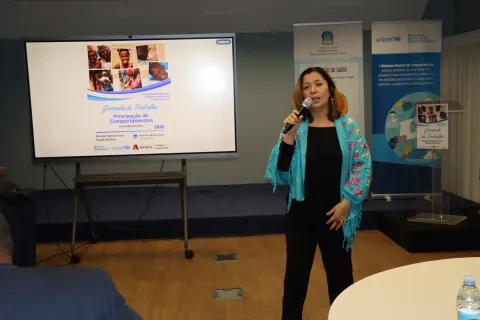
Unity by faith in the fight against cholera.
Through an alliance, members of different religions reinforce their commitment to health in their communities.

- Portuguese
- English
The cholera outbreak continues to pose a huge risk to communities and families in Angola. Many lives are being lost and the outbreak is expanding rapidly, which has already affected 17 of the country's 21 provinces. Since the confirmation of the first case, to date, Angola has already registered more than 13 thousand cases, with the provinces of Luanda, Bengo, Icolo and Bengo, Cuanza Norte and Benguela being the most affected.
In Angola, religious institutions are key actors in health promotion. Their commitment to their communities fosters their leadership in changing attitudes and adopting positive practices, such as cholera prevention measures and prompt treatment of those with symptoms.
In this context, the Luanda Provincial Health Office - GPSL, with the support of the Social and Behavior Change unit of UNICEF Angola, has been promoting the engagement of different religious institutions so that they have access to information that can save lives, better understand their role and know in practice what measures can help fight cholera.
Celestino Abel Gimbu, Pastor of the Baptist Convention Church of Angola, welcomes the Alliance's initiative, which is already increasing his knowledge about cholera prevention and sharing it with his community.
"It was with great pleasure that we received the invitation to this initiative. I am satisfied with the information I have received about the prevention and treatment of cholera," said the religious leader.

Eager to bring about change in their communities, the Alliance of Religious Institutions has taken concrete action, making a commitment to support their communities in the fight against cholera.
"We are instructing our community to be more attentive and to follow the instructions of the Ministry of Health," added the religious leader.
During the meeting, topics on cholera prevention measures were addressed. The participants also obtained information on how to identify the symptoms of cholera, the importance of seeking care at the health unit and how to prepare oral hydration serum.
Mário Bravo, Secretary-General of the Islamic Community in Angola, highlighted the importance of the meeting as it is another opportunity to strengthen knowledge about measures to combat cholera.
"We have been passing messages to our faithful about the problem of cholera. We are here for our knowledge to be more refreshed and to better serve our community here in Angola".
Church representatives describe UNICEF's support as a force that should expand to other provinces.

Fátima Nguisi, representative of the church on the 7th day of the Ramiros, praises the initiative "because the church was isolated. Now, with the collaboration of the Provincial Health Office and the support of UNICEF, we no longer feel alone. We will all support for the good of our population".
"Church engagement is one of several strategies in UNICEF's Social and Behavior Change area to co-create solutions with communities that respond to their priorities." Highlighted Ines Filipe White, UNICEF's Social and Behavior Change program officer.
In addition to supporting the mobilization of communities, religious leaders have also supported the monitoring of the quality of water consumed, through a pilot project for water chlorination.
The first step in this partnership was taken in 2024, following the mission of the UNICEF Advisor for the Southern Region on Social and Behaviour Change, Siddartha Shresta. The idea gained strength after a meeting with representatives of religious institutions held in the municipality of Kilamba Kiaxi in Luanda, to discuss the strength of faith-based communities in promoting routine vaccination.