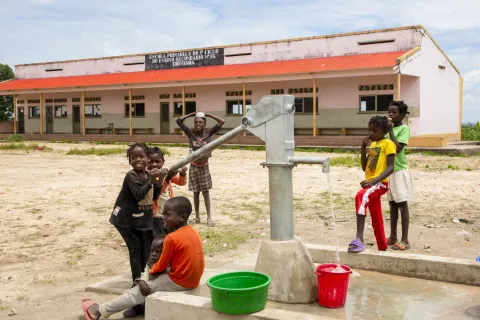
Simplified Sanitation Project promotes community participation.
Residents of the Mulenvos neighbourhood in Viana are taking part in community dialogues to discuss improvements to sanitation in the community.

- Portuguese
- English
Luanda 13 May - Residents of the Mulenvos de Cima neighborhood, in the Estalagem Urban District in Viana, are actively participating in community dialogues to discuss improvements in local sanitation as part of the pilot project on ‘Improving Sanitation, Water, Hygiene and Waste Management Services’.
This project, which includes constructing the simplified sanitary sewer system, seeks to drive significant change in the community, with community engagement at the center of the project's movement and concept.
Weekly community dialogue sessions are held where residents are sensitized and empowered to actively contribute to decisions that could affect the implementation of the project. In this way, greater confidence, willingness, and understanding of the problems that affect them are promoted.
This community involvement is helping to build a sense of collective responsibility, allowing residents to be active agents of change in their own community.
Maria Serafim, who has lived in the neighborhood for 18 years, is one of the more than 60 participants and expresses that the lack of sanitation is the biggest challenge facing the community. ‘The sanitation conditions here are terrible, every day we have to deal with flies, and rubbish, and the most distressing thing is seeing the children being subjected to this,’ explained Maria, also emphasizing the urgency of changes in sanitation to guarantee a safe environment for her community.
For Maria, Simplified Sanitation is not just an infrastructure, but a symbol of dignity, health, and a cleaner, more prosperous future.
‘The project brings hope to Mulenvos and with hard work and collaboration it will be possible to transform the community for the better’

The streets of the Mulenvos neighborhood will be able to witness tangible change as teams of workers move tirelessly to implement this system that aims to promote integrated solid waste management practices. This initiative not only aims to improve residents' quality of life, but also has the potential to reduce the infant mortality rate, strengthen urban infrastructure, include recycling thinking, and promote a more sustainable economy.
‘It's encouraging to see the local authorities working side by side with us, I feel that together we can overcome the challenges and it's been great to be able to help my community solve the sanitation problem,’ said resident Emiliano Alberto, another member of his community's dialogue.

About the Simplified Sanitation project
The project, ‘Improving Sanitation, Water, Hygiene and Waste Management Services’ through Simplified Sanitation Systems and Integrated Solid Waste Management with Local Entrepreneurship, is based on Collective Social Behaviour Change.
The initiative combines innovative construction technologies with community and local authority involvement in the implementation of simplified sanitation systems, waste management, environmental education, and the promotion of other actions to improve public health in the community.
This initiative represents a response to the poor sanitation and inadequate hygiene practices that plague many communities and have been a significant source of infectious diseases, which contribute to the high infant mortality rate. In this system, community participation is extremely important for solving local problems that involve not only aspects of sanitary sewage, but also the quality of the water used by the area's inhabitants. The pillars of the project are a simplified sewage collection system, solid waste management and handling, environmental education, community involvement, and public health.
The project is part of the National Sanitation Strategy and is being implemented jointly by the Government of Angola (through the Ministry of the Environment - MINAMB) and the United Nations Children's Fund (UNICEF), with technical support from Brazilian institutions: the Secretariat of Cities of the Government of the State of Ceará (SCicades-CE); the Water and Sewage Company of the State of Ceará (CAGECE); and the National Health Foundation (FUNASA). The initiative is funded by the India, Brazil and South Africa Fund (IBSA Fund), which is managed by the United Nations Office for South-South Co-operation (UNOSSC).