Quality Education Starts with Reliable Data.
GEPE Empowers Technicians to Improve Data Collection, Analysis and Use.

- Portuguese
- English
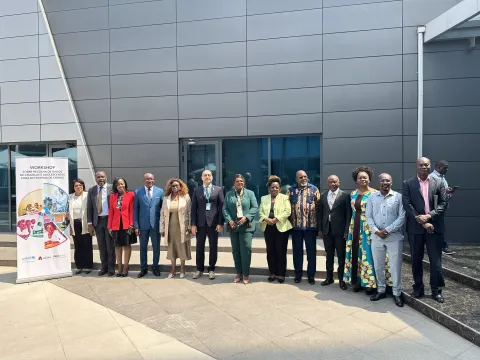
Training in educational statistics, organized by the International Institute for Educational Planning (IIEP) and funded by UNICEF, is playing an essential role in strengthening the capacities of Angolan technicians to improve data collection and decision-making in the education sector. Since its inception on July 8, this program has provided essential tools to professionals in several provinces, contributing to creating more effective educational policies.
The Training Programme in Information Systems and Statistics for Educational Planning, developed by IIEP, UNESCO and funded by UNICEF, is in its third edition and aims to train Angolan technicians in the collection, analysis and use of statistical data, which are fundamental for the construction of educational policies.
Madalena Nunda, one of the 41 professionals participating in this training, Planning and Statistics technician at the Provincial Office of Education in Huambo. With a degree in Psychology and a postgraduate degree in Educational Management and Administration, she is responsible for supervising the production of statistical information in her province.
With a long experience in the sector, his participation in training has brought new approaches to his work.
"My role involves coordinating, assigning and executing tasks, planning, monitoring and supervising the production of statistical data at the provincial level. The training has been essential for the improvement of the techniques and procedures for processing this data."

One motivation for participating in the training is the "exacerbated thirst" to seek more knowledge and ensure the quality of the data that guides educational policies in the province.
She describes the training as "fruitful and enriching", highlighting the modules that deal with the collection and analysis of statistical data as the most useful for her work. "This training will undoubtedly improve the way we deal with educational statistics, allowing us to work with more reliable and quality information," he added.
The impact of training goes beyond individual work, extending to the formulation of more efficient public policies, both at the provincial and national levels.
"Training has been positively influencing the creation of more effective educational policies. With access to reliable and timely indicators, we can make more informed decisions," concluded Madalena.
For its part, UNICEF recognizes the impact of training in building a better education system. Vatileny Santana, Data and Knowledge Manager in UNICEF's Education section, explains that this initiative is in line with UNICEF's commitment to assist the Angolan government in improving the production of school policies based on accurate data. "
By joining this training program that aims to help the government improve data collection at school level, we realize that we are meeting one of our main indicators, which is the improvement of data collection, which is essential for the formulation of more effective educational policies," he said.
In addition, Vatileny stresses the need to standardize data collection in primary schools, to improve the timely availability of statistical education yearbooks.
"While in some countries yearbooks are published annually, in Angola this can take up to three years. When technicians learn to collect and send information in a timely manner, the Central Planning and Statistics Office will have access to clear and standardized data for all of Angola, facilitating the construction of the statistical yearbook more quickly," he concluded.

The Training Program in Information Systems and Statistics for Educational Planning represents an essential step towards strengthening education in Angola. By training professionals from the Office of Studies, Planning, and Statistics (GEPE) in data collection and analysis, the program not only contributes to the improvement of public policies, but also promotes more efficient and informed educational management.
With the implementation of this program, it is expected that decisions made at the national level will be increasingly based on accurate and up-to-date data, ensuring quality education for all Angolans.