More than 8,000 children benefit from Learning at the Right Age in Cazenga.
A delegation from The Church of Jesus Christ of Latter-day Saints followed the advances of an approach that puts each child at the center of the learning process.

- Portuguese
- English
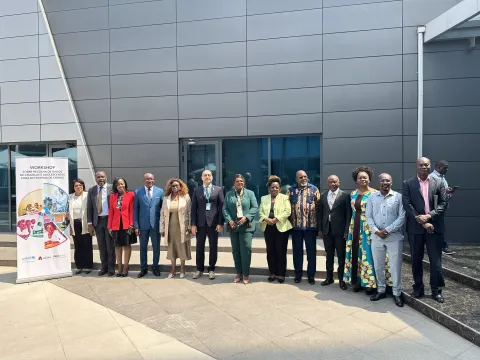
Cazenga, Luanda, April 22 - A team from The Church of Jesus Christ of Latter-day Saints visited the municipality of Cazenga to monitor the implementation of the Learning at the Right Age (AIC) approach, an initiative developed by the Ministry of Education with the support of UNICEF and partners, which aims to strengthen children's fundamental skills of reading, comprehension and mathematical calculation.
The visit was attended by education officials at the municipal, provincial and national levels, who had the opportunity to directly observe learning sessions in the schools covered by the program and interact with teachers, school managers and beneficiary students.
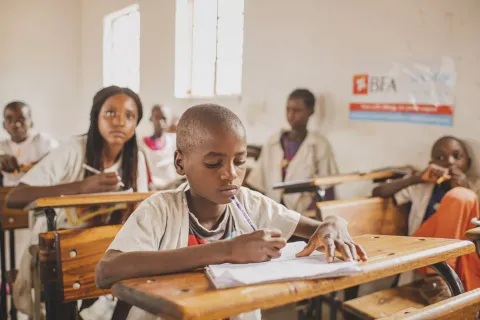
Currently, more than 8,000 children benefit from the AIC approach in the municipality of Cazenga. The program seeks to ensure that all children acquire basic reading, writing and numeracy skills at the appropriate age, creating solid foundations for their educational path.

Learning at the Right Level is inspired by the international Teaching at the Right Level (TaRL) methodology and adapts teaching to each child's actual level of learning. Instead of grouping students only by the class they attend, the approach promotes activities that respond to the specific needs of students, allowing for a faster recovery of fundamental learning.
According to the formative evaluation of the implementation of the pilot program in Angola, the methodology has contributed to improving literacy and numeracy skills, through participatory and child-centered teaching strategies. During the AIC sessions, students are grouped according to their level of learning in Portuguese language and mathematics, allowing for closer and more effective monitoring by teachers.
The approach also stands out for the playful nature of the activities developed in the classroom. Educational games, visual materials and interactive exercises help to make the learning process more attractive and inclusive, increasing student participation and strengthening their confidence. Implementation experiences in Angola show that children learn more actively and motivated, while teachers have more appropriate tools to respond to different learning needs.

The delegation's visit also included meetings with the National Director of Pre-School Education and Primary Education and with the UNICEF Angola team. The meetings allowed for a deeper dialogue of the results achieved by the AIC, as well as to discuss opportunities to expand and strengthen the initiative, helping more children to develop the essential skills for school success and lifelong learning.

Implemented in Angola with the support of UNICEF and technical partner TaRL Africa, the AIC integrated, in its pilot phase, dozens of schools and thousands of students, demonstrating potential to accelerate the recovery of learning and respond to the educational challenges faced by the most vulnerable children.
Witnessing the results achieved in Cazenga, the delegation reaffirmed its interest in supporting initiatives that promote inclusive and quality education, contributing to all children having the opportunity to learn, grow and thrive.