
Cholera: There is hope in Treatment Centres.
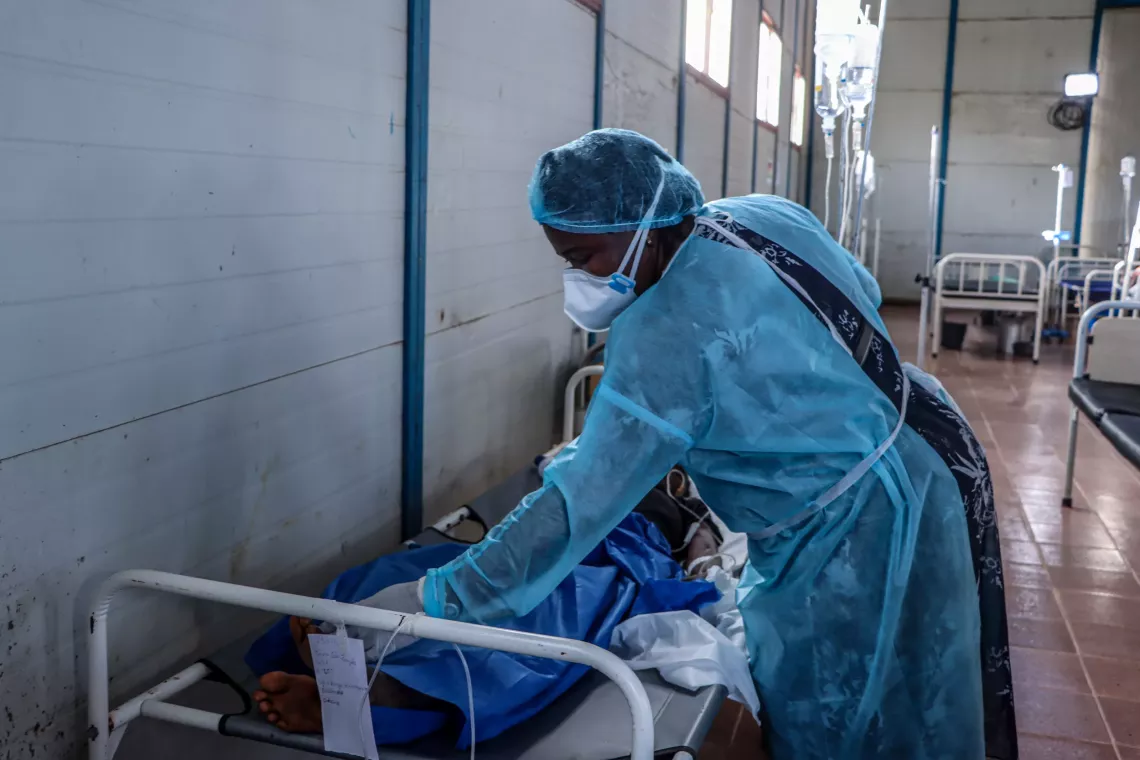
Thanks to the care in the cholera treatment centers and the commitment and dedication of several health professionals, many lives have been saved.

- Portuguese
- English
On April 18, 13-year-old Avelino Jongo began to show symptoms such as vomiting, diarrhea and slight malaise. Madalena, the little one's mother, was out of the house and the little one had to be rescued by neighbors who took him to the neighborhood Health Center and later referred to the Cholera Treatment Center.
"Suddenly the diarrhea started. As I was not at home, the neighbors made the effort and brought him downtown. We slept there and early in the morning the ambulance brought us here." Madalena says that she only realized that her son had caught cholera when she arrived at the Cholera Treatment Center.

In a raft adapted for this purpose, one of the Cholera Treatment Center (CTC) of Sambizanga operates, a place where several cholera patients from the municipality and surroundings are referred. On the day Avelino was admitted, 3 other children were hospitalized, some in serious condition.
Cholera is a serious disease that can lead to death in a short time, but it can be treated if the patient arrives early at medical services. Since the beginning of the outbreak in January, more than 20 thousand cases have been reported. Children and adolescents continue to be strongly affected. More than 50% of the cases reported in the 18 provinces are individuals aged 0 to 19 years.
At the Sambizanga CTC, Avelino was soon seen and started with treatment. The priority was to ensure fluid replacement through oral serum. After three days of treatment, he is recovering satisfactorily and is already looking forward to returning to school to help raise awareness among his classmates and talk to them about fighting cholera.
As part of the cholera response, the Government, with the support of partners such as UNICEF and WHO, has set up several Cholera Treatment Centres as one of the most effective and life-saving measures. In these centers, health technicians are trained to respond immediately to cases that arrive, often in serious condition due to dehydration.

Maria Adelaide, health technician and head of the Sambizanga CTC, says that despite a reduction in cases, concern and care for patients remains.
"The treatment is done according to a protocol and depending on the patient's condition. The most serious ones go to plan C and less serious to plan A and B", describes Maria Adelaide, adding that "the biggest concern is patients who arrive with weakness, diarrhea, vomiting, and with a high level of dehydration."
The data indicate that the number of cases that arrive early at cholera treatment centers is more likely to be saved. In the municipality of Lucala, Cuanza Norte province, for example, João Fernando, 32 years old, resident of the Aldeia Nova neighborhood, was saved by the fact that he arrived early at the CTC.

On the night of April 25, vomiting and belly aches began. Noticing the malaise, he contacted the municipality's ambulance that attended to him and his brother who also had the same symptoms and they were quickly referred to the CTC installed in the seat of the municipality of Lucala.
"I always had doubts and had never seen the person who has these pains. It was around 1 am, after feeling the symptoms I went to the bathroom and later we called the hospital ambulance".
The team led by nurse Nazareth Lourenço, leads the group that received João Fernando, and accompanies the patients who come to the Center.
The nurse, who is already dealing with a cholera outbreak for the second time, says that "in some localities there are difficulties and sometimes resistance from families to take patients to treatment centers or a health unit and the delay in taking some measure has been fatal".
"Taking into account the challenges, when a patient recovers, it is a joy for the whole team", highlights Nazareth with satisfaction, who take advantage of the moment of discharge to give some advice on prevention measures to avoid a new contagion.
Thanks to the care in the cholera treatment centers and the commitment and dedication of several health professionals, many lives have been saved. With the commitment of all and with the right measures, it is possible to stop cholera in many communities.


