Feed the child, feed the future
Improving early childhood development in Mae Hong Son

- English
- ไทย
Early childhood – from birth to age five – is a magical time. Families delight in watching a child learn to walk, talk and play, as their brain forms one million new connections every second – a pace that is never repeated. Such incredible growth needs the right fuel: good nutrition, care, and the right combination of play and learning. Children thrive best when they have loving and attentive caregivers and also receive expert support, such as that provided in 17,000 Early Childhood Development (ECD) centres across Thailand. While learning is rightly the key focus in these centres, nutrition is also a priority, recognised as a bedrock of child development.
One such centre is Sona Pundit Camp Early Childhood Development Centre, in the Pai region of Mae Hong Son province. This is where Ms. Mayuree Khampong, a 37-year-old ECD teacher, goes to work each day determined to help children on their path towards school and adulthood.
“I’m not from the north originally—my husband was stationed at the military camp, so I moved here,” Ms. Mayuree explains. “When I arrived, I noticed that children around here lack opportunities in many areas. The centre lacked a trained teacher but fortunately I majored in ECD and began work. Child-centred development must be prioritised from the moment children enter the centre. We don’t just want children to come here to eat, play, and sleep, we want them to learn and grow.”
One challenge Ms. Mayuree and colleagues faced was a limited budget that left them unable to offer the level of good nutrition young children need. “The food we served wasn’t as good as we needed it to be and we couldn’t provide any milk.” Ms. Mayuree and her team worked closely with local authorities to secure additional funding to tackle this problem.

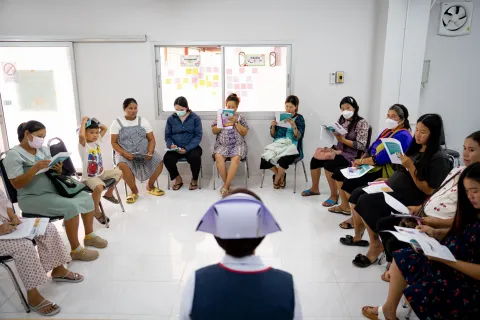
With the right food now available, the next step was to strengthen teachers’ and parents’ knowledge of healthy nutrition for young children — and this is where the partnership with UNICEF made a real difference. The centre joined a UNICEF Thailand pilot programme reaching 21 ECD centres across Mae Hong Son. Through the programme, teachers gain practical skills to enrich classroom learning and work closely with families to support children’s development. This included promoting healthy nutrition at the centre and in children’s homes by reinforcing and encouraging positive learning and nutrition habits.
“UNICEF helped us to work better with parents, such as hosting information-sharing sessions focused on issues including nutrition,” says Ms. Mayuree. Teachers were trained first and then helped parents learn more about child development, positive communication, and nutrition. Parents often seek our advice, such as if a child isn’t speaking or is underweight, and we can support them better now.”

Unfortunately, not all children benefit from such support. Thailand has made impressive progress in early childhood education services, with 75 per cent of children aged between three and four attending some form of education. However, there remains a significant gap in the availability, affordability, and quality of childcare services for children under three.
Meanwhile, nutrition remains a problem for too many children in Thailand, with over 10 per cent growing up stunted due to poor nutrition. This harms not only children’s physical growth, learning and long-term health — it also carries a real economic cost for the country. Children who are undernourished are more likely to struggle in school, earn less as adults, and face poorer health throughout their lives. In a country facing an aging population and a shrinking workforce, failing to invest in children’s nutrition today puts Thailand’s future prosperity at risk.

“ECD centres can provide invaluable support to children and parents in the early years,” says Napat Phisanbut, an Early Childhood Development specialist at UNICEF Thailand. “When children arrive at the centres at age two or three, they need the right nutrition, which means good, healthy food. This period is also when we can promote healthy eating which embeds lifelong good habits and improves children’s health and growth into adulthood. UNICEF works with the Department of Health to develop guidelines, communication materials, and training for ECD teachers and food providers to ensure that meals are more nutritious.”
UNICEF Thailand tackles child malnutrition both nationally and locally. At the national level, UNICEF advocates for stronger nutrition policies, clearer regulations, and better public communication for children and families, including large-scale awareness campaigns such as Kin Rai Dee (What’s Good to Eat) which has reached millions of families and children with information on good nutrition for all children. At the local level, UNICEF works to improve early childhood services for children through practical initiatives such as the ongoing ECD pilot programme, directly supporting children and families in communities.
Ms. Mayuree already feels better equipped to teach both children and parents. “We encourage children to eat vegetables by integrating them into lessons and doing taste testing. We also use positive reinforcement like ‘Carrots are delicious; they make your cheeks pink and you’ll be strong and healthy.’”

Parents certainly appreciate the support offered by high quality ECD centres. Ms. Nittinan Moonpradit’s young daughter attends the centre where Mayuree teaches. “The thing that impresses me most is probably the care the teachers provide for the children as well as the teaching methods” says Ms. Nittinan. “Since starting at the centre my daughter talks more and more fluently.”
Ms. Nittinan also appreciates the school’s efforts to promote healthier eating in the school and outside. “In the past, my child didn’t really want to eat vegetables at home, but the teacher said she did eat vegetables at school. The teachers make the food into different shapes to make it look cute, like a snack. The other children then enjoy eating, and my daughter is learning to follow them in eating healthier food.”
Laying out UNICEF’s future goals, Napat explains: “We are working with the Department of Local Administration to adapt the training curriculum used in Mae Hong Son into an online platform and a practical manual. This will allow other ECD centres to benefit from the programme and scale it up in their own areas, helping reach many more parents and children.”