Children’s laughter echoed through a small classroom at Mae Jo Early Childhood Development (ECD) Centre as a group of young children experimented with colorful liquids, watching in amazement as oil and water refused to mix. It was one of many joyful moments during a field trip June Kunugi, UNICEF Regional Director for East Asia and the Pacific, took in September, eager to witness how early investment, inclusive policies, and strong community action are shaping brighter futures for children in Thailand.
The nation stands at a critical juncture. As one of the first countries in Southeast Asia to face the challenge of an aging society, the need to invest in the youngest generations is urgent – but one in five young children are developmentally off track. The country is striving to move from middle-income to high-income status, but stark inequalities hold back progress, excluding the most marginalized and undermining hard-won gains.
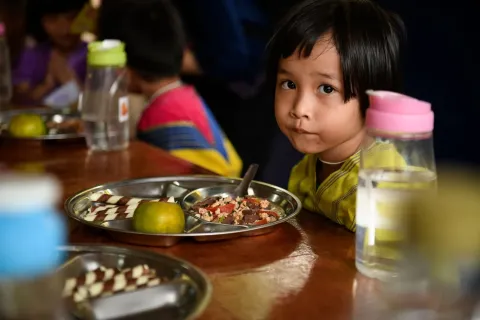
That’s why ECD centres like the one at Mae Jo are important, where parents and teachers collaborate to fill young lives with opportunities. One particularly creative initiative is a monthly school market, where children learn about money and practice life skills by buying snacks prepared by parents. “This is one of the best structured and most comprehensive ECD initiatives I have seen,” Ms. Kunugi said. “Crucially, it’s taking a whole-of-society approach.”

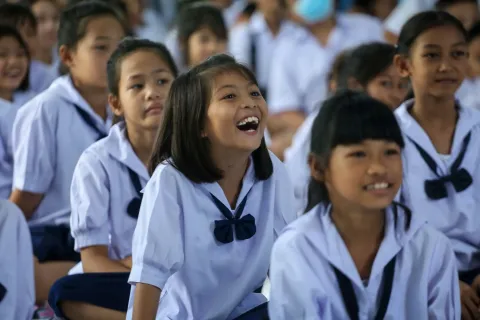
Inclusion was also the focus at Saraphee Pittayakom School, where the challenges aren’t age but identity. More than 100,000 children in northern Thailand live without birth certificates, legal status or citizenship, leaving them stateless and with limited access to education, healthcare and career opportunities.
Two bright 16-year-old students - Seng Kham* and Hseng Hom* - know this reality all too well. Despite their top grades, their legal status prevents them from representing their school beyond their district. “Our GPA is above 3.9, but we cannot compete in outside academic competitions,” said Seng Kham. “I also work to help my family but can’t even open a bank account. I’m also afraid to travel anywhere because I worry I could be arrested.”

To address such challenges, UNICEF supports mobile registration units which take social workers and community volunteers into schools and communities, assisting children and families through the complex process of applying for a legal identity. UNICEF also co-ordinates with authorities, particularly district offices.
Ms Kunugi’s next stop was the centre of Chiang Mai to visit the Provincial Office of the Ministry of Social Development and Human Security and learn about a new pilot programme reaching one of the country’s most marginalised groups – children with disabilities. The programme is particularly designed to bring more children with disabilities into the education system, where far too many are currently excluded.
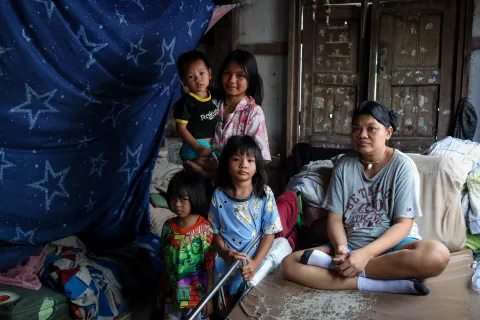
Nearby, UNICEF and the Baan Dek Foundation work with businesses to improve the lives of children living in construction site camps. An estimated 60,000 children grow up in these camps, often in cramped conditions with limited access to healthcare, education, and safe play spaces. Through the Building Social Impact Network, companies are encouraged to prioritise children’s rights, creating safe spaces to learn, play, and access education and healthcare. 28 companies have already joined the initiative, and more than 9,800 workers and children benefited.
Ms. Kunugi was particularly impressed with her visit to Baan Pa Bong Primary School in Chiang Dao district. This school has become a model of inclusion for children from ethnic minority and migrant families. A decade ago, classrooms were nearly empty. Today, the school is lively with 109 children from five different ethnic groups, many of whom have never attended school before.
Thailand’s education policy guarantees 15 years of free schooling for all children, but in practice many migrant children still face barriers, such as language challenges and widespread misunderstandings of regulations. While 71 per cent of Thai children aged 7–14 achieve basic reading proficiency, that rate drops to 43 per cent among children from non-Thai-speaking households.

At Baan Pa Bong, teachers have created multilingual games to help children connect and master Thai as a second language while respecting their mother tongues. An eight-year-old girl in a bright Dara-ang outfit shared her experience. “I never went to school before. Now I like learning Thai - it’s fun! I have friends here, and it’s much better than staying home.”
School Director Sudaporn Wittaya described the school’s long journey. “At first, the children couldn't speak Thai and ethnic groups did not mix. But with support from UNICEF and the Foundation for Applied Linguistics, children now learn both Thai alongside their ethnic languages with Thai teachers. They learn, play and communicate fluently with each other.”
“A very successful model of inclusion in education,” Ms. Kunugi observed. "Language can be a bridge, connecting people from different backgrounds and countries. This is a powerful model developed by Thailand with UNICEF support - and a wonderful example of generosity and shared humanity.”
* Not their real names