The Childhoods We Choose Start with Clean Air
Calling for a Clean Air Law that puts children first.

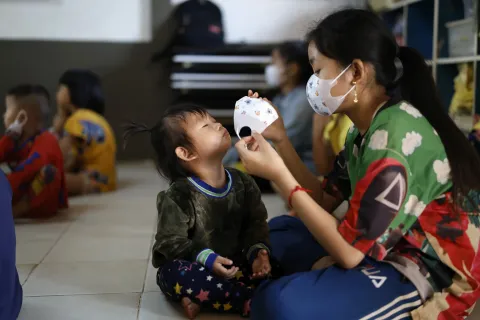
It’s mid-morning in a primary school in Chiang Mai, and children are excitedly answering their teacher’s questions when the air sensor on the classroom wall blinks from orange to red. Some children notice and groan, knowing at once what it means. Their teacher pauses the lesson to run through a familiar routine: outside break time is canceled, and all children must stay indoors to stay safe from air pollution.
This is an all-too-common scene in Thailand - and these children are the lucky ones.
Others are absent, their childhoods increasingly shaped by polluted air that affects not only their health, but their ability to learn, play and simply be children. Take Darwin, a 5-year-old who spoke out alongside his mother as part of UNICEF’s #CountMeIn climate campaign in 2025. Darwin was particularly sensitive to pollution and went through two surgeries to address his failing respiratory system. He was unable to live a normal young child’s life and spent most of his time in a specially-designed, highly filtered room.
“They operated on my throat and my ears too. I felt terrible!” Darwin told us. “I don’t want to be sick any more. When I’m sick, I can’t go to school, can’t go anywhere. I can only go to the hospital, and I don’t like it there.”
His worried mother, Siregran Sakuliampaiboon, said, “If we lived in a country with better air quality, Darwin could live like a normal child.”
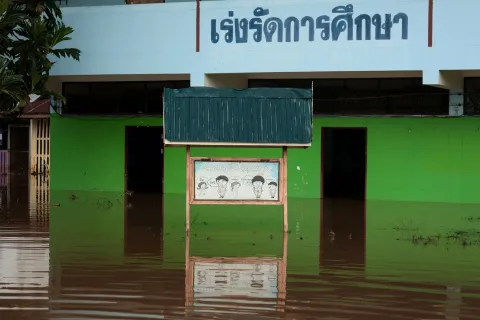
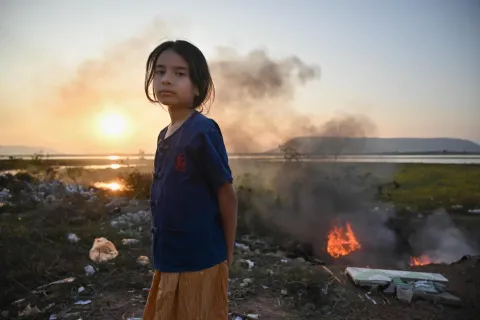
It’s hard to overstate the impact air pollution has on children’s lives. In 2023, the air monitor at Yupparaj Wittayalai School in Chiang Mai recorded 101 days above the "safe” level - more than one day in four. In just one week in January 2025, more than 350 Bangkok schools closed because of pollution. The harm caused to education is incalculable, and it is little wonder many children grow up believing haze is a season, as natural and inevitable as the weather. It is neither. Thailand’s pollution levels can and must change.
That change is needed urgently. The haze is already returning in many parts of Thailand and soon 11 million children will be highly exposed. A joint committee of MPs and senators has just agreed on a new, revised version of Thailand’s Clean Air Bill and will soon submit the draft to Parliament. It has been a journey of many years, but the law is closer to reality than ever before. We must choose a future where children are protected.
Although pollution affects almost every person in Thailand, there are many reasons children need to be Parliament’s top priority when they vote on the bill. Put simply, children are not small adults. They breathe faster, take in more air, and often run and play hard. Lungs keep growing until age 20, which means they’re being built, breath by breath, in the air we create for them. Damage done in these years can last a lifetime.
The harm can begin before a child even takes its first breath. Every ten extra micrograms of PM2.5 a pregnant woman breathes increases the risk of premature birth by about 12 percent. This can damage a child’s growth and potential or worse: in 2023, air pollution was linked to the deaths of 245 Thai newborns in their very first month of life, according to the Global State of Air report.
This is rare, of course, but harm to health is certainly not. Doctors have heard the same story repeatedly: a child stays home with what seems like a cold. The family waits for it to pass, but it lingers and - by the time the child reaches the hospital – has developed into asthma. These children aren't unlucky. They are unprotected.
Air pollution also carries a high economic cost, through healthcare expenses, missed work, and lost productivity. A study led by Kasetsart University and the Thailand Clean Air Network found that in 2023, PM2.5 pollution cost Thai households as much as 2.06 trillion baht in economic damage, equivalent to 11.49 percent of GDP.
For a country facing a demographic crisis where its future depends on the health and potential of a smaller generation of children, the need for clean air is more urgent than ever. In addition, Thailand’s ambition to join the Organization for Economic Co-operation and Development (OECD) requires that it first demonstrate its adherence to core OECD environmental standards. These include the Recommendation of the Council on the Control of Air Pollution from Fossil Fuel Combustion.
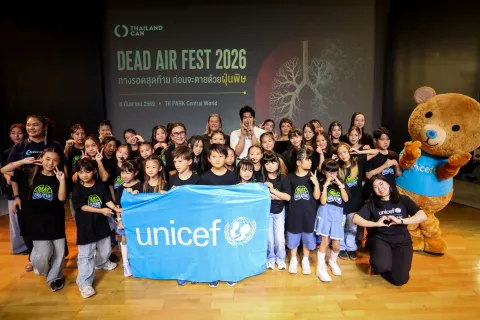
UNICEF is working with partners including the Royal Thai Government to address the crisis. Together with the Ministry of Education, 6,000 schools have begun adopting climate-smart education policies which aim to address climate challenges, including air pollution. Joining forces with the Thailand Clean Air Network, UNICEF’s online campaign - #CountMeIn – is now carrying children's right to clean air into millions of homes, schools and social feeds.
But a Clean Air law remains the most important step forward possible. Thailand has already shown progress. The House of Representatives endorsed the Clean Air Bill unanimously, a rare moment when MPs from every party agreed on something that matters to every family. Schools and communities have already taken steps to provide protection to children and deserve recognition.
The best news? Clean air laws and policies work - and they work faster than most people expect. After China declared a “war on pollution” in 2014, its fine-particle pollution fell by about 41 percent between 2014 and 2023. The University of Chicago’s Air Quality Life Index estimates the average person in China will live 1.8 years longer as a result, and tens of millions of children are already benefiting.
That's why, on this World Children's Day, we urge Parliament to pass a strong clean air law that puts children first. A law with targets and timelines. A law with clear responsibilities and accountability for the reduction of pollution. A law that puts protecting children first.
Our dream is that fifteen years from now, two children from that classroom we opened with will meet again. They’ll reminisce about happy school days but also the weeks of haze when they couldn’t even go outside. They’ll look across at their own children – chasing each other round a park under clear blue skies – and feel proud that they were part of the generation that took action. “They’ll never know what that pollution was like,” one might say. “Isn’t it wonderful?
That is the childhood every child in Thailand deserves. It is within our reach, if we choose it.