Securing safe water to children in a changing world
UNICEF builds climate change resilient solutions to ensure regular water services to children around the world.
The consequences of climate change are already affecting children all over the world. Climate change causes extreme weather events such as severe droughts and floods, and threatens people’s access to water and sanitation as water sources become more polluted and scarcer.
UNICEF operates globally to make sure that children and their families have access to clean water even in the face of climate change. Often in partnerships with governments, civil society organizations and communities, UNICEF builds climate-resilient water services that can withstand the effects of climate change and ensure that children’s needs are met.
Water just a step away


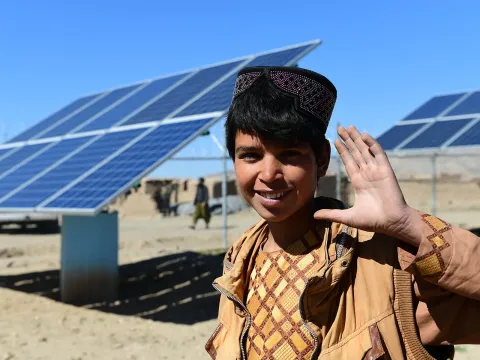
A solar-powered water supply system built by UNICEF has ensured that 2,500 people living in Khormaloq village in Afghanistan’s Farah Province now have clear water on their doorstep. In total, UNICEF has constructed 34 climate-resilient water supply systems in Faryab, Helmand and Farah, providing more than 69,000 people with access to safe drinking water.
Before, people in the village had to rely on a stream located nearly a kilometre away from their homes to meet their daily water needs. “I have a large family, and we need a lot of water. My daughters and I used to fetch water three to four times a day, and it still was not enough,” recalls 48-year-old Amina.
“The water was neither clean nor safe, but we had no other choice,” recalls Amina’s neighbour, 60-year-old Fatima. “Now we have water just a step away from our kitchen and bathroom, available 24 hours a day, and seven days a week,” she adds.
Read more on Safe water on their doorstep
More time to play


“I used to wake up, have my breakfast and walk to the river to fetch water. When the buckets were empty, my brothers and I had to go to fetch water again. It was tiring”, recalls Luis Carlos, a 13-year-old boy who lives in the Sᾶo Francisco Macuxi indigenous community in Roraima state, Brazil.
The water he fetched from the river was not treated, and in the rainy season collecting it becomes dangerous due to strong currents. The increasingly long periods of drought also raised concerns about the river’s future capacity to meet the villagers’ needs.
“When I learnt that clean water would come to us, I was very happy because I would have more time to play or do things I like."
UNICEF, in collaboration with the local community and support from local authorities, built a water supply system to ensure clean water for Sᾶo Francisco’s people. The system uses water from a well identified by the community, and that has been active even during the hardest droughts.
Sᾶo Francisco is one of the 35 located communities in the Indigenous Reserve Sᾶo Marcos where UNICEF has been working to ensure safe water to children and their families.
Read more Com a chegada da água, tenho mais tempo para brincar (in Portuguese)
Water services’ transformative power

"We used to walk 50–60 kilometres without finding water. Our children missed school, and our livestock suffered and died. The river water we collected caused many diseases and problems," recalls Mary Lokwalop, a mother of five. Mary lives in Kalopiria, a village in Turkana, which is one of Kenya’s driest and most water-insecure regions and that has been severely affected by recurring droughts.
The construction of the Kalopiria Water Supply System – a solar-powered borehole paired with a 1,300-meter pipeline – has transformed Mary and her community’s lives. Built by UNICEF, the system provides safe drinking water at the local school, which is a 20-minute walk from Mary’s home.
The water is clean, there is enough for our families and livestock, and hygiene has greatly improved."
The system is part of a larger project, which has included the drilling of over 70 boreholes and provided safe drinking water to more than 170,000 people to date. A second phase of the project is expanding access to safe water, and sanitation and hygiene services across Turkana Central, Loima, Kibish, and Turkana North.
Read more on From Drought to Hope: Advancing Water, Sanitation and Hygiene in Turkana County
Enhanced safety with easier water access


“I go quickly and return, and the water is clean. I feel very happy.”
In Nashwa’s home, as in many others around Sudan, the responsibility of collecting water falls on girls. Before UNICEF built a safe water facility near her home, she walked up to three hours daily in search of water. Sometimes she had to go even further when the nearby water well dried up.
What once took three exhausting hours takes now only 5 minutes thanks to the water facility. “The distance became shorter, and it saves me so much effort,” she says with a smile.
The facility provides sufficient water for 6,400 people from 900 households in Alsofara village, West Galabat, Gedaref state, where Nashwa lives with her family. The nearby water access also significantly reduces the risks of harassment and sexual violence that many girls and women face while searching for water.
Read more on From burden to blessing
Rainwater harvesting ensuring health and education


With UNICEF’s support, 55 schools across Dien Bien – one of Viet Nam’s most water vulnerable provinces – are using a rainwater-harvesting and treatment system to provide clean water to children, teachers and staff. The climate-smart technology treats rainwater, making it safe for daily use, which means children can stay healthy and keep learning.
Health worker Lò Thị Cương has two children attending Bình Minh Primary School, one of the schools that have received the system. She feels relieved.
"Having enough clean water at school means better health for my children."
In Viet Nam, UNICEF employs rainwater harvesting as part of a broader approach to promote climate-resilient and low-emission water, sanitation and hygiene services for underserved populations affected by climate change consequences, such as aggravated drought and salt intrusion.
Read more on Climate Resilience