Remarks by UNICEF Executive Director Catherine Russell at the High-Level Workshop on Sovereign Debt and Capital Flows in Developing Countries in Crises: One Year After the Jubilee Report
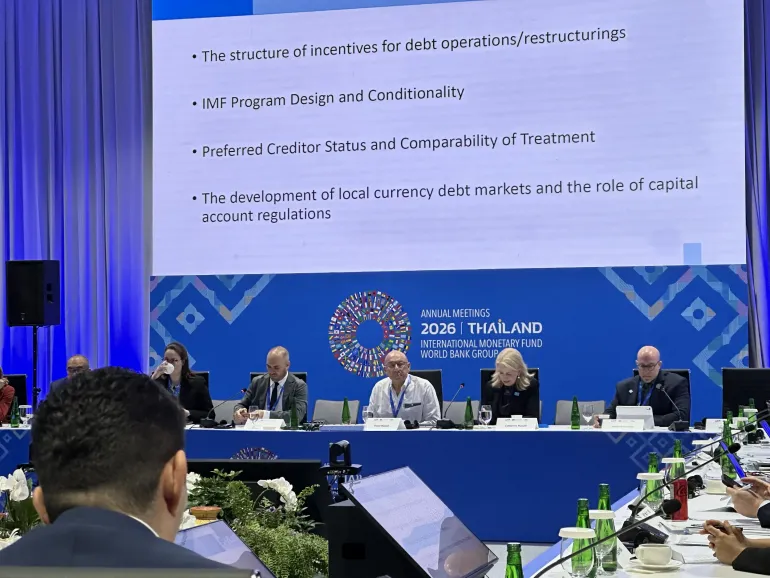
NEW YORK, 15 October 2026 – “Martin, thank you for your leadership and for your work with UNICEF on the forthcoming Children and the Global Debt Crisis book. I also want to thank the Initiative for Policy Dialogue, the Boston University Global Development Policy Centre, and the Financing for Development Lab for organizing this important discussion.
“I am pleased to join this distinguished group of policymakers and academics, whose discussions and decisions can help shape the futures of hundreds of millions of children around the world.
“Debt is not just a matter for national treasuries and financial markets. The decisions made about borrowing, spending, and debt relief have profound consequences for children and for the opportunities available to them.
“Borrowing can be a vital tool for development. But when debt becomes unsustainable, children often pay the highest price.
“The scale of the problem is alarming.
“In 34 countries, home to 1.1 billion children, governments spend more on interest payments than on health. Across low- and lower-middle-income countries, 665 million children live in countries where interest payments exceed combined spending on health, education, and social protection.
“The consequences of this imbalance can be irreversible; millions of children missing out on adequate nutrition, healthcare, and learning.
"Underinvestment in children also undermines future productivity, economic growth, and public revenues. In other words, failing to invest in children today weakens the very foundations of debt sustainability tomorrow.
“This is why I have made it a priority for UNICEF to play a more active role in the global debate on debt in developing countries.
“Our forthcoming book, Children and the Global Debt Crisis, draws on new analysis and in-depth country studies to highlight three critical challenges.
“First, debt pressures are undermining essential services, often in ways that headline budget figures fail to capture. Salaries may be protected while medicines, school supplies, and maintenance are cut. Safeguards for social spending do not always translate into services reaching children.
“Second, responses to debt crises can compound the damage. Fiscal adjustment can further squeeze essential investments, while prolonged debt restructuring can leave children waiting years for relief.
“Third, the international debt architecture is not delivering at the speed or scale required. The Common Framework has helped bring creditors together, but negotiations remain slow, creditor participation remains difficult, and questions persist about whether the relief provided is sufficient.
“Underlying these challenges is a fundamental problem: debt sustainability assessments do not adequately account for the long-term economic consequences of failing to invest in children. The IMF and World Bank’s recent agreement to introduce a long-term module is a welcome first step towards addressing this gap.
“Forty years ago, UNICEF helped shift the global debate through Adjustment with a Human Face.
“At a time when austerity measures dominated, UNICEF made a simple but powerful argument; we must not sacrifice human outcomes in the short term to achieve them in the long term. That argument mattered then – and it matters just as much now.
“Today, our forthcoming book makes the case for a renewed approach that places children at the center of debt and economic policymaking.
“This means building on recent progress in debt sustainability analyses, to account for both children's essential needs and the long-term economic returns of investing in them.
“It means making debt restructuring faster and more effective.
“It means strengthening social spending safeguards so that they protect the delivery of essential services, not just budget targets.
“And it means assessing the impact on children before borrowing and fiscal decisions are taken, while strengthening national debt management and transparency.
“UNICEF stands ready to work with governments, creditors, and international financial institutions to advance these changes.
“Because debt sustainability and investment in children are not competing priorities. They are part of the same solution.
“Debt can be restructured. But children's futures cannot be put on hold.
“Thank you.”
Media contacts
About UNICEF
UNICEF, the United Nations agency for children, works to protect the rights of every child, everywhere, especially the most disadvantaged children and in the toughest places to reach. Across more than 190 countries and territories, we do whatever it takes to help children survive, thrive, and fulfil their potential.
Follow UNICEF on X, Facebook, Instagram and YouTube