Shifting perspectives on mental health
In western Nepal, school-based mental health sessions initiated under a UNICEF and Z Zurich Foundation partnership, is helping children and young people better articulate their feelings and anxieties

Surkhet, Nepal: Nishant used to struggle a lot with his emotions. A student at the Shree Sarada Secondary School in western Nepal, he often found it difficult to express himself and kept his thoughts and anxieties bottled up.
"I was very closed up," he recalls. "I didn’t speak much…. I had a lot of fears and doubts." Things, however, began to change when he participated in mental health classes introduced at his school.
"I now find it much easier to open up about my feelings," Nishant says.
He has even started discussing his physical health more openly with the school nurse — something he would have never considered before.


These classes are part of a larger initiative to promote the mental well-being of young people. Thanks to the support of the Z Zurich Foundation, UNICEF has developed a set of socio-emotional learning (SEL) tools aimed at supporting adolescents, young people and their caregivers. The SEL tools were carefully designed by combining global best practices with approaches that have been tested and adapted locally to meet specific community needs. Nepal is one of seven countries where the tools are being rolled out in schools and communities.
Nishant and his peers, these sessions have offered new ways to handle their emotions. Srijana, another student at Shree Sarada, is among them. She used to be overwhelmed by fear and anger, often lashing out at friends or withdrawing. Sharing her anxieties seemed impossible.

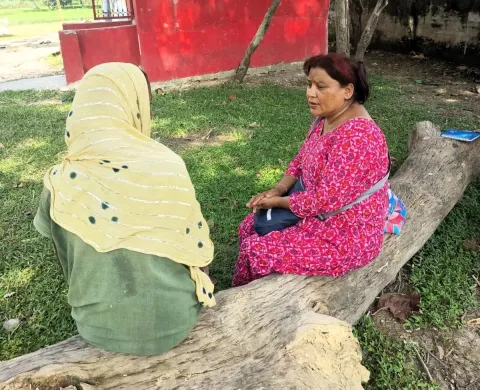
UNICEF Nepal/2024/RUpadhayay
"I thought I had to solve everything on my own," Srijana admits
But with the guidance provided in the mental health classes, Srijana learned a different approach. Now, she first tries to identify the problem and seeks help if she can't address it herself. Whether it’s a teacher, friend or the school nurse, she knows there’s always someone she can turn to. This shift in mindset, she says, is visible among her friends as well.
The changes observed in these students are the result of focused efforts to address the mental health needs of adolescents in Karnali Province


Dipa Pulami, one of the facilitators of the socio-emotional learning package, remembers how challenging it was initially for students to understand their own thoughts and feelings. To help them, she introduced various tools, such as a feelings chart, which allowed the students to see how emotions can evolve over time.
They also learned stress management techniques they could practice at home.
"These sessions are designed to be very interactive, with lots of activities, making it easier for the students to understand and internalize the concepts," Dipa explains.
The effects of these sessions extend well beyond the classroom. Bhawana Bhandari, the school nurse, has noticed significant changes in how students communicate about their issues. Adolescents, particularly those in grades six through ten, have become more open and willing to discuss their problems. When students face problems now, they approach her readily, and if the situation is beyond her expertise, she coordinates with counselors at UNICEF’s partner organization CMC Nepal or helps to connect them to specialists at Kanti Children’s Hospital in Kathmandu.
Dr. Rabin Khadka, Director of the Karnali Province Health Service Directorate, highlights the success of the program, particularly its use of creative tools like comics and art to address mental health needs.
"The results have been very positive," he says. "It is the aim of the provincial government to extend this initiative to all schools in all municipalities as far as possible."

To ensure that young people are supported to improve their mental health and well-being, UNICEF and the Z Zurich Foundation have launched a global partnership. The partnership seeks to equip adolescents and caregivers with the skills to care for their own and each other's mental well-being, as well as to promote positive connections, increasing awareness, knowledge, and action. Learn more about the global partnership here.