Opening doors to hope
How UNICEF, with support from the Rettig Group, is expanding child and adolescent mental health care in Madhesh

Dhanusha, Nepal: When Aakriti Giri began her career in psychiatric nursing, most of her work involved adults.
“I had some knowledge about children, but it was very general,” she says.
That changed after she joined a UNICEF-supported training at Kanti Children’s Hospital in Kathmandu, where she learned how to understand and respond to the mental health needs of children and adolescents.

“The training helped me see how differently children experience and express mental distress,” Aakriti explains.
“It also gave me the confidence to assess and manage young patients, not just from a medical point of view, but by really listening to them.”
The training was part of a UNICEF child and adolescent mental health initiative — implemented with Kanti Children’s Hospital and CWIN with generous support from the Rettig Group — that had first taken root in Karnali Province.
Based on its success there, the project was expanded to Madhesh Province in 2025.
Aakriti, who had worked in Surkhet during the earlier phase, moved to Janakpur to help establish the new Child and Adolescent Tele-Mental Health Clinic at the Madhesh Institute of Health Sciences (MIHS).
Since June this year, she has been screening young patients, counselling them and their caregivers, and connecting them to specialists at Kanti through tele-consultations. The tele-mental health service, she says, has been crucial in bridging the gap between children in Madhesh and child psychiatrists based in Kathmandu.

“Many families here would never be able to afford to travel to the capital for specialized care,” she says.
“Through video consultations, children can be assessed by experts at Kanti, and we can jointly plan their treatment. It has made access to mental health care possible for families who might otherwise go without any help.”
She also refers moderate and severe cases to psychiatrist, Dr Robin Jha at MIHS.
“On average, we see three to four young patients a day,” she says.
"Most of them come from across the province, not just Dhanusha. But many more children could be helped if there was greater awareness.”
“People often believe mental health problems can’t be treated,” she adds.
“They don’t know that with the right support, these conditions can be managed to improve a child’s quality of life.”

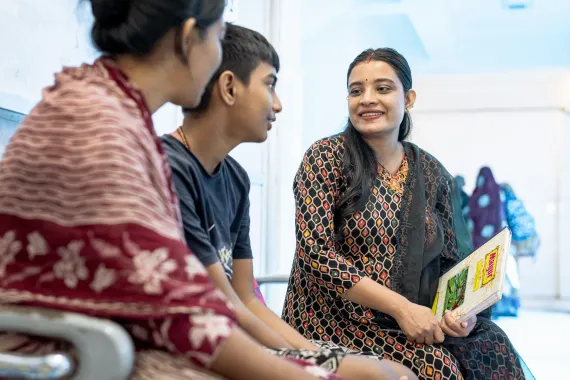
Her approach begins with understanding both the child and their caregiver. “I usually speak to them separately at first,” she says.
“I try to help the parents understand how to respond to their child calmly, how not to overreact or shame them. These sessions take time — between half an hour to an hour — but that time is essential in getting to the root of the situation.”
One case that has stayed with her is that of a 17-year-old girl who came to the clinic with her friend.
“She was very distressed,” Aakriti recalls. “She said she couldn’t stop overthinking and didn’t want to live anymore.”
Aakriti’s gentle conversation revealed signs of severe depression. When the girl had a panic attack during the assessment, Aakriti immediately arranged a tele-session with a clinical psychologist at Kanti. Together, they guided her through breathing and relaxation exercises.
As the sessions continued, Aakriti learned more about the young girl’s home life: Her father’s drinking, violence at home, and a previous suicide attempt. With the combined support of a psychiatrist and psychologist, the girl began to improve.
“The next week she came back much better,” Aakriti says. “She said the techniques and medication had helped her, and that she was feeling hopeful again.”
Later, the girl brought her father to the clinic. “He promised to stop drinking and asked for help,” Aakriti says. “That moment felt powerful. It showed how addressing one person’s mental health can also start healing a whole family.”
For Aakriti, this is what her work is about – creating spaces where young people and their families feel heard and supported. “At first, even my colleagues at MIHS were not familiar with the idea of having a mental health unit dedicated for children and adolescents ,” she says.
“Now, when a child with emotional or behavioural issues comes to other hospital wards, they are referred directly to us. That feels like progress.”

She hopes the service will see increased uptake in the days to come.
“More children and parents in remote areas should know that mental health care is available,” she says. “And we need to keep building the capacity of local health workers, so that this kind of support can reach every community.”
Aakriti says that seeing a child feel a sense of hope after weeks of sadness is the best reward.
“That’s when I feel that what we’re doing truly matters.”