New beginnings
In western Nepal, the Joint Recovery Action Plan helps a young mother navigate the challenges of life post-disaster, particularly in ensuring her son’s health and nutrition

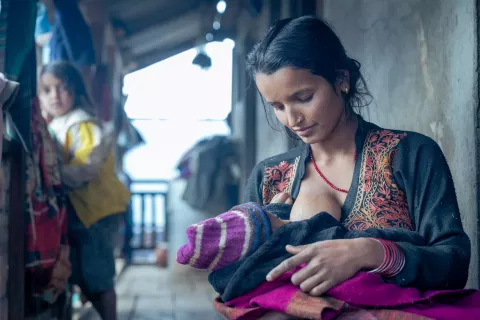
Jajarkot, Nepal: In Rawat Gaun in Jajarkot District in western Nepal, Indu Nepali is sitting on the steps of her old house, her seven-month-old son, Shubham, feeding quietly at her breast. Heavy rains through the night have washed the trees and stones in the village to a sheen and the morning air is crisp, but monsoon clouds still hang overhead—a reminder of both the beauty and challenges of life in this part of the country.
Serving another reminder are the damaged buildings and bits of rubble that litter the settlement, evidence of the 6.4 magnitude earthquake that hit Jajarkot and neighboring Rukum West in November 2023. In fact, Rawat Gaun suffered inordinate losses in the disaster, witnessing over 30 deaths of locals, six of whom were members of the same family.
Indu, who was pregnant at the time the earthquake struck, fortunately escaped unscathed.
“Our home was damaged beyond use,” she says, pointing to the cracked structure behind her. “But we were lucky to be alive.”
The family, much like others in the community, is currently residing in temporary shelters set up nearby.
However, surviving the earthquake was just the beginning of the challenges for families like Indu's. Beyond physical damage, the earthquake has also exacerbated an already fragile nutritional landscape in Karnali, a region where malnutrition rates were alarmingly high even before the disaster. To respond to the needs of affected communities – including that related to nutrition – and to build resilience, the Joint Recovery Action Plan (JRAP) was launched in 2024 by the National Disaster Risk Reduction and Management Authority (NDRRMA), with the generous support of the UK’s Foreign, Commonwealth and Development Office (FCDO). This joint programme is being implemented by four UN agencies – IOM, UNFPA, UNICEF, and WFP – under the leadership of the UN Resident Coordinator’s Office.
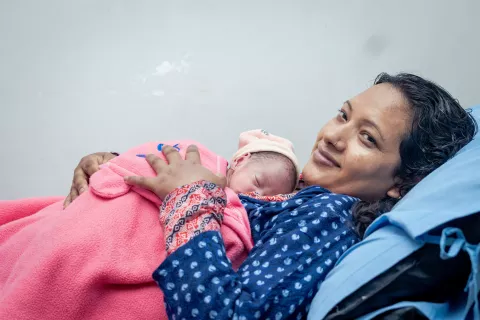
As part of its efforts in the nutrition sector, JRAP aims to build the capacity of health workers and female community health volunteers (FCHVs). These health workers and FCHVs, equipped with relevant skills and knowledge through project-supported trainings, then guide mothers like Indu through health mothers' groups and health facilities, promoting, protecting and supporting breastfeeding within the first hour after birth, exclusive breastfeeding for six months, and continuation of breastfeeding for two years and beyond.

They also counsel on introducing age-appropriate complementary food, particularly linking with the proper use of cash transfers to improve the consumption of nutritious food. This approach ensures the delivery of quality nutrition education and counseling in health facilities, communities, and households.
Indu says that through her participation in the health mothers' group, she has gained valuable insights on optimal feeding practices for her child.
"Thanks to the FCHVs and other mothers, I have learned so much about how to feed and look after my son — things I wouldn’t have known on my own,” she shares.
The young mother has successfully breastfed Shubham exclusively for the first six months and is now introducing age-appropriate and diversified complementary foods to his diet, following the guidance from the FCHVs. Indu says she will continue breastfeeding Shubham until he is two years old and beyond, believing it is essential for his growth and development.
"This will help him become strong and healthy.”


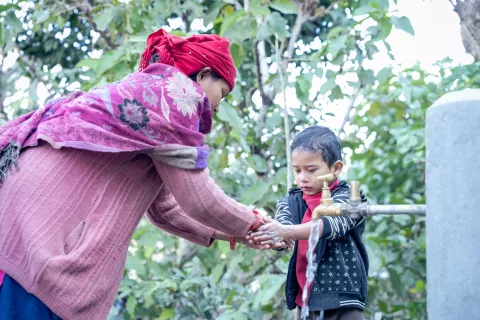
Of course, life in Rawat Gaun also presents other challenges. After the earthquake damaged the community’s main source of water, Indu spends a great deal of time each day walking across the river to fetch water from a communal pipe. Often, she must wait in line for up to an hour in addition to the 40 minutes it takes her to walk to the pipe and back.
Recognizing these difficulties, under the JRAP, UNICEF is also collaborating with local partners to establish a water supply project that will bring safe water directly to homes in the area. Work has already begun on a reservoir tank, and once pipelines are laid, the burden of water collection for Indu and her neighbours is sure to ease considerably.

As Indu navigates these multiple challenges in the wake of disaster, her commitment to Shubham's health and well-being remains unwavering. With the support of the community and ongoing initiatives under JRAP, she is determined to provide for and care for her child the best she can.
“Everything I do, it’s for him,” she says.