Bringing water home
In a small community in western Nepal, access to safe and reliable water – made possible through the Joint Recovery Action Plan – has made all the difference in the lives of residents

Jajarkot, Nepal: When we first met Tila Kumari Pun from Thulabagar in Jajarkot District in western Nepal in August 2024, lack of safe water in her community was foremost among her challenges. The November 2023 earthquake had severely damaged the local water sources, leaving residents without reliable access. Tila spent hours each day walking to and from the river to fetch water, leaving little time for other tasks.
“Life was very difficult,” she recalls.
Today, walking into Thulabagar is another experience altogether. This little riverside settlement is abuzz with farming activity, locals bent over their crops, gardens thriving in green.
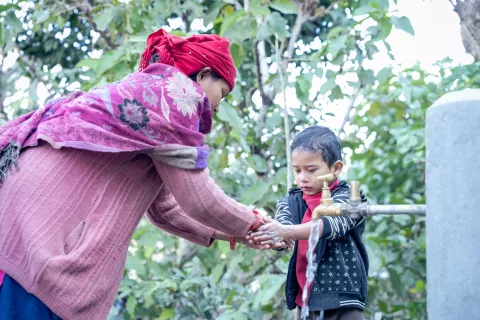
Gone are scenes of Tila and her friends with heavy vessels on their backs and hips, setting off or returning from long treks to the river or the distant water source. Instead, one finds them busy at the newly installed taps in their homes, some washing dishes or clothes, others bathing their children.


UNICEF Nepal/2024/RUpadhayay
It’s a true testament to the difference water can make.

For Tila, having a tap in her own home has eased her daily workload significantly, and freed up considerable time for other chores.
“We can use the water from the taps for drinking, washing clothes, and even for our cattle.
Everything is so much easier now,” she says.
This change was made possible through the Joint Recovery Action Plan (JRAP), an initiative led by the National Disaster Risk Reduction and Management Authority (NDRRMA), with financial support from the UK’s Foreign, Commonwealth, and Development Office (FCDO), and implemented by UNICEF, IOM, UNFPA and WFP under the leadership of the UN Resident Coordinator’s Office.
The November 2023 earthquake caused widespread destruction in Jajarkot and Rukum West Districts, including the loss of safe water and sanitation sources. Thulabagar is one of 70 communities in Jajarkot and Rukum West Districts that faced urgent challenges in accessing safe water and sanitation following the 2023 earthquake, and where JRAP is supporting affected communities by restoring these essential services.
Rajendra Jaishi, WASH coordinator at UNICEF, explains how the team had first worked to identify a viable water source that could serve the 40 or so households in the community. Once a source was found, the team then established the infrastructure for the supply system, including a reservoir tank that would collect water from the source and then distribute it to individual households.
“Community members have been very active in the process,” shares Rajendra. “They have contributed their own time and labour.”
“Now, all households have a tap each with running water supply.”

Making every drop count 💧

JRAP’s objectives, of course, go beyond providing water for the immediate needs of communities – sustainability and resilience are also key aspects of the water supply schemes.
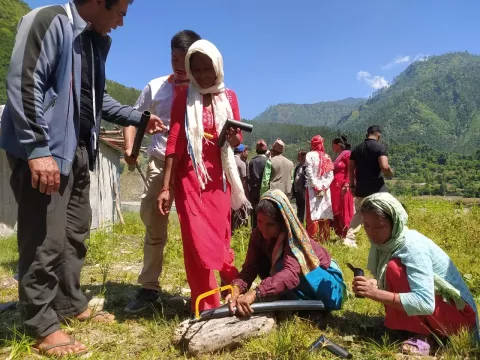
WASH interventions, for instance, also include efforts to establish water users’ committees comprised of locals who can take ownership over the operation of the schemes. Trainings have also been provided to Village Maintenance Workers to support repair and maintenance needs in the days to come.


Further, JRAP also advocates with the community to maximize the use of water for different purposes so as to prevent wastage. Rajendra highlights the multipurpose approach: “Most families here have a kitchen garden, but lack of water meant they couldn't really do much with these spaces. But with this water supply scheme, the waste water that is produced, it can easily be used in people's kitchen gardens.”
An additional tank has also been constructed to collect overflow from the main reservoir tank, so the water can be use in systematic irrigation of farms in the community.
“That’s one of the ways in which the project is also contributing to climate resilience,” Rajendra says.

Tila, for one, has embraced this approach. She uses wastewater from her household tap to nourish her kitchen garden, where she cultivates a variety of crops and vegetables. With hopes for a generous harvest, she plans to sell any surplus in the local market.
“Now we can grow crops year-round. If there’s enough, we can sell them and maybe buy new shoes or a pair of chappals,” she says.