Onward and upward: Champa’s story
How the Joint Recovery Action Plan empowered a mother from western Nepal to recover from the effects of the earthquake, and gain skills to support her family and community

Rukum West, Nepal: When Champa Pun Magar’s son met with an accident a few years ago, it dealt a deep blow to an already struggling family.
Although Champa and her husband, residents of Sani Bheri in Rukum West District, managed to get the little boy the medical attention he needed in time, the treatment and subsequent follow up appointments were expensive and weighed heavy on their pockets.
“We didn’t have a stable income,” Champa says. “So, covering his medical expenses and ensuring his education felt impossible.”
The earthquake that hit western Nepal in November 2023 only deepened these challenges. Families like Champa’s, already vulnerable, were now left grappling with even more uncertainty about their futures.

To support such families in their time of need, the Joint Recovery Action Plan (JRAP) was launched in Karnali Province in 2024. Initiated under the National Disaster Risk Reduction and Management Authority (NDRRMA) with financial support from the UK’s Foreign, Commonwealth and Development Office (FCDO), JRAP is implemented by IOM, UNFPA, UNICEF, and WFP under the leadership of the UN Resident Coordinator’s Office.
Part of the programme’s multisectoral efforts across Jajarkot and Rukum West Districts included identifying and supporting households with the most vulnerable children through psychosocial counseling, income-generation activities, and community awareness initiatives.

Champa was among those who received this support, aimed at improving her child’s health and well-being, as well as ensure learning continuity.
“With the programme’s support, we were able to buy seeds, fertilizers and other things to started planting vegetables,” says Champa. Her garden abounds in cauliflower, cabbage, as well as tomatoes – which she is growing in a plastic tunnel.
Whatever surplus is left over from what the family consumes is then sold off.

UNICEF Nepal/2024/RUpadhayay
“This has helped us pay for my son’s medical needs, buy his clothes and school supplies, and cover household expenses.”
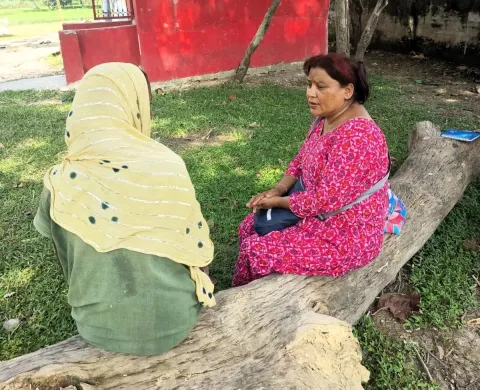
Mina Shahi, a programme officer with SOSEC Nepal, a JRAP partner organization, emphasizes the importance of regular follow-ups in cases like that of Champa’s. “We visit families time and again to monitor their progress,” Mina explains. “Champa’s vegetable farming has been going very well.”

What’s more, the community of Chinabagar, where Champa lives, was also one of the sites selected for the establishment of a new water supply scheme through JRAP, which has now brought safe, reliable drinking water directly to people’s homes.
Even before the earthquake, water supply wasn’t regular in the village, and involved long walks back and forth from distant communal sources.
Now, however, with the new water supply system bringing safe water to all households, daily life has eased a great deal.
Bhoj Thakurathi, an engineer with RSDC – one of JRAP’s partner organizations on the ground – talks about some of the efforts made to ensure the long-term sustainability of the water supply scheme. “To enable easy repair and maintenance of the water supply system, we trained two Village Maintenance Workers (VMWs) who are locals of this community,” he says. “This helps to ensure that if there is any repair needed in the future, there will be locals who have the necessary skills to take on the work.”
And Champa just happens to be one of these trained VMWs.

Initially, this decision was met with skepticism. “People would say, ‘How can a woman do this kind of work — fitting taps and pipes?’” she recalls.
“But I thought, why couldn’t a woman do this? I didn’t let those comments discourage me.”
She went ahead with the training, and today, Champa is a skilled maintenance worker, equipped to handle repairs and ensure uninterrupted water supply for her community. “It was challenging at first,” she says, “but once I got the hang of it, it became easy.”

For Champa, these opportunities have been life-changing. “After the earthquake, we were stuck at home, unable to find work anywhere,” she says.
“It would have been difficult without the support.”