Rebuilding health and hope
JRAP is providing critical support to earthquake-affected families in western Nepal, helping them access resources and knowledge to improve child nutrition and health while rebuilding their lives

Jajarkot & Rukum West, Nepal: In the wake of the November 2023 earthquake in western Nepal, Karnali Province faced an overlapping crisis: the destruction of homes and livelihoods in affected areas, and the immediate threat to the health and nutrition of children. With food supplies scarce and families struggling to meet their basic needs, ensuring that children received adequate nutrition became a critical priority.
Saraswati Bhandari, a mother from Kushe, Jajarkot District, vividly recalls the desperate times after the quake.
"Our situation was very dire after the earthquake," she reflects. “It was a struggle to keep everyone safe and fed.”


To support families like Saraswati’s and to help them recover and rebuild, the Joint Recovery Action Plan (JRAP) was initiated in 2024. Launched under the National Disaster Risk Reduction and Management Authority (NDRRMA) with financial support from the UK’s Foreign, Commonwealth and Development Office (FCDO), JRAP is implemented by IOM, UNFPA, UNICEF, and WFP under the leadership of the UN Resident Coordinator’s Office. And included among its different areas of work are efforts to improve child nutrition and health.
Through JRAP, families like Saraswati’s gained access to resources that could prevent malnutrition. "We were informed that there was an organization that would be providing support for children's nutrition," Saraswati explains.
"We used the support to buy ingredients to make lito and jaulo (nutritious porridge)."

UNICEF Nepal/2024/RUpadhayay
"The support came to us in a time of urgent need, so we're happy."
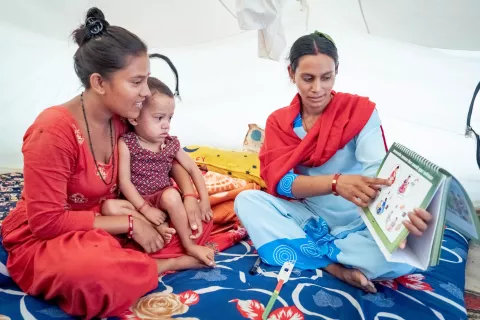
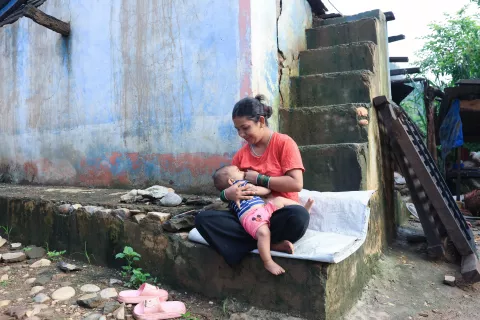
Playing a pivotal role in JRAP’s efforts are female community health volunteers (FCHVs) who help promote breastfeeding among new mothers, and teach others the proper techniques to prepare nutritional food.
Hiunkali Chand was among these FCHVs, and she worked tirelessly to ensure caregivers like Saraswati knew how to properly prepare and serve these meals: "I taught them different things like how to roast the different cereals and beans, pack them separately, grind them into flour, and then mix them together to prepare the porridge."

"They've been following through," Hiunkali adds, proud of the positive impact on families.

Beyond immediate benefits
Another young mother, Sandhya Pun Magar from Sani Bheri in Rukum West District, shares how the support she received from JRAP has made a tangible difference in her children's health.
"My eldest daughter is going to turn four soon. And my two younger girls, who are twins, are turning one," she explains. "With the support we received, I've bought milk, eggs and other nutrient-rich foods, including grains and pulses, and fruits, to feed to the children."


Beyond these immediate benefits, the support has allowed Sandhya to plan for the future. "To make things even easier, I'm also planning on using the support to buy two chickens, so that they can lay eggs for us at home," she says. "And with what remains, maybe we can buy a goat, which we can use or sell later to buy food for the children. That's what I'm thinking to do."
As families like Saraswati’s and Sandhya’s continue to rebuild, these small yet significant steps are helping them ensure the health of their children in a time of great uncertainty.