Help at hand
In western Nepal, female community health volunteers trained under the Joint Recovery Action Plan are promoting and protecting child nutrition and health in earthquake-affected communities
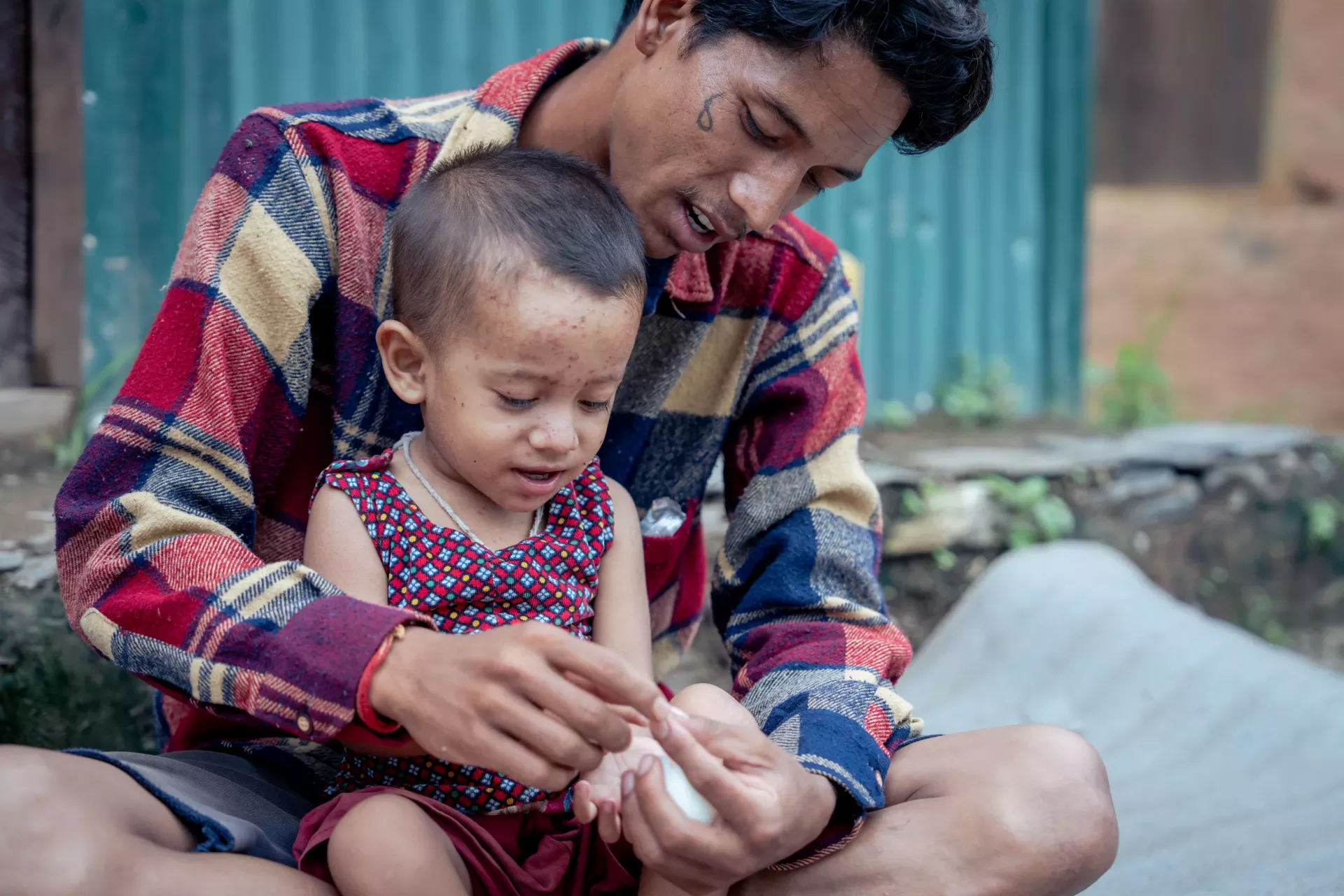
Rukum West, Nepal: On the premises of Nirmala Pariyar and Shishir Sunar’s home in the village of Chaur in Aathbiskot Municipality, Rukum West District, Shishir is feeding their young son, Nithin, a boiled egg.
With each eager bite Nithin takes, relief washes over his parents’ faces.

UNICEF Nepal/2024/RUpadhayay
This is because just a few weeks ago, the one-year-old was diagnosed with moderate acute malnutrition (MAM).
That diagnosis had been one in a long list of challenges that the family suffered after the earthquake that had hit western Nepal in November 2023. “We were sleeping on the first floor when it hit,” Nirmala recalls of that fateful night. “We didn’t even realize it was an earthquake at first. My husband and I grabbed one child each and ran out as the house started to collapse around us.”
Since then, Shishir, Nirmala and their two sons have been sleeping in a tent pitched next to the remains of their old home. “There are risks of snakes, and we often have frogs, insects and mosquitos coming in.”
Amid all these difficulties, Nirmala admits that their children’s nutrition had taken a bit of a back seat, with the family resorting more to packaged and junk food for convenience.


It wasn’t until Sushma Saha – a female community health volunteer (FCHV) in the village – had come by during a routine visit that Nithin’s condition became evident. When she noticed that the boy appeared a bit thin, Sushma brought out a mid-upper arm circumference (MUAC) tape to measure his arm.

UNICEF Nepal/2024/RUpadhayay
The result showed yellow, indicating that Nithin was suffering from MAM.
“If the tape shows yellow, we know the child is moderately malnourished, and if red, they need immediate medical attention,” Sushma explains.
Conducting this test is among the skills Sushma had learned, together with other FCHVs, as part of a training received under the Joint Recovery Action Plan (JRAP). JRAP was launched in 2024 by the National Disaster Risk Reduction and Management Authority (NDRRMA), with the generous support of the UK’s Foreign, Commonwealth and Development Office (FCDO). This joint programme is being implemented by four UN agencies – IOM, UNFPA, UNICEF, and WFP – under the leadership of the UN Resident Coordinator’s Office.
Recognizing the need to promote and protect child nutrition and health post-disaster, JRAP is thus equipping health workers and FCHVs like Sushma with relevant skills and knowledge.
FCHVs play a crucial role in community settings, often the first point of contact for families, providing essential health education and early detection of health issues like malnutrition.


This is of particular significance in regions like Karnali, where events like the earthquake threaten to worsen already concerning malnutrition rates.
“We have been sharing what we learn with mothers in our community,” Sushma adds.
“In our mothers’ groups, we teach them about proper breastfeeding practices, complementary feeding and the importance of cleanliness. We also go door-to-door to check on children’s nutritional status.”


Nirmala and Shishir have taken Sushma's advice to heart. “We’ve been feeding him like she advised at least four times a day,” she says. “He eats well now, and we can see improvements in him compared to before.”

Sushma will continue to monitor Nithin’s progress, using the MUAC tape regularly to ensure his condition improves.
For the young parents, having Sushma nearby has been a significant comfort. “It’s made things a lot easier for us,” Nirmala says.