“I’ll Keep Talking”: One young man’s stand against child marriage
“No child, boy or girl, should face violence.”

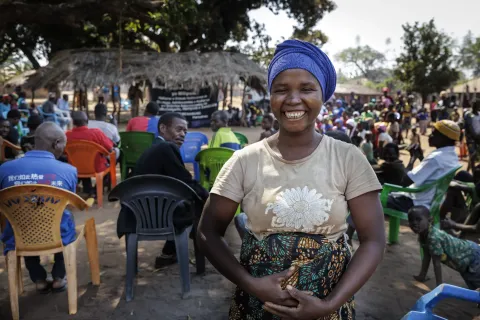
BOILA-NAMETÓRIA, Nampula - Under a roadside community shelter, 21-year-old Hale Eusébio Ossufo Ibraimo sat on a concrete counter as mothers, children and community leaders gathered nearby to declare their commitment to ending child marriage.
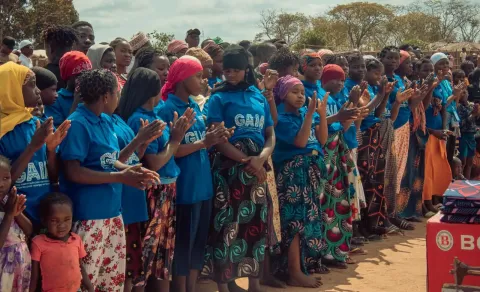
Days earlier, Hale had joined eight other peer mentors from the Horizonte Azul Sociocultural Association (ASCHA) for an improvised theatre performance in neighbouring Horta-C. Through drama, they invited community members to discuss children’s rights, family violence and ways adults can help protect children.
For Hale, protecting children extends beyond organised activities. His commitment is rooted in his own childhood experiences.
“My father died when I was born,” he said.
When Hale was about nine or ten years old, he left his mother’s home so that he could continue his education.
“My mother didn’t have the means to put me through school, but a relative did,” he said.
The arrangement enabled Hale to remain in school, but he said he also experienced violence and carried responsibilities that no child should have to bear.
“What kept me going was knowing I had to stay in school,” he said.
After completing secondary school, Hale could not afford to attend university. Then a cousin told him that a local organisation was recruiting young people to become peer mentors. Hale applied, completed the training and joined ASCHA.
During the training, he learned about child labour, child marriage and gender-based violence. The lessons helped him see his own childhood experiences differently.

As I learned more about gender-based violence and child marriage, I realised I was living through violence myself. No child, boy or girl, should face violence.
“As I learned more about gender-based violence and child marriage, I realised I was living through violence myself,” he said.
That realisation strengthened his commitment to encouraging families to talk about children’s safety, education and well-being.
“No child, boy or girl, should face violence,” he said.
As a peer mentor, Hale tries to listen rather than confront. When community members question messages about children’s rights, child marriage or gender equality, he listens to their concerns and works with them to identify possible solutions.
He has also started these conversations within his own family, encouraging boys and girls to share household responsibilities.
“I’ve already told my mother that cooking shouldn’t be only my sisters’ job, that boys should learn it too, so when we have our own families, we can share the load,” he said.
For Hale, such conversations can help families examine expectations that place an unequal burden on girls and consider how responsibilities can be shared more fairly.
Continuing the work has not always been easy. Hale recalled a period when funding for activities paused and peer mentors did not receive stipends. Even then, he continued speaking about children’s rights with the people around him.
“I know it’s not easy,” he said. “Even without funding, I’ll keep talking about this. I can sit with my friends, with my mother, with my brothers and sisters, and talk.”
Hale hopes to study nursing and eventually graduate as a nurse. For now, he continues his work as a peer mentor, encouraging dialogue on child marriage, violence and gender equality.
“Funding helps because it keeps the programme running,” he said. “But continuity depends on people.”
This activity was supported by the UNICEF-UNFPA Global Programme to End Child Marriage, funded by the Governments of Canada, Italy, the Netherlands, Norway and the United Kingdom, and Zonta International.