A theatre performance changes Zélia’s plans for her next baby
With the generous support of the European Union through the NutriNorte programme, UNICEF supports the Government of Mozambique to strengthen nutrition services in Cabo Delgado, Nampula and Zambézia.

Namuno, Cabo Delgado - The sound of drums announces that something is about to happen in Naculuge.
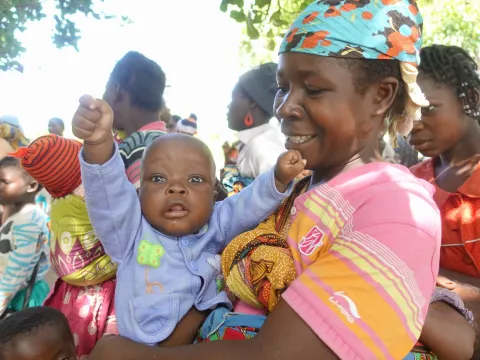
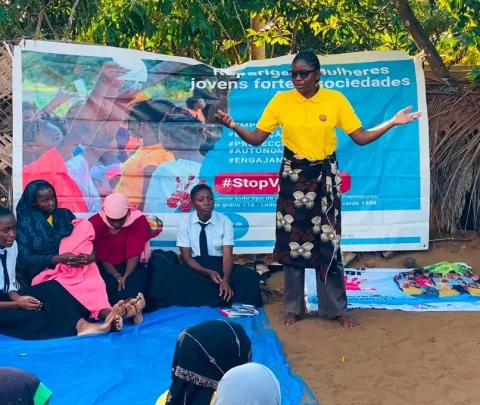
Children come running. Older residents arrive carrying chairs and benches. Men and women walk in from the surrounding fields, some still carrying shovels and tools. Soon, a crowd gathers around a dusty patch of ground shaded by trees.
At one side, a tarpaulin forms a makeshift dressing room. Behind it, members of a travelling theatre group change into costume. In front, others beat drums and begin to sing.
Among those watching is Zélia José, 27, who is four months pregnant with her fourth child and has lived in Naculuge all her life.
“I really enjoy watching the theatre, and I have come to see it twice before,” she says. “I like the singing, the dancing, the laughter and the messages. They are very funny people.”
This week, during World Breastfeeding Week, the performance focuses on breastfeeding.
The first scene features a mother and her baby. When the baby cries, the grandmother insists the child needs water and porridge. The mother refuses, explaining that she learned at the health centre that babies should be exclusively breastfed for their first six months.
Then the husband arrives.
To loud laughter, he sides with his mother and tries to persuade his wife to feed the baby. She stands her ground.
For Zélia, the scene carries a practical lesson.
“With my other babies, I did not have this information,” she says. “When they cried, I thought they wanted food, not just milk. With the baby coming now, I will do it differently. I will wait six months.”
Zélia says older women have traditionally influenced how younger mothers feed their babies.
“They have a lot of experience and knowledge, more than us, so there can be pressure to follow what they say,” she says. “But we are learning.”
The performance continues with songs, jokes and other scenes. A health worker and community leader speak briefly at the end to reinforce the messages. The crowd responds with clapping, cheers and whoops as the performers bow.
Community leader Alberto Banco, 38, says the theatre group has been visiting Naculuge for about three months, addressing issues ranging from health and nutrition to child marriage.
“People come to watch because it is entertaining, and they remember the information they hear,” he says. “We elders repeat the messages at church, at football matches, at community meetings and at the WASH committee.”
Alberto says the messages apply to his own family too.
“My wife is pregnant, and now I know she should exclusively breastfeed for six months,” he says. “I will help the rest of the community, but I must start at home first.”
The travelling performers are from Namuno district and communicate in Makua, using familiar situations, local humour, music and drama to share health information. The initiative forms part of UNICEF’s Social and Behaviour Change approach, which provides the participatory methodology and strategic guidance behind the performances. Drawing on Theatre of the Oppressed, the approach uses performance to encourage reflection, dialogue and community-led action.
With the generous support of the European Union through the NutriNorte programme, UNICEF supports the Government of Mozambique to strengthen nutrition services in Cabo Delgado, Nampula and Zambézia. NutriNorte also supports the travelling theatre initiative, including training and transport.
Zélia believes the approach works because it combines useful information with entertainment.
“Nearly everyone likes to come and watch the show,” she says. “People will remember the message because of the singing, dancing and laughing.”
She now plans to follow that advice when her baby is born.
“I advise other mothers not to give food or water to their babies before six months,” she says. “After six months, we can introduce nutritious foods, such as porridge with peanuts and moringa, so our children can grow healthy and strong.”
As the crowd disperses and the performers pack away their makeshift stage, Zélia is already thinking about their return.
“I am looking forward to the next show already,” she says. “So is the whole community.”