Anabela Helps Children Speak Up in Cabo Delgado
UNICEF, with financial support from the Eastern and Southern Africa Humanitarian Fund (ESAHF), supports an integrated Education and Child Protection programme in Chiúre and Muidumbe districts in partnership with Plan International.

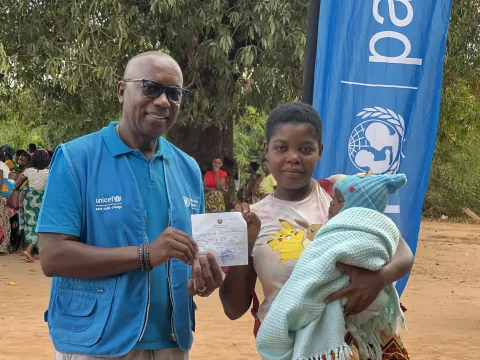
Chiúre, Cabo Delgado - At Maningane Primary School, before classes begin each morning, 15-year-old Anabela Alberto dreams about her future. She hopes to become a teacher or a nurse one day. But after taking part in a child protection training in her community, she has found another purpose: helping protect other children.
For four days, Anabela joined community leaders, teachers, school council members, case managers and community facilitators at Maningane Permanent Resettlement Centre to learn how to identify, prevent and report violence against children.
“I learned that boys and girls have the same rights,” Anabela says. “I also learned that when girls are at risk, there are people and services that can help protect them.”
As a member of the School Council, Anabela was invited to participate because of her leadership role. During the training, she became one of the most active participants, determined to use what she learned beyond the classroom.
“After this training, I will share what I have learned with my classmates and other girls in the community,” she says.
Maningane Permanent Resettlement Centre was established in 2020 to host families displaced by the conflict in Cabo Delgado. Today, more than 10,000 people live in the area, across over 3,000 households.
Although families have worked hard to rebuild their lives, many children and adolescents continue to face protection risks. Child marriage, early pregnancy and different forms of violence remain common challenges, particularly for adolescent girls.
For many children, trusted adults in the community are often the first people they turn to when they need help. Strengthening these local protection networks can make a critical difference by helping children receive timely support when they are at risk.
The training equips community members with practical knowledge on child protection, referral pathways and reporting mechanisms, so they can identify children at risk and connect them with appropriate services.
By bringing together teachers, community leaders, school councils and frontline workers, the initiative helps strengthen collaboration among the people responsible for children’s wellbeing.
For Anabela, the training has also given her confidence to become part of that support system.
“I now know that I can help other girls understand their rights and encourage them to speak up if they are facing violence,” she says.
UNICEF, with financial support from the Eastern and Southern Africa Humanitarian Fund (ESAHF), supports an integrated Education and Child Protection programme in Chiúre and Muidumbe districts in partnership with Plan International.
More than 160 community actors are expected to receive similar training, strengthening local protection networks that will benefit thousands of conflict-affected children across Cabo Delgado.
For Anabela, the impact goes beyond the four days of training. The knowledge she has gained is something she intends to carry with her and pass on to others, helping create a community where children, especially girls, can grow up safer, remain in school and pursue their dreams free from violence.