Cabo Delgado: Vicente’s second chance at education
"Many of us lost the opportunity to study because of the conflict. Education can help us rebuild our lives and develop our country."

Palma, Cabo Delgado - At 21 years old, Vicente Benjamim is back in a classroom, pursuing a dream that conflict almost took away from him.
Born and raised in Mute village in Palma District, Vicente grew up enjoying school, reading and helping his family cultivate maize and cassava. From an early age, he dreamed of becoming a teacher.
“I want to become a teacher so that I can help children learn and contribute to the development of our country,” Vicente says with a quiet smile.
In 2017, however, his education was suddenly interrupted. Vicente was attending Grade 6 when insecurity linked to the conflict in Cabo Delgado began affecting nearby communities. One day, while he was in class, his teacher abruptly told the students to go home.
“Our teacher told us that the situation was not good,” Vicente recalls. “We were afraid because attacks were happening in nearby communities. After that, I could no longer continue my studies.”
Instead of attending school, Vicente spent his days working on the family farm. Although he helped his family produce food, he continued to think about the education he had lost.
“I missed school every day,” he says. “I always wished I could continue learning.”
In 2020, as violence intensified, Vicente and his family were forced to flee their home. Accompanied by his uncle, he travelled through Nangade District to Montepuez, where they settled at the Massasse displacement site. His father and siblings sought safety at the Namdimba displacement site in Mueda District.
Life in displacement was difficult. Resources were limited, and the uncertainty surrounding Vicente’s future left little room for him to consider returning to school.
In 2023, as security conditions in Palma improved, Vicente returned home. The homecoming brought relief, but it also revealed how much the family had lost.
“When we came back, we had almost nothing,” he says. “We had to start rebuilding our lives from the beginning.”
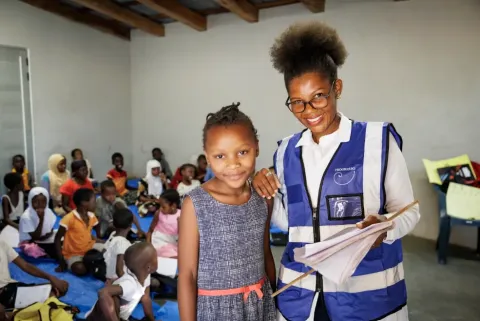
Vicente remained out of school until he attended a community meeting at a local school and learned about the Accelerated Education Programme. Implemented by the District Services for Youth, Technology and Education (SDEJT) of Palma, the programme helps children and young people whose education has been interrupted to recover lost years of learning and return to the education system.

As soon as I heard about the programme, I knew I wanted to be part of it. I had stopped studying in Grade 6, and I wanted to continue my education.
“As soon as I heard about the programme, I knew I wanted to be part of it,” Vicente says. “I had stopped studying in Grade 6, and I wanted to continue my education.”
He enrolled in Cycle 2 alongside other young people whose education had also been disrupted by conflict and displacement.
Since enrolling, Vicente has received notebooks and other school supplies. The World Food Programme (WFP) also provides take-home food rations. Together, this assistance has helped him attend classes regularly and remain focused on his studies.
“The materials and support encouraged me a lot,” he explains. “They gave me strength and motivation to continue studying.”
Vicente is now progressing with his education and remains determined to complete his studies and become a teacher. He also hopes that other young people affected by the conflict will receive the same opportunity.
“I would like this programme to reach more young people like me,” he says. “Many of us lost the opportunity to study because of the conflict. Education can help us rebuild our lives and develop our country.”
For Vicente, returning to the classroom has restored his confidence and his belief in what he can achieve.
“Education showed me that my future is still possible,” he says.
UNICEF supports the Accelerated Education Programme through generous funding from the Government of Sweden.