Mozambique and partners underline the importance of timely protection for children associated with armed groups
Government, the United Nations and partners reaffirm their commitment to children affected by the conflict in the north, as Canada announces support for a UNICEF protection and reintegration programme in Cabo Delgado.
- Português
- English
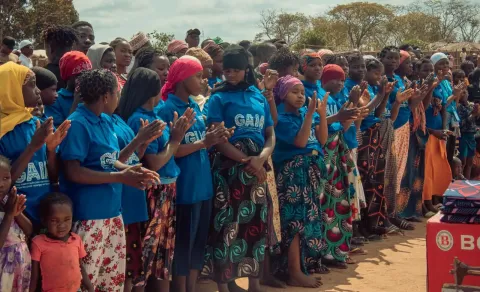
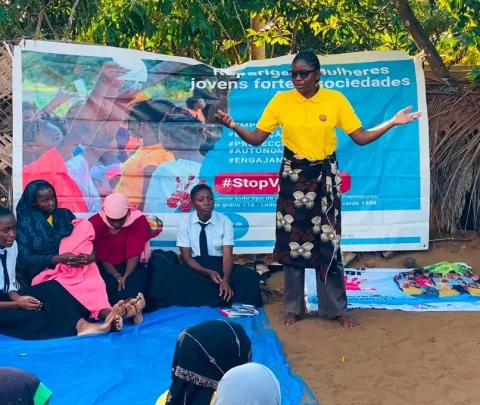
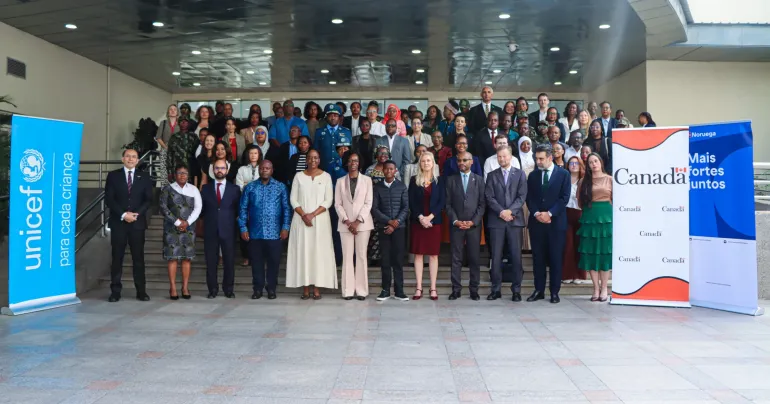
MAPUTO, Mozambique – Ivete Alane, Minister of Labour, Gender and Social Welfare, today addressed a commemoration of Red Hand Day, the International Day against the Use of Child Soldiers, at the Joaquim Chissano International Conference Centre in Maputo, jointly hosted by the Government of Mozambique and UNICEF. Participants underlined the importance of timely protection for children associated with armed groups (CAAFAG). The event brought together senior representatives of the Government, the United Nations, international partners including High Commissioner of Canada, Anderson Blanc, and Ambassador of Norway, Egil Thorsås, as well as other members of the Group of Friends for CAAC, civil society, religious and community leaders, and young people, in a shared commitment to children affected by the conflict in the north of the country.
Government institutions represented included the Ministry of Labour, Gender and Social Welfare, the Ministry of Justice, the Ministry of the Interior, the Ministry of National Defence, the Ministry of Youth and Sport, as well as the Attorney General’s Office and the Supreme Court.
In her address, Minister Alane reaffirmed the Government’s commitment to protecting children affected by armed conflict and to ensuring that children associated with armed groups are treated, first and foremost, as victims of grave violations of their rights.
The commemoration was also addressed, via video message from New York, by Vanessa Frazier, the Special Representative of the Secretary-General for Children and Armed Conflict, who underscored the importance of international attention to the protection of children in Mozambique.
Mozambique has been included as a situation of concern in the United Nations Secretary-General’s annual report on children and armed conflict since 2022. Violence and conflict in the north of the country have exposed children to grave violations of their rights, including recruitment and use by armed groups, abduction, killing and maiming, sexual violence and attacks on schools and hospitals. In 2025, the United Nations verified 552 grave violations against 355 children in Cabo Delgado and Nampula Provinces. The conflict has displaced over 1.2 million people across Cabo Delgado, Nampula and Niassa provinces, more than half of them children.
Progress and partnership
Mozambique has taken concrete steps to strengthen the protection of children affected by armed conflict. Training and technical support on the prevention of grave violations and on human rights have been provided to the country’s security and defence forces, with the support of the United Nations, the European Union, Canada, and other partners.
National authorities and partners have also worked to strengthen child protection services in Cabo Delgado and Nampula and to support the recovery and reintegration of CAAFAG and holistic support to all children affected by the armed conflict.
At the event, Canada announced its support for a UNICEF programme for the protection and reintegration of CAAFAG in Cabo Delgado, a US$3.5 million programme running until 2028, delivered in partnership with ROSC, FDC, Muleide, Humanity and Inclusion, in support of Government systems and services.
Ensuring timely protection for children
Speakers underlined that what matters most for children affected by armed conflict is timely protection alongside credible accountability processes that deter violations and reinforce children’s rights.
Any child who is separated from, or escapes, an armed group should be recognised as a victim of violence and swiftly handed over to civilian child protection authorities, enabling immediate access to care, family tracing, mental health and psychosocial support, and education to support their safety and recovery.
This approach is grounded in commitments Mozambique has already made under the Convention on the Rights of the Child and its Optional Protocol on the involvement of children in armed conflict. The United Nations and partners continue to support the Government to put in place the systems and procedures, including the finalisation and implementation of a national handover protocol. This will formalise pathways to reintegration, strengthen links with accountability mechanisms, and ensure that timely, consistent, and child-centred protection is applied in every case.
Standing with the Government
Members of the CAAC Working Group, CAAC Group of Friends co-chairs and the United Nations including UNICEF, reaffirmed their commitment to supporting the Government of Mozambique with continued technical support, including on standard operating procedures, resourcing, the training of relevant authorities and the strengthening of national child protection systems. Partners also encouraged the endorsement of the Paris Principles and the Vancouver Principles and the full implementation of the Safe Schools Declaration.
Quotes
"Every child has the right to grow up in safety, pursue an education and dream about the future without fear. Today’s commemoration is a reminder that protecting children affected by conflict requires sustained commitment from all of us. We welcome the continued cooperation between the Government of Mozambique and the United Nations and encourage all partners to maintain their support for protecting children. Together, we can help ensure that every child is protected, nurtured and empowered to become an agent of peace and realise their full potential."
Dr. Catherine Sozi, United Nations Resident Coordinator and Humanitarian Coordinator for Mozambique
“Mozambique has made real progress in protecting children affected by the conflict in the north, including by working with the United Nations to train its armed forces and to support children to recover and rebuild their lives. What matters now is that every child found with an armed group is recognised as a victim of violence and reaches the care of civilian child protection services without delay. Finalising a national handover protocol would help make that protection systematic, and UNICEF will continue to support the Government every step of the way.”
Mary Louise Eagleton, UNICEF Representative in Mozambique and co-chair of the Children and Armed Conflict Working Group
"Every child has the right to learn in safety. Norway remains committed to supporting Mozambique on the CAAC agenda, including implementation of the Safe Schools Declaration, which aims to protect schools from attack and ensure children can continue their education during conflict. Stronger implementation will be key to turning these commitments into real protection for children.”
H.E. Egil Thorsås, Ambassador of the Kingdom of Norway and co-chair of the Group of Friends on Children and Armed Conflict.
"Protecting children in armed conflict is a priority for Canada. Ongoing abductions and child recruitment in northern Mozambique underscore the need for coordinated action. Canada, alongside our partners UNICEF, Muleide, ROSC, FDC, Humanity and Inclusion, and the Dallaire Institute, is supporting the Government of Mozambique in efforts to prevent these violations, protect affected children, and reinforce accountability. As we commemorate Red Hand Day, we reaffirm our commitment to safeguarding every child’s right to a safe and secure childhood.”
– H.E. Anderson Blanc, High Commissioner of Canada and co-chair of the Group of Friends on Children and Armed Conflict.
Notes to editors
- The Children and Armed Conflict Working Group in Mozambique, co-chaired by the United Nations Children’s Fund (UNICEF) and the United Nations Resident Coordinator’s Office, brings together United Nations agencies and civil society to monitor and respond to grave violations, engage in advocacy, and support the protection of children affected by armed conflict. Members of the Working Group include: the United Nations Resident Coordinator’s Office, the United Nations Children's Fund (UNICEF), the Office of the United Nations High Commissioner for Human Rights (OHCHR), the United Nations High Commissioner for Refugees (UNHCR), the United Nations Population Fund (UNFPA), the United Nations Office on Drugs and Crime (UNODC), the International Organization for Migration (IOM), the United Nations Office for the Coordination of Humanitarian Affairs (OCHA), the World Health Organization (WHO), Save the Children and Street Child.
- The Group of Friends on Children and Armed Conflict in Mozambique is an informal grouping of diplomatic missions, co-chaired by the High Commission of Canada and Embassy of Norway, that advocates for the protection of children affected by armed conflict. Members of the Group of Friends include: the Embassy of Norway, the High Commission of Canada, the Embassy of Brazil, the Embassy of Egypt, the Embassy of Sweden, the Embassy of Netherlands, the Embassy of Ireland, the High Commission of Kenya, the Embassy of Finland and the European Union Delegation.
- The Red Hand Day commemoration in Maputo was jointly hosted by the Ministry of Labour, Gender and Social Welfare (MTGAS) and UNICEF.
- Red Hand Day is the international day against the use of children as soldiers, observed worldwide on 12 February. The commemoration in Maputo brings together Government, the United Nations, diplomatic partners, civil society and young people.
- UNICEF and partners work in support of the Government of Mozambique, which leads and owns the national response. The role of the United Nations and partners is to support and strengthen Government systems, alongside communities.
Media contacts
About UNICEF
UNICEF works in some of the world’s toughest places, to reach the world’s most disadvantaged children. To save their lives. To defend their rights. To help them fulfill their potential. Across 190 countries and territories, we work for every child, everywhere, every day, to build a better world for everyone. And we never give up.
For more information about UNICEF and its work for every child in Mozambique, visit www.unicef.org/mozambique.
Follow us on social media: WhatsApp | Twitter | Facebook | LinkedIn
Please consider donating to our work in Mozambique.