As climate hazards intensify, education resilience must be a priority
Using evidence to identify risks, target investments and protect learning
When heatwaves, floods, drought and storms strike, children’s learning is often among the first things disrupted. In 2025, at least 171 million students experienced climate-related school disruptions – one in ten students worldwide. Three in four of them live in low- and lower-middle-income countries. Beyond lost classroom time, these disruptions risk deepening inequalities and undermining children’s futures.
As climate-induced shocks intensify, protecting education systems and infrastructure is becoming increasingly urgent. On 14 November, COP31’s thematic day on Children, Youth, Education and Skills offers an opportunity to translate international commitments into action that protects learning. The Greening Education Partnership will bring attention to country-level implementation, evidence and monitoring.
For governments, building resilient education systems start with quality data and evidence. In the face of limited resources and competing priorities, evidence helps decision-makers target investments and design effective and equitable responses that can be sustained over time.
Making education resilience a climate priority
Alongside efforts to strengthen climate literacy and equip children with the skills to drive climate action and build resilient communities, education systems must be prepared to anticipate, respond and recover from climate-related disruptions.
Yet, education often receives less than 1 per cent of global climate finance. Education resilience requires greater prominence in national adaptation plans, financing strategies and investment decisions – a priority that UNICEF and partners, including the Global Partnership for Education (GPE) is actively advancing.
The stakes are particularly high where climate exposure intersects with poverty, vulnerability and education systems facing structural challenges. In low-income countries, schools affected by extreme climate events lose an average of 18 instructional days annually. Children who already face barriers to quality education may have fewer ways to continue learning during a disruption. How quickly learning resumes also depends on the capacity of schools and education authorities to act when disruptions strike.
Addressing these challenges requires a granular and context-specific understanding of how climate risks intersect with education disadvantages and other vulnerabilities. Governments therefore need locally grounded evidence to better understand where risks and disadvantages overlap, why similar hazards produce different education consequences, and which responses are most effective, equitable and feasible in each context.
Cameroon: Where evidence meets policy priorities
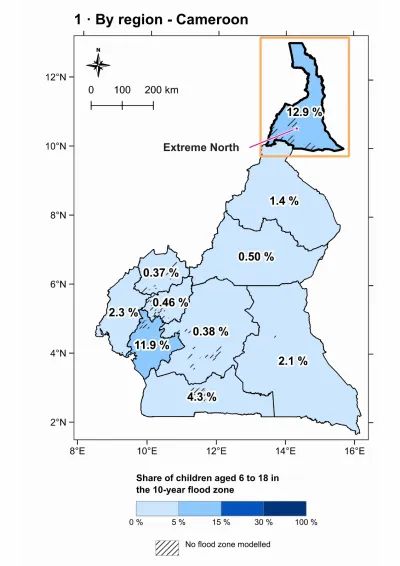
In Cameroon, climate hazards, conflict and persistent disadvantages create overlapping challenges for children and the education system. More than 1.5 million school-age children need education assistance, including some 564,000 in the Far North, where recurrent flooding compounds insecurity and displacement. Against this backdrop, the government, supported by GPE, is redefining its Priority Education Zones (ZEP), across the country’s 360 communes.
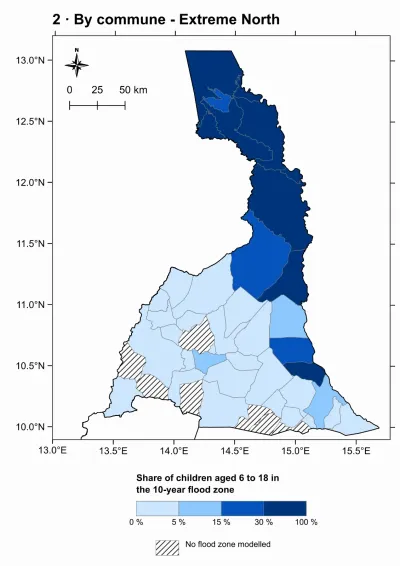
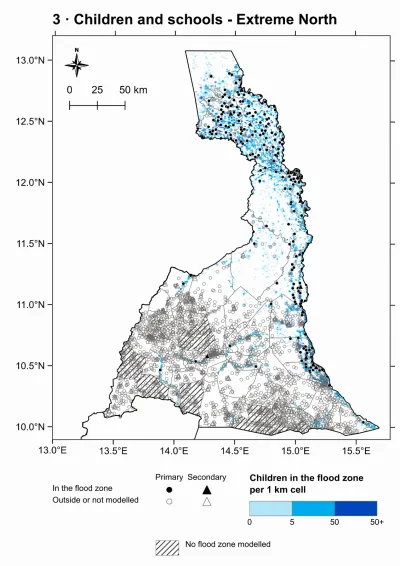
This granular approach reveals disparities that broader geographic averages often conceal and identifies where targeted education support is most needed. Evidence shows that in flood-prone areas, children can lose weeks or months of learning when schools are damaged, inundated or cut off, making targeted support essential to restore access quickly. Investing in safer, climate-resilient schools can also help withstand future shocks. River flood exposure in Cameroon's Far North illustrates why this level of detail matters: regional figures can conceal substantial differences in children's exposure across communes, while more detailed mapping makes visible the children and schools located in flood-prone areas.
To support this process, a national technical team, bringing together more than 30 institutions including government ministries, Cameroon’s National Observatory on Climate Change (ONACC), civil society and unions, is working with UNICEF Office of Strategy and Evidence (OSE) – Innocenti and UNICEF Cameroon to develop a comprehensive database. It integrates education, socioeconomic conditions, conflict-related data and climate hazards data. The resulting database will underpin the research of overlapping risks and education disadvantages at the commune level and help identify the children requiring priority attention.
Beyond revealing the scale and distribution of risks, the research will help the government prioritize education programmes, resources and investments. It will help strengthen cross-sector collaboration and overcome financing and implementation bottlenecks.
In parallel, UNICEF Cameroon is helping position education more prominently within national adaptation planning, connecting evidence-informed priorities to wider climate adaptation policies, plans and financing mechanisms.
Alongside these efforts, UNICEF Cameroon is supporting the construction of over 1,080 climate-resilient classrooms, with designs adapted to the specific climatic and agro-ecological conditions of each area.
"As the impacts of climate change intensify, it is essential that every child can continue to learn in a safe and resilient environment. Early insights from the study on Priority Education Zones show how better use of data can help identify vulnerabilities, guide investments and ensure that the most vulnerable children and communities are not left behind," said Nadine Perrault, Representative, UNICEF Cameroon.
A new multi-country research agenda for a climate-resilient education
In 2025 alone, climate hazards disrupted schooling in 106 countries and territories around the world, with 40 experiencing repeated disruptions. When COP31 concludes, the real challenge will be to ensure that commitments to climate-resilient education translate into action where they are needed most.
Cameroon is one of the several countries participating in Protecting Learning from Climate and Environmental Hazards, a new research initiative led by UNICEF OSE–Innocenti. The programme helps governments identify where climate hazards intersect with vulnerability and education-system challenges, understand impact on learning and prioritize effective responses. Co-created with national partners, the initiative is tailored to country priorities while strengthening local capacity for evidence-informed decision-making.
The work leverages OSE–Innocenti’s expertise in applied research on learning, education systems and policy together with geospatial analysis and tools, such as the Global Child Hazard Database. Together these provide a detailed, multidimensional understanding of climate risks facing education and the investments needed to build resilience and protect learning.
We are grateful to the valuable contributions made by colleagues including Thomas W. Dreesen, Kevin Clidoro, Amy Wickham, Sean Torr, Haogen Yao, Yuanyi Ji, Sahiba M. Turgesen and Kathleen A. Edison.