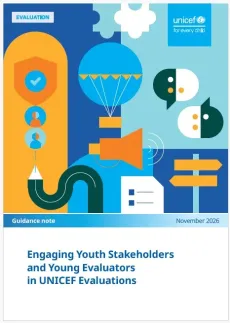
Engaging youth and young evaluators in UNICEF evaluations
New guidance from the UNICEF Evaluation Office on involving youth stakeholders aged 18–24 and Young and Emerging Evaluators safely, ethically and meaningfully in evaluation.

About
Young people are rights-holders, partners and agents of change, and their perspectives make evaluation evidence stronger. With more than 1.2 billion people aged 15–24 worldwide, decisions about programmes, policies and systems directly affect their lives. Drawing on young people’s lived experience helps evaluations understand what works, who is being reached or left out, and what needs to change. Engaging young evaluators, in turn, broadens the perspectives and capabilities of evaluation teams while building a more inclusive and diverse evaluation profession.
About this guidance
This guidance provides practical direction for engaging two distinct groups in UNICEF evaluations:
- Youth stakeholders (aged 18–24), engaged primarily as rights-holders and stakeholders who contribute lived experience, perspectives and feedback on the intervention or subject being evaluated; and
- Young and Emerging Evaluators (evaluation professionals aged 18–35 with fewer than five years of professional evaluation experience), engaged for their evaluation knowledge and skills in defined professional roles.
It sets out practical steps for deciding whether engagement would add value, selecting an appropriate role and mechanism, and supporting participation throughout the evaluation process – safely, ethically and meaningfully. The guidance does not require the same form or level of engagement in every evaluation. It supports proportionate, case-by-case decisions based on the evaluation’s subject, purpose, questions, intended use and context, so that engagement has a clear purpose, adequate resources and genuine influence rather than becoming tokenistic.
What the guidance includes
- A Quick Start decision process for determining whether and how to engage, covering added value, roles, mechanisms, feasibility and documentation, assessed separately for youth stakeholders and young evaluators;
- The institutional framework for youth engagement in evaluation, grounded in the Convention on the Rights of the Child, the UNICEF Strategic Plan 2026–2029 and Youth2030: the United Nations Youth Strategy;
- Key considerations on principles for meaningful engagement; inclusion, representation and accessibility; and ethics, safeguarding and participant well-being;
- Practical guidance across the five phases of an evaluation: framing, planning, designing, conducting, and reporting, dissemination and use; and
- Adaptable tools and templates, including an engagement planning checklist, a Youth Advisory Group toolkit, a template role description and procurement language for young evaluators, and an accessible communication and closing-the-loop checklist.
Who the guidance is for
The guidance is intended primarily for UNICEF staff at country, multi-country, regional and global levels who commission, manage, lead or support evaluations. It is also relevant for external evaluators and evaluation firms working for UNICEF, young evaluators, programme staff and partners supporting youth engagement, youth organizations and networks, members of evaluation reference groups and other advisory bodies, and managers responsible for evaluation recommendations and management responses.