A decade of evidence on peacebuilding, social cohesion and child-centred resilience
For every child, peace starts in everyday life

On the International Day of Peace, a rapid review of UNICEF evaluation evidence reminds us that peace is not shaped only at negotiating tables but also strengthened in the everyday places where children live, learn and grow.
For a child, what does peace look like?
It is, of course, the absence of war and violence. But it is also being able to walk safely to school. Having clean water and essential health services. Being protected from exploitation, recruitment, trafficking and abuse. Having access to justice when rights are violated. Feeling included in a community – and having a voice in decisions that shape your future.
As we mark the International Day of Peace, we looked across 120 UNICEF evaluation reports from 2014 to 2024 to ask a simple question: What does our evaluation evidence tell us about how UNICEF contributes to the conditions for peace?
The evidence offers an important message. UNICEF's contribution to peace extends well beyond programmes explicitly labelled as “peacebuilding”. Across humanitarian response, education, child protection, justice, social protection, WASH, health and other areas, evaluations show how work for children can help strengthen the social foundations on which sustainable peace depends.
Several lessons stand out:
- First, peace is strongest when it is locally anchored. Evaluations show that interventions are more likely to contribute to social cohesion when communities participate in shaping them and when they strengthen local institutions and trusted services. A functioning school, an equitable water system or an accessible social service can do more than meet an immediate need: it can reinforce trust, inclusion and a sense that institutions work for everyone.
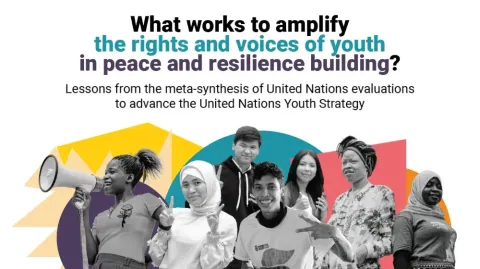
- Second, children and young people are not simply beneficiaries of peace – they can be agents of it. Across contexts, evaluations highlight the value of investing in adolescents' and young people's leadership, life skills, civic engagement and participation. The evidence similarly underscores the importance of women's leadership and participation in community decision-making.
- Third, protection is peace in practice. A child experiencing violence, exploitation, unsafe migration, child marriage or recruitment does not experience peace. Strong child protection systems, child-friendly justice, diversion and reintegration can interrupt cycles of exclusion and harm and help children reconnect with families and communities.
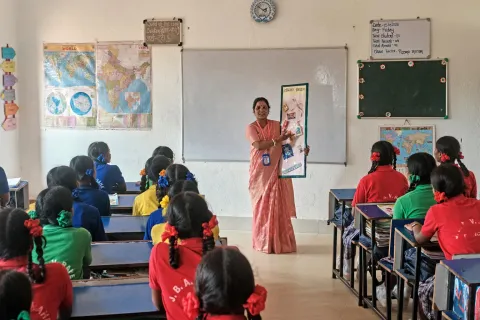
- Fourth, education can be one of UNICEF’s most powerful investments in peace. Safe, inclusive and gender-responsive schools can create spaces where children experience belonging, encounter difference, develop skills to resolve conflict and imagine a future together.
The evidence also points to a child-centred understanding of resilience: children and communities are better able to withstand shocks when protection, services, justice and local systems are trusted, inclusive and responsive.
Our evidence has evolved too. Earlier evaluations often captured peacebuilding indirectly through humanitarian response, education and protection. More recent evaluations increasingly examine conflict sensitivity, social cohesion, resilience, refugee inclusion and the humanitarian-development-peace nexus. Yet an important challenge remains: we need to become better at measuring whether our programmes strengthen trust, belonging and social cohesion over time.
At a moment when millions of children are growing up amid conflict, displacement, climate shocks and increasing social fragmentation, this evidence carries particular urgency.
Peace is not only something negotiated after conflict. It is something UNICEF helps strengthen every day – through safe schools, protection from violence, equitable services, resilient families, trusted institutions and opportunities for children and young people to participate.
On this International Day of Peace, evaluation reminds us not only to ask whether our programmes deliver results, but also what kind of societies those results help create.
For every child, peace begins with safety, dignity, inclusion and hope – and evidence can help us build it.
Most representative evaluation evidence
The rapid review draws from evaluations across all UNICEF programme areas. Among the most representative evidence streams are:
- Evaluation of UNICEF’s response to the Rohingya refugee crisis in Bangladesh
- Evaluation of the UNICEF response to the level 3 humanitarian crisis in Syria
- Jordan Country Programme Evaluation 2018–2022
- Kyrgyzstan Country Programme Evaluation 2018–2022
- Sudan Country Programme Evaluation 2018–2023
- Libya humanitarian response / evaluation
- No lost generation: A catalyst for action & a foundation for fulfilling the rights of children affected by crises