
Evidence matters most when it leads to better outcomes for children. The recent evaluation of UNICEF’s work on access to justice for children goes beyond assessing progress: it provides evidence to inform what comes next. UNICEF is using the findings to sharpen priorities and support concrete action – from strengthening justice systems and helping children understand and claim their rights, to improving access to legal aid and representation and protecting children from detention. In this way, evaluation is not the end of a process, but a catalyst for learning, improvement and action for children.
This was the central message of the 14 July 2026 webinar, Strengthening Justice for Children: Insights from Evaluation, convened by UNICEF’s Evaluation Office and the Global Programme Division, Child Protection and Migration team. The event showcased how the findings of the evaluation of UNICEF’s work on access to justice for children are already shaping action through the management response plan. The evaluation focused on UNICEF’s Justice for Children agenda, launched in 2021, as a ten-year vision to advance children’s rights within child-friendly, restorative and rights-based justice systems and contribute to broader goals on ending child detention. Rather than revisiting the agenda in full, the webinar focused on producing evidence about the relevance of the agenda and how prepared is UNICEF to implement it.
Why this evaluation? Why now? What approach?

Conducted with Coram International between 2024 and 2025, the evaluation drew on surveys, interviews, document review, administrative data analysis, and eight country case studies across diverse contexts. This mixed-methods approach provided a strong basis for understanding both the promise of the agenda and the practical conditions needed to implement it effectively and at scale.
Global, regional and country focus
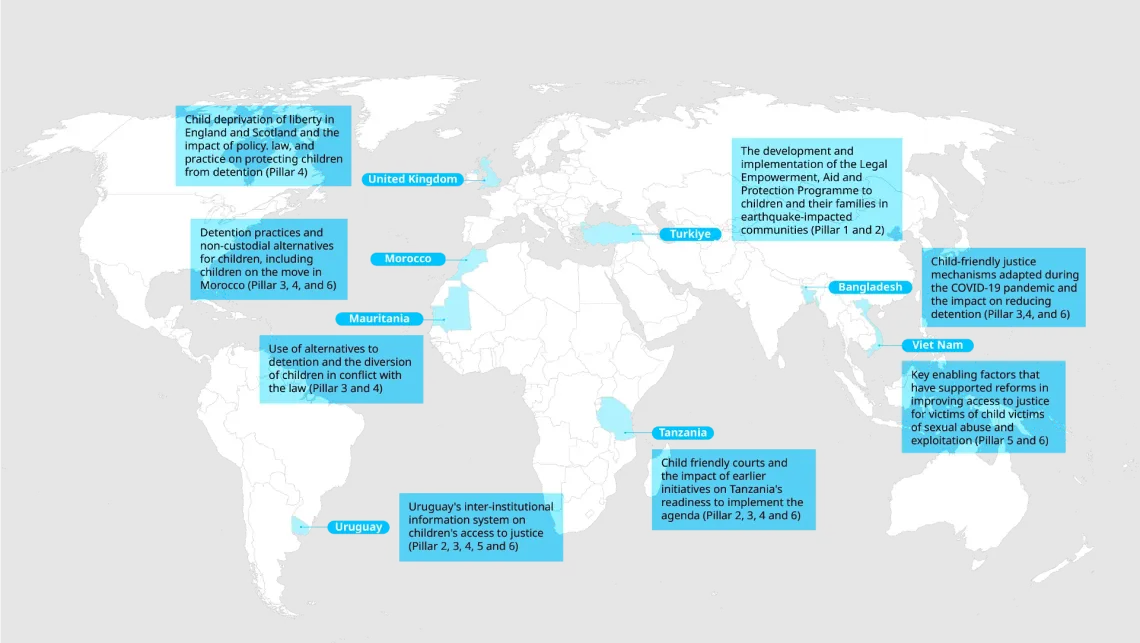
The findings point to a clear opportunity for UNICEF. The agenda is highly relevant, aligned with the Convention on the Rights of the Child, Sustainable Development Goal 16, and wider global justice commitments, and recognized by stakeholders as an important framework for strengthening child protection systems. In several countries, it has helped influence programming, reinforce multi-sectoral approaches, and support reform efforts, particularly where sustained investment, national ownership, and collaboration across justice, social welfare, and child protection actors are in place.
At the same time, the evaluation identified challenges that need to be addressed if this potential is to be fully realized. These include uneven understanding of some parts of the agenda, limited operational guidance, fragmented coordination, and constraints in technical capacity and resources. The evaluation also found that UNICEF’s level of ambition in justice for children is not yet matched by the scale of investment required, with justice remaining a relatively small share of overall child protection and programme spending.
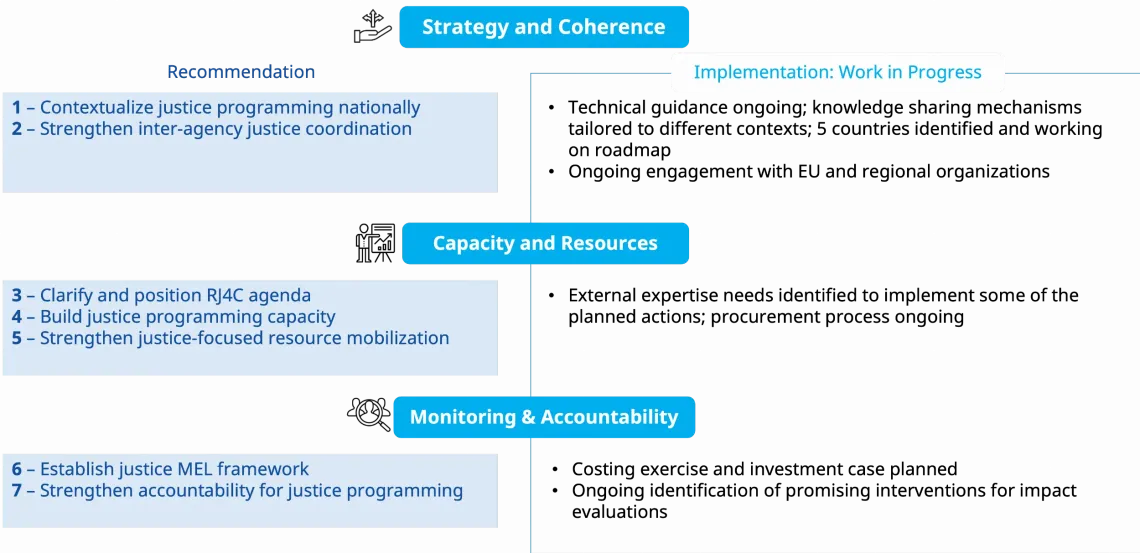
A major focus of the webinar was how UNICEF is using the evaluation findings and its recommendations to strengthen the agenda and accelerate the achievement of its objectives. The Global Programme Division, Child Protection and Migration team designed an evaluation management response that translates the evaluation’s recommendations into a practical action plan built around seven priorities: contextualizing justice programming, strengthening inter-agency coordination, clarifying and positioning the UNICEF agenda on justice for children, building capacity, mobilizing resources, establishing monitoring and learning systems, and strengthening accountability.
The implementation of this action plan drafted in April 2026 has already begun; more than half of the 22 planned actions are already underway, including the development of new technical guidance, strengthening justice focal-point networks, engagement with regional organizations, preparation of investment cases, and the integration of justice considerations into broader child protection systems strengthening approaches. Justice for children has also been explicitly reflected in UNICEF’s new Strategic Plan for 2026–2029, addressing one of the key concerns identified by the evaluation.
Implementation of recommendations: Work in progress
The discussion that followed among the 150 participants reinforced several themes; from the importance of applying the agenda across humanitarian and development settings to the need of strengthening of data and evidence systems, and to the criticality of engaging political, security, justice, social welfare, and child protection actors more strategically. The conversation also underscored the need to position justice for children more visibly in relation to broader programmes such as the prevention of violence, the protection and wellbeing of children affected by migration, and the work on child protection systems strengthening. Across these themes, the message was clear: progress will require technical expertise, political engagement, stronger coordination, and more sustained investment.
The webinar illustrated evaluation at its most effective: not as an end in itself, but as a lever for change. Crucially, UNICEF coupled the evaluation with a structured management response, creating a clear pathway from recommendations to implementation. The findings have since been used to strengthen programme guidance, build institutional capacity in key areas, support resource mobilization, and deepen coordination with partner organizations. The process has also helped embed justice for children more firmly within broader child protection systems. The experience serves as a reminder that the true value of evaluation lies not in the evidence it produces, but in the decisions, reforms, and investments it helps unlock for children.