Putting children at the centre of independent AI evaluation
At UNGA, UNICEF joined partners to advance a global AI evaluation ecosystem that puts children first.


On 23 September 2026, UNICEF co-hosted a UN General Assembly (UNGA) side event in New York with Humane Intelligence and the UN Human Rights Office (OHCHR), bringing together over 100 policymakers, researchers, civil society, funders and technology leaders to explore a pressing question: how can we build an independent AI evaluation ecosystem that serves the public interest?
The event, Interoperable Practice, Policy and Investment: Building an International and Independent AI Evaluation Ecosystem, also marked the launch of the Independent AI Evaluation Foundation (IAEF).
For UNICEF, the central message was clear: children must not be treated as an afterthought in the development and evaluation of AI.

Opening the event, Lily Caprani, UNICEF's Chief of Global Advocacy, emphasized that evaluating AI for children must go beyond preventing the most serious harms. It should also consider whether AI supports children's learning, development, and ability to exercise their rights. “We don’t just want to prevent the worst from happening. We want to make sure that children who are using AI in their daily lives are actually learning and flourishing.”
AI systems are increasingly being used by children, yet most evaluation approaches were not designed with children in mind. In a panel discussion, UNICEF Chief AI, Henrietta Ridley, highlighted several challenges in building AI evaluations for children.
First, children do not experience AI in the same way. Their needs and experiences can vary depending on their age, language, culture, and circumstances. Any AI evaluation must account for these differences.
Second, some risks of AI may only emerge over time. This means evaluations should look not only at individual interactions, but also at how children engage with AI over repeated use.
Third, safety alone is not enough. It is important to check whether AI avoids harmful responses, but we also need to understand whether it supports children's dignity, development, and well-being.
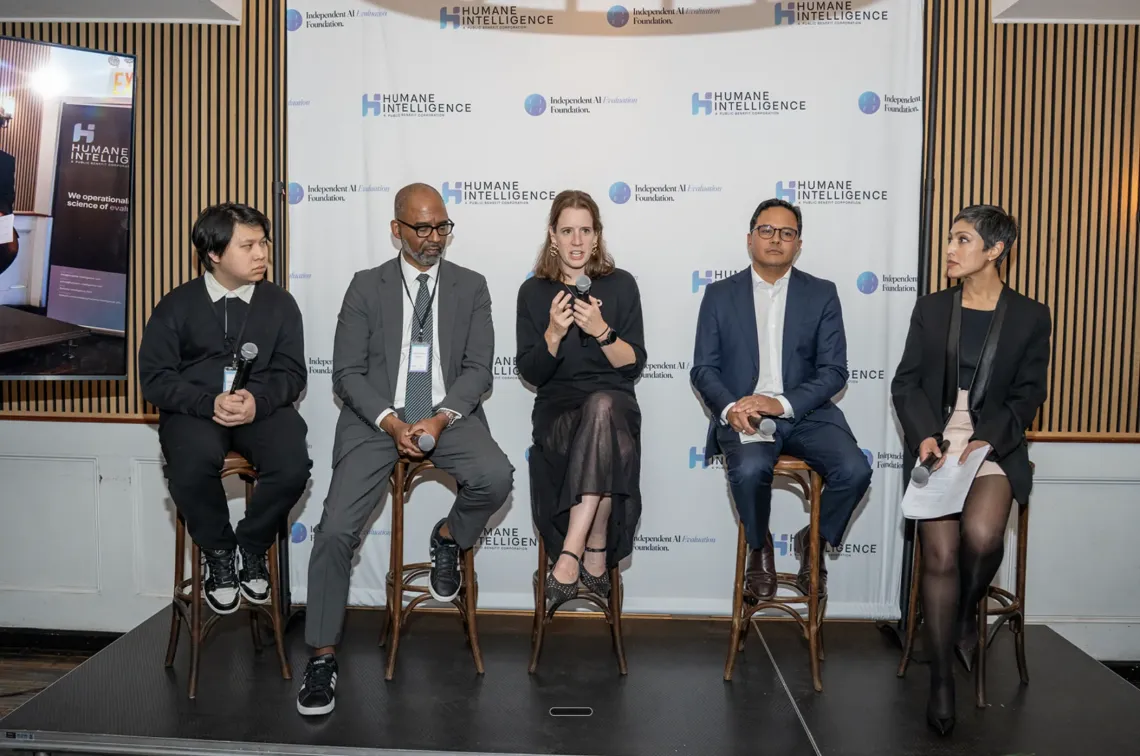
"Please stop treating children as an edge case, we have to make sure that children are involved in the benchmarking and in the evaluations of these systems that they are using every day."
Building momentum for independent AI evaluation for children
The discussion concluded with calls for governments, technology companies, funders and evaluation experts to strengthen collaboration and invest in the institutions, practices and standards needed for independent AI evaluation.
The event builds on growing international momentum to ensure children's rights are protected in the digital world, including the recently launched Coalition for Children's Rights and Protection in the Age of AI, of which UNICEF is a co-founder.
UNICEF will continue working with partners to ensure children's voices, experiences and rights are part of how AI is evaluated, governed and used.
Watch the full event livestream.