From connected schools to an AI-ready future
How Uzbekistan is turning nationwide school connectivity into new opportunities for learning, innovation and the future

In the small provincial town of Syrdarya region, Grade 5 student Dilnoza Sultanova is experiencing how internet access can expand opportunities for learning at School No. 1.
“I use the internet to learn many new things,” she says. “I study my lessons and improve my knowledge.”
For Dilnoza, connectivity extends learning beyond the classroom, providing access to information, educational resources and new ways to engage with the world around her.
Her experience reflects a much broader learning transformation unfolding across Uzbekistan.
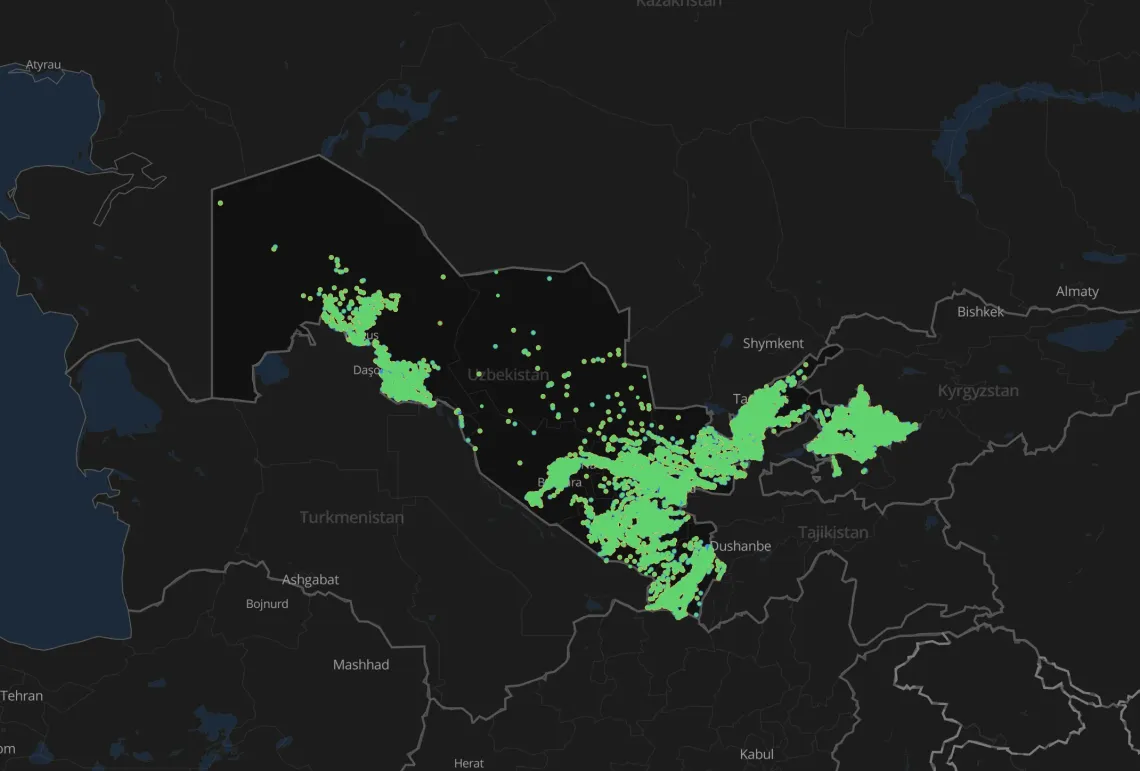
In just five years, the country has transformed from limited school connectivity to near-universal coverage across its public-school system. This nationwide reach is now complemented by real-time monitoring, providing the Government of Uzbekistan with greater visibility into the quality and performance of school internet connections, including in the most remote rural areas.
At the heart of this transformation is Uzbekistan's collaboration with Giga, the UNICEF-International Telecommunication Union global initiative working to connect every school to the internet.
The partnership began in May 2021, when the government shared national school connectivity data with Giga, laying the foundation for collaboration on improving connectivity data and real time monitoring.
As connectivity expanded, the focus evolved from extending access to ensuring that connections are reliable, measurable and capable of supporting digital learning.
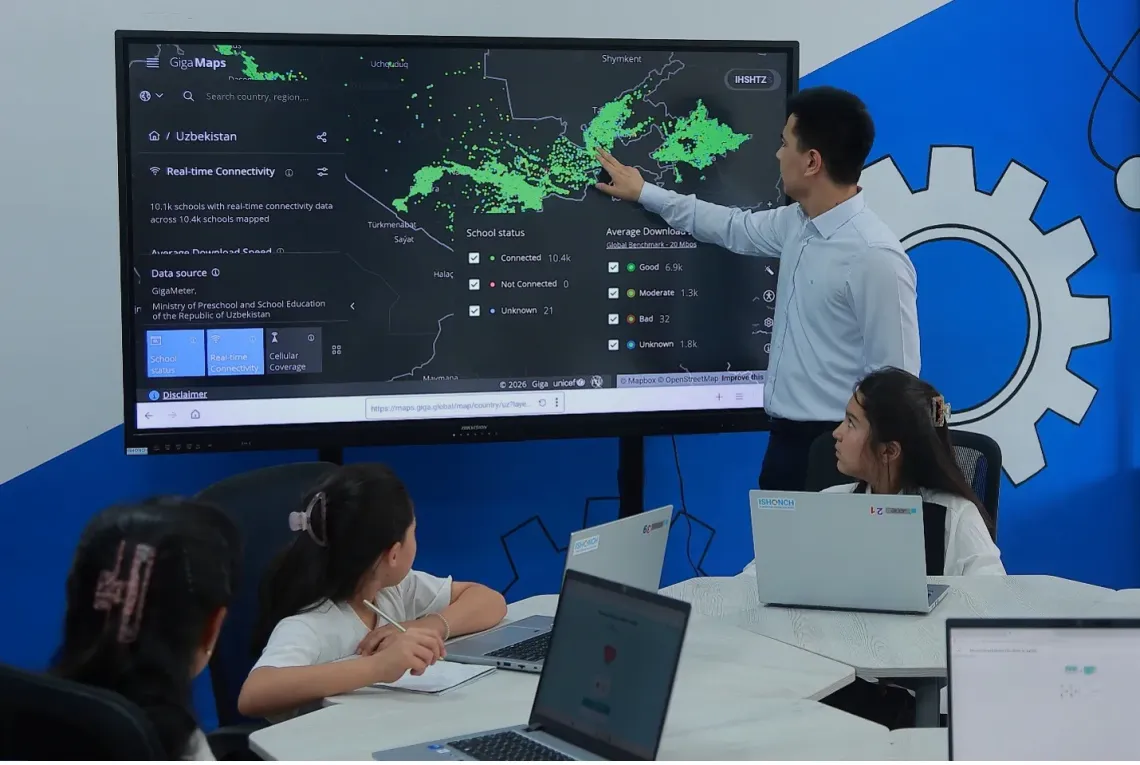
In 2025, Uzbekistan reached a significant milestone with the nationwide deployment of the Giga Meter across all public schools. Today, the system provides real-time connectivity data from more than 10,000 schools, giving decision-makers greater visibility into internet performance and supporting more informed planning and investment.
“We have been able to provide high-quality internet access in every school across the country, even in schools located in the most remote areas of Uzbekistan,” says Mr. Jasur Askarov, Deputy Director of the Digital Education Development Center. “The project also allows us to continuously monitor internet speed and quality.”
“Previously, the internet in our school was very slow and unreliable, internet speed has increased significantly and has helped improve the quality of education. This has enabled our teachers to use online resources more effectively during lessons.”
This marks an important evolution: from measuring access to understanding performance. Real-time data can help identify connectivity gaps and service disruptions and provide an evidence base for more targeted investments.
More than 1,000 kilometres from the capital of Uzbekistan, in Nukus in the far west of the country, Meradin Rejepov teaches ICT at School No. 8.
“Previously, the internet in our school was very slow and unreliable,” he says. “Internet speed has increased significantly and has helped improve the quality of education. This has enabled our teachers to use online resources more effectively during lessons.”
The impact extends beyond access to online resources. Combined with appropriate technology and teaching practices, The Ministry of Pre-school and School Education with support from UNICEF Uzbekistan is building on expanded connectivity to create new opportunities for students to explore, experiment and develop digital skills.
Back at School No. 1 in Syrdarya region, Saidbek Saidolimov demonstrates a four-wheel-drive SmartCar that he programmed using Arduino platform and STEM kits.
His interest began with a much simpler project.
“This is the very first thing I built,” he says, holding up a small hand-held fan.
Today, Saidbek is developing his interest in robotics and coding through practical projects in his school's STEM classroom, introduced through the modeling of a new Tinkering with Tech programme.
“Before, we didn't have these opportunities. Now we do,” he says.
Saidbek's experience illustrates a broader shift: connectivity is becoming an enabling platform for learning, creativity and digital skills development.
With this digital foundation increasingly in place, Uzbekistan is now looking towards the next frontier.
UNICEF, through ISHONCH 20301 funding is supporting the government to develop 50 model inclusive digital schools, demonstrating how connectivity, digital technologies, STEM resources and teacher development can work together to strengthen teaching and learning.
Across the 50 model schools, girls and boys have equal access to digital devices, ICT resources and digital learning opportunities, supporting inclusive and equitable participation in technology-enabled education.
The country is also preparing for the next phase of its digital transformation. In 2026, the Government of Uzbekistan, with support from UNICEF and the World Bank, has developed a national strategic framework for artificial intelligence in education, designed to guide the responsible and equitable integration of AI across the education system.
Together, these developments reflect a broader evolution: from expanding connectivity, to monitoring its quality in real time, to leveraging digital infrastructure as a foundation for improved learning and future-ready education.
For Regina Castillo, UNICEF Representative in Uzbekistan, the scale and pace of this transformation point to a broader opportunity.
“Uzbekistan is no longer catching up,” Castillo says. “It is setting the benchmark and showing the world, how digital transformation can be done for all children.”
Uzbekistan's experience demonstrates that universal school connectivity is more than an infrastructure milestone. Its transformative potential lies in turning reliable connectivity into better learning opportunities and ensuring that every child, wherever they live, can benefit from an increasingly digital future.