Sixteen-year-old Michelle walks eight kilometres to school every day. She had no background in coding, only some experience with website design, but she asked to be placed in the intensive React Native coding track of the Oky hackathon because she wanted to learn more about code. "This hackathon is really next-level" she said on day one. Assigned to a team of university students who took her under their wing, she spent a night video-calling her teammates to get their code ready for their Day 4 pitch and helped fix a real bug in the Oky app, a calendar wheel that kept failing to display the day cards. Before the hackathon, Michelle had planned to become a lawyer. By the end of it, she was telling her team she could build a website or app entirely on her own, and she has since decided to join an after-school coding club and aim for a career in the digital industry instead.
A few desks away, seventeen-year-old Nami had arrived on the UX/UI Oky hackathon track feeling nervous and out of place. "In my selected courses like physics, ICT, or computer science, most of them are boys," she said. By day four, her team of six had, in her words, become like family, and she left describing herself as a "charismatic coding lover" with plans to teach AI to girls in rural Mongolia. "We need girls in that field" she said.
Michelle and Nami started the Oky Mongolia hackathon at different points on the digital literacy spectrum. Digital literacy is not one technical skill but a whole range of technical and soft skills, running from lower-level competencies like using a smartphone confidently, through to creating content, designing for other users, and writing code. Girls often arrive at lower entry points on that spectrum than boys, a gap shaped by the gender digital divide. Building a girl-led event that could hold space for both Michelle's and Nami's entry points was the whole point.

Oky's next step: from digital platform to digital literacy hackathon
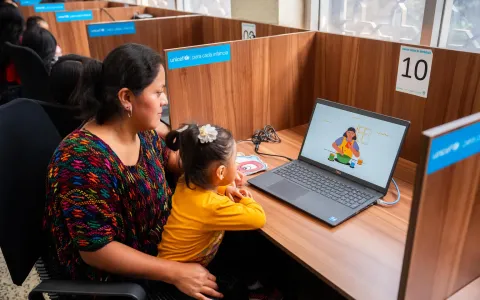
Oky is UNICEF's digital public good for menstruation and adolescent health education, designed with and for adolescent girls aged 10 to 19 in low- and middle-income countries. It brings trusted, evidence-based information on puberty, menstruation, nutrition, healthy relationships, child marriage, protection from violence and online safety into the hands of adolescent girls, in formats that work for them: encyclopaedia, quizzes, reminders and gamified content. Oky is live as a localised country instance in 13+ countries, including Mongolia, and a global app serving users across the world. Since it launched in 2019, each Oky deployment has been co-designed and localised by hundreds of girls who shape its interface, features and content for their own context.
Oky also gives girls a digital adoption pathway: they build digital literacy through both using Oky and co-designing it. Earlier girl-led Oky hackathons in Kenya in 2025 pointed to what becomes possible when girls move from users to digital creators, and the Oky Mongolia hackathon, co-run by UNICEF Mongolia and the Oky franchise partner WASH Action NGO, built on those ideas. We used Oky's open-source code and content as the entry point, building girls' digital literacy through experiential, hands-on approaches rather than abstract, theoretical STEM instruction, in a safe, inclusive, team-based setting.
We designed the event around what is known to work in building girls' digital participation: using Oky itself as the hackathon challenge and as a familiar entry point that girls already use, rather than a hypothetical brief; prioritising female mentors for visible role models; keeping teams small and girl-led so mentors could support rather than direct; and measuring changes in girls' confidence, voice and agency rather than simple headcounts.
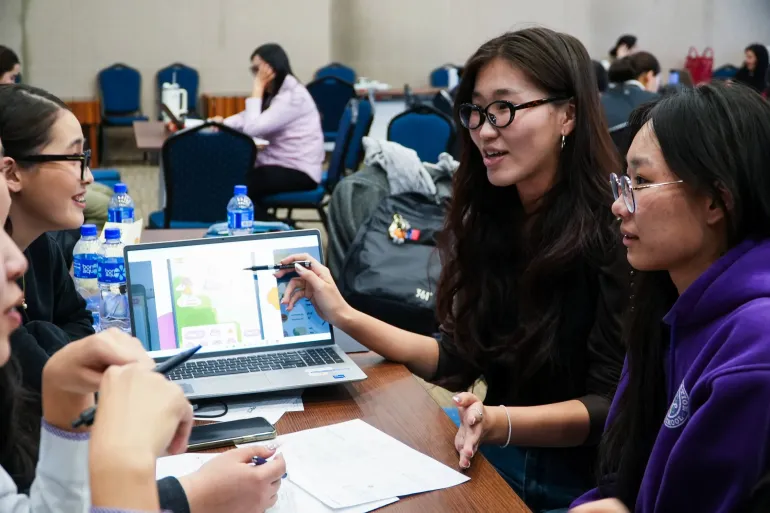
Sixty Mongolian girls and young women aged 13 to 24 took part over the four days, split across three tracks: coding, UX/UI design, and digital content and engagement. The tracks were designed to reach girls across the digital literacy spectrum, not only those who already had the confidence or exposure to code. One group worked directly with the Oky Mongolia open-source codebase. Another worked on UX/UI design, reshaping the app's interface and avatars. The final group worked on digital content and engagement, developing outreach strategy and marketing campaigns to grow Oky's user base.
Many hackathons are built solely around a coding track, but those only ever reach the smaller number of girls who already feel confident stepping into one, leaving the rest with nothing. We made sure the Oky Mongolia event had lower-barrier tracks like UX/UI and digital content so a wider range of girls could take part from wherever they were starting on the digital literacy journey, each moving along their own path from using digital technology, to contributing ideas, to becoming co-creators with a stake in what gets built next.

Moving girls along the digital pathway
The idea behind the hackathon was to shift how girls see their own place in the digital world, from consumers of technology built by others to people who could shape it themselves, over the four days and beyond. Mentors observed a real shift in team dynamics across all three groups, from uneven participation and dependence on mentor input early on, to fully collaborative, girl-led working by the final pitches, teaching each other the digital tools, finding workarounds when they hit technical walls, and pulling together very different perspectives into a single shared strategy for Oky Mongolia. Seventeen-year-old Shurtsetseg, already an experienced coder through UNICEF's GirlsCode programme and one of only five girls in her school's hundred-person robotics club, put it simply: "I've got the skills, I can do something, but I didn't know how to contribute to other girls' lives. Through Oky, I can contribute my ideas and make girls' lives better."
Working on a girl-centered adolescent health product brought a cultural shift alongside the technical one. Several girls described using Oky Mongolia as a way of pushing back against patriarchal norms and helping younger girls access information they themselves had lacked growing up. Nineteen-year-old Misheel, on the digital content track, spoke about confronting a discomfort she had carried for years: "For me, I really feel kind of embarrassed to talk about these types of topics, because it's kind of Mongolian culture that it's not acceptable for public speaking. I want to not be afraid of these topics. It's not a thing to be embarrassed of. It's a very normal thing."

"I felt very proud to see Mongolian girls taking part in this process to further develop Oky and make it better reflect girls' interests and needs. Mongolia was the first Oky country, back in 2019, and we have come so far. It was so inspiring to see that girls were eager not only to build their own digital capabilities, but also to support other girls in developing theirs."
By the end of the four days, the girls had generated more than thirty concrete ideas to improve Oky Mongolia: a stronger password recovery flow, clearer error messages, faster mood and period logging, cycle-phase colour coding, avatar customisation reflecting Mongolian dress and representing girls with disabilities, and a full brand book for the app in the Mongolian language, complete with a mascot the girls named Enkhjin.
Of the 45 girls who completed the closing survey, 98% said they had learned new skills, 96% said they felt more confident contributing to digital technology, and 93% said they wanted to continue learning in digital and STEM subjects. A six-week follow-up survey found that girls' confidence and belief in their own digital capability held up over that time, and most had already shared what they had learned with someone else, building and drawing on adolescent peer networks that matter for learning.

"I watched participants transform from technology users into technology creators, generating ideas that could directly improve Oky for girls around the world. Investments in Oky matter because they combine access to trusted health information with opportunities for girls to build confidence, develop digital skills, and shape the solutions that affect their lives."
From hackathon idea to live feature
The success of the Oky Mongolia girl-led digital literacy hackathon shows that this design approach has real legs. Phase 2 puts even more power in girls' hands. Michelle, Nami, Shurtsetseg and the girls who worked alongside them will move from proposing ideas to actually building them, working directly with technical mentors to bring their ideas to life and seeing that work go live across Oky Mongolia, in the app itself and in the content and channels that reach girls across the country. Connecting them with peers from Oky Kenya working on similar ideas is part of the same shift: rather than girl innovators working out these ideas alone in different countries, we are starting to build a genuinely girl-led digital literacy ecosystem across Oky, one where girls in one country can learn directly from girls in another.
Oky was originally co-created with girls to give them information they could trust. Mongolia's hackathon showed Oky can do even more for girls: it opens a pathway into the female digital economy, moving girls from co-creators of Oky to its builders.