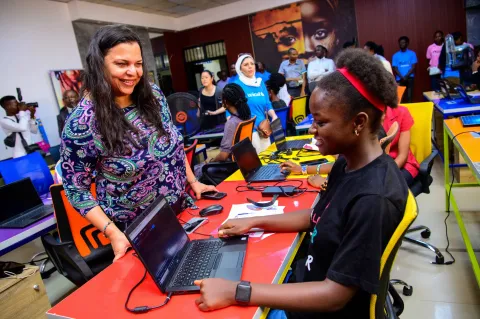
When 15-year-old Halima first learned about menstruation through the Oky app, she was surprised that an app could speak so openly about something rarely discussed at school or at home. For a girl like Halima, who lives with a disability, access to easy to understand and dignified information about puberty and her body can transform her life.
Across the world, millions of adolescent girls still face barriers to managing their menstrual health. Girls with disabilities are often among the most excluded. Oky, a digital innovation co-created with girls, is helping change that story.

Oky: A game-changing digital innovation for all girls
Oky is a girl-centred digital menstruation education and period tracker app that was created with and for adolescent girls in low- and middle-income countries, including girls with disabilities. As an approved Digital Public Good, Oky helps to break taboos and myths surrounding menstruation and reproductive health by providing accurate, engaging, and accessible information.
Oky is built to meet girls' digital realities. It works offline, is lightweight and simple to use on shared or low-end phones. Its bright visuals, clear navigation and friendly language make it easy to understand for users with different levels of (digital) literacy. Oky gets localized in every new country together with local partners, girls and their communities, and experts. Girls with disabilities always participate in the localization process. Based on these experiences, a practical guide and tips on How to improve digital inclusion and accessibility for girls with disabilities is publicly available. Oky is now available in 20+ languages across 12 countries and has reached more than one million online users, with many more using it offline.
From the outset, Oky has aimed to make menstrual health and puberty information accessible to every girl, including those who face double stigma because of both menstruation and disability.
Partnering with disability organisations for inclusive design
Building a truly inclusive app begins with collaboration. Across the 12 Oky countries, Oky implementing partners engaged worked with local Organisations of Persons with Disabilities (OPDs) and special needs schools to ensure that girls and young women with disabilities are meaningfully involved in every stage of development.
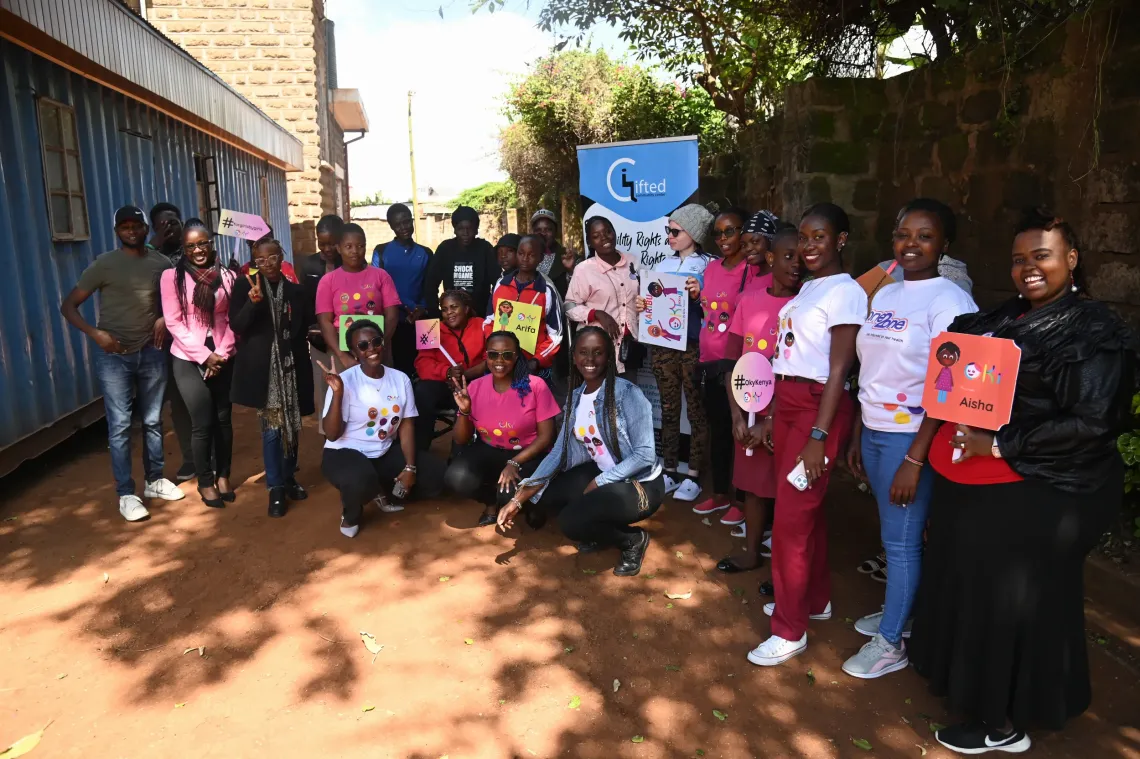
For example, in Kenya, LVCT Health partnered with the Gifted Community Centre after mapping disability-focused organisations in the country. In Papua New Guinea, Save the Children worked with the PNG Assembly of Disabled Persons, Callan Services and Cheshire Homes. These partnerships helped the Oky localization and deployment teams to understand how to reach girls with different types of disabilities and their care-givers, and how to adapt activities to their needs, from providing sign language interpreters to ensuring venues were physically accessible.
Engaging caregivers to normalise conversations around menstruation
Parents and caregivers are central to how girls with disabilities experience menstruation. Their attitudes, knowledge, and resources often determine how girls can manage their periods with dignity and navigate adolescence. Oky is intentionally designed to support both girls and their caregivers. Oky’s encyclopaedia content provides practical advice that helps parents and teachers understand menstrual health and support the girls in their care.
In Tanzania and the Philippines, Oky partners found that involving caregivers directly in consultations created a powerful ripple effect. Parents who initially viewed menstruation as a private topic began using Oky alongside their daughters, opening conversations that had never been possible before.

Accessibility as a continuous journey
Inclusion and accessibility is at the heart of Oky’s design. The app is built to align with the internationally recognised Web Content Accessibility Guidelines (WCAG), ensuring that users with disabilities can navigate and understand content easily. Oky’s codebase and interface have been reviewed by accessibility and digital inclusion experts. This has led to practical improvements such as clearer button labels, alternative text for images, logical screen-reader navigation and a tablet landscape mode for users with vision impairment or dexterity limitations.
Oky partners continue to share innovations that make the app more accessible. In the Philippines, the team produced audio versions of encyclopaedia articles in Tagalog, inspiring Oky Kenya to create a similar feature in Swahili.
Accessibility is, however, an ongoing process. Oky continues to collect feedback from users, caregivers, teachers, and disability organisations to refine new features. Some visual aspects, such as colour contrast, can pose challenges for users, but can be mitigated through using smartphone’s native accessibility features such as high-contrast display modes.
Representing diversity and girls with disabilities in Oky
Representation matters. Oky ensures that girls with disabilities see themselves reflected in its design, avatars, visuals and stories. In Tanzania, Kenya, and the Philippines, girls with disabilities co-designed avatars that mirror their diversity and experiences.

Content within the app has also been adapted to address topics specific to managing menstruation with a disability, using simple and empowering language. In Papua New Guinea, where many girls do not have smartphones, Unicef and Save the Children complemented the app with Oky Toky radio shows for community listening. One episode featured a girl with visual impairment who shared her story of managing her period, overcoming barriers and thriving at school.
In Kenya, LVCT Health invited Rose, a young woman from the deaf community, to feature in a video clip, using sign language to explain how she contributed to the localized design of Oky Kenya, how she uses Oky, and why it matters to her. These stories help make Oky relatable, inclusive and inspiring.

Building digital literacy through Oky
Girls with disabilities often face more barriers to digital access. Oky is helping change that by acting as both a menstruation and a digital literacy tool. In Kenya, Tanzania, and the Philippines, partners have run training sessions to help girls with disabilities and their caregivers learn how to use Oky and to explore the accessibility features on their devices, such as screen readers or voice commands.
One girl in Tanzania shared, “These features will not only help me, but also my mother who struggles to read small text on her phone. I will teach her how to use the zoom tool so she can read comfortably.”
Future training sessions will include more hands-on time, for example on practicing with assistive technologies such as screen reader and alternative input devices.
Continuing the journey towards inclusion
Oky’s journey towards full disability inclusion is still evolving and shows what is possible when girls with disabilities are included from the start. As the app continues to grow, so does the commitment to ensuring that every girl can use it confidently, safely, and independently. Oky partners across the world are deepening their work with OPDs, strengthening local collaborations and embedding accessibility into every stage of the process.
To make Oky’s content even more accessible, UNICEF has been working with GIZ’s Inclusion of Persons with Disabilities Programme and FAIR Forward to pilot the use of Easy Read formats. Easy Read versions simplify information through short sentences, clear structure and supportive images. They are particularly useful for persons with intellectual disabilities, people with dyslexia or anyone who finds reading challenging.
Because creating Easy Read materials is usually time-consuming and expensive, UNICEF, together with GIZ and ETH Zurich, are exploring the use of open-source generative AI to automate the process.
If you are working at the intersection of digital, gender, and disability inclusion, we would love to connect and learn from your experience. Together, we can build a more inclusive digital future for every child with a disability, everywhere.
For more information, contact Michael Nique at [email protected].