Child Alert: Haiti’s children confront a polycrisis
Compounding shocks and instability threaten the future of an entire generation.

- English
- Français
Haiti is facing a devastating and fast-evolving humanitarian crisis. Children are paying the highest price as violence spirals, internal displacement soars and families are cut off from basic services including food, health care, education and protection.
Without decisive action, the future of an entire generation is at stake.
Issue snapshot

How are children being impacted?
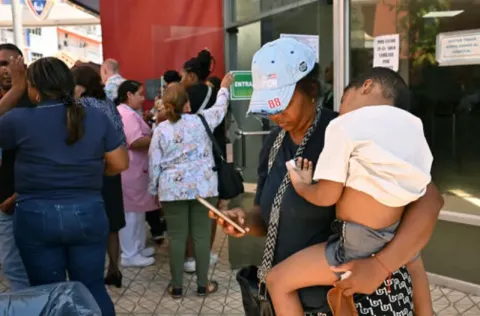
In 2025, more than 3.3 million children in Haiti need humanitarian assistance. The unprecedented level of insecurity has displaced more than 680,000 children, often multiple times. Meanwhile, cases of acute malnutrition, child recruitment, gender-based violence, and other grave rights violations of children’s rights have also increased.
What’s behind the crisis?
Haiti’s current crisis is not rooted in one single event, but in decades of compounding shocks and chronic instability. Political fragility, economic inequality, natural disasters and weakening institutions have converged to create one of the most complex humanitarian emergencies in the world.
For many families, the tipping point came with the 2021 assassination of President Jovenel Moïse, which triggered a power vacuum and a sharp escalation in armed violence. Since then, armed groups have expanded their control over neighbourhoods, ports and national roads – paralyzing services, disrupting trade and terrorizing communities.
At the same time, Haitians have endured recurring environmental disasters. In the past 15 years alone, the country has been struck by a 7.0 magnitude earthquake in 2010, Hurricane Matthew in 2016 and a 7.2 magnitude earthquake in 2021. These disasters destroyed infrastructure, eroded coping mechanisms and strained an already fragile state.

Haiti’s children face an immediate protection crisis
In Haiti today, children are not only caught in the crossfire but are also being directly targeted. The scale and severity of violence against children and women have reached alarming levels, with grave violations of children’s rights becoming a daily reality in areas under the control of armed groups.
For countless children, trauma is a daily reality, and unless protection services are urgently restored, an entire generation risks growing up in fear and under relentless exposure to violence and exploitation.

Long-term threats to their health and nutrition
More than 1 million children face critical levels of food insecurity. In many of these areas, insecurity and armed group activity have cut families off from food markets and humanitarian assistance. Rising prices for staple goods have further reduced household purchasing power, forcing families to skip meals or rely on nutrient-poor diets.
Water and sanitation infrastructure has collapsed in many displacement sites and areas under the control of armed groups, and more than 1 million children lack regular access to safe water, increasing the risk of waterborne diseases.
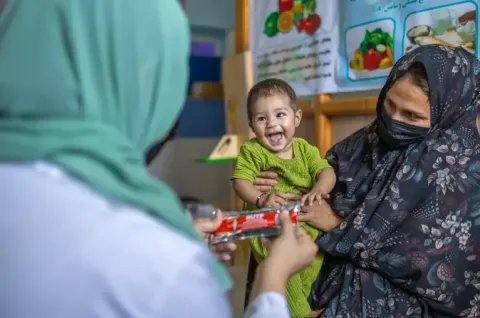
The health system is overstretched and under-resourced, with insecurity forcing the closure of multiple health centres, particularly in Port-au-Prince and surrounding areas. Treatment coverage for malnutrition, meanwhile, remains dangerously low – well below the threshold required to prevent a broader crisis.

And enormous barriers to learning
Haiti’s education system is in freefall – with the future of an entire generation of children hanging in the balance.
Conflict, displacement, poverty and insecurity have converged to make learning nearly impossible for hundreds of thousands of children. During the school year 2024–2025, many schools were directly impacted by violence, with more than 1,600 schools closed and dozens occupied by armed groups.
In overcrowded shelters and displacement sites, children lack access to textbooks, learning materials and qualified teachers. Many adolescent girls drop out entirely due to safety concerns, caregiving responsibilities or the absence of menstrual hygiene materials.

Building hope: What UNICEF is calling for
Haiti is at a breaking point. The future of its children depends on choices made today and delay or inaction will cost lives. With urgent international support, coordinated action and restored access, there is still time to protect its children and reverse the country’s downward spiral.
- First and foremost, humanitarian access must be restored and protected. Armed actors must comply with international law, ensure the protection of civilians and civilian infrastructure and facilitate the safe and unhindered delivery of humanitarian assistance. Negotiated humanitarian corridors and security guarantees are essential to reach the most vulnerable populations.
- Second, the scale and scope of humanitarian funding must increase immediately. As of June 2025, UNICEF’s Humanitarian Action for Children appeal for Haiti was only 13 per cent funded, well below what is needed. Donor governments and international partners must mobilize immediate and sufficient resources to fully support critical programmes in Haiti, including child protection, health, nutrition, water and sanitation, and education, ensuring that all children have access to lifesaving services.
- Third, basic services must be restored and safeguarded, particularly in health, education and water and sanitation. This includes rehabilitating infrastructure, supporting local service providers and ensuring frontline workers can safely reach communities. Investment in mobile and community-based service delivery is essential in areas inaccessible by traditional means.
- Fourth, displaced children must be protected and supported, through safe shelter, case management, family tracing and reunification and psychosocial support. Returns should only take place when they are safe, voluntary and dignified, with adequate support for reintegration, in line with international standards and norms. Survivors of gender-based violence must also be protected and supported to regain some form of normalcy.
- Finally, there must be investment in long-term stabilization and child-focused recovery. Haiti’s crisis requires not only humanitarian relief but also sustained political engagement and investment in long-term stabilization and child-focused recovery. Without a pathway toward inclusive governance, equitable development and accountability for perpetrators of violence, the cycle of conflict and vulnerability will persist.
UNICEF calls on the international community to prioritize Haiti’s children and to act with the urgency and scale that the crisis demands. The tools and resources exist to help Haiti emerge from this crisis. It’s time to put them to use – for every child.
Highlights
Haiti is facing a devastating and fast-evolving humanitarian crisis as violence spirals, internal displacement soars and families are cut off from basic services. ‘The polycrisis for children in Haiti’ draws on the latest data, field reports and sectoral analyses to sound the alarm on the scale of the crisis facing children in Haiti.